Showing posts with label Physical anthropology. Show all posts

Saturday, December 27, 2014

Historical Greek racial continuity and Modern-Ancient Greek physical similarity is a reality.

Above : Modern Greek actresses reenact ancient Greek Olympic ceremonies.


It is occasionally stated that today's Greek speaking population of Greece and the Aegean & Ionian seas bare little physical resemblance, and have little to no ancestral connection to the Greeks of old.  The doubters usually say so out of ignorance or an obvious racial bias of their own. However, regardless of anyone's opinion, the notion is completely falsified by hard scientific inquiry. There exists much data and summaries in the (physical) anthropological literature refuting those type of dubious claims.


 J Lawrence Angel's conclusion


The most comprehensive skeletal analysis of ancient Greek material was done by the late J. Lawrence Angel. Angel took a schematic approach though his examination of Greek skeletal remains by way of his own conceived morphological/typological system. By this method he came to the conclusion that modern Greeks show significant physical continuity and physical similarity to the ancient Greeks.  


Angel 1944 (page 337) notes
"So great is the phenotypic racial continuity of the Greek people in ancient times (and probably down to the present day) that the average ancient Greek male defined by the total series in table 2 may well stand for ancient Greece as a whole as well as for the standard of comparison for the six types."
See averages here & here.


Angel came to the conclusion that the Mycenaean era ancient Greeks descended largely from an earlier Neolithic 'pre Greek' agricultural population around the Aegean, which then amalgamated with Bronze age migrations from the north [and also to a lessor extent from the east]. Once this synthesis was complete, the basic foundation of the Greek ethnicity was formed. This Mycenaean foundation is STILL the fundamental genetic foundation of the living Greeks. 

Angel 1944 (page 361) notes
"The Mycenaean blend seems to be fundamental in all later Greek populations down to the present day. Its formation was principally absorption of Middle Bronze Age intrusive strains by the pre-Greek racial substratum."


Angel 1944 (page 373) in his summary concludes.
1. "Ancient Greeks as a whole are unusually heterogeneous. 

2. Their high variability is 7% above normal, and expresses the contrast between six arbitrary morphological types : Basic White, an ill- filled, rugged, long-headed, coarse-faced version of Atlanto-Mediterranean ; gracile, dolichocrane, pentagonoid Classic Mediterranean, with narrowed triangular face ; muscular, well-filled, long, hawk-nosed, rectangular-faced Nordic-lranian ; mesocrane and high Dinaric-Mediterranean hybrid, with long nose in long hexagonal face; intermediate Mixed Alpine, with puffed-out mesocrane vault, big forehead, and squat face ; and round-headed, blunt-faced Alpine. These types are validated by close comparison with non-Greek groups, by their low variability, and by their generally successful predictions of period groups. 

3. Greek racial history shows an alternation of an overwhelmingly ‘ ‘Mediterranean” complex reflecting southeastern maritime infiltrations, and a more balanced Alpine-influenced combination of all types reflecting northern invasions. The former is typical of Mycenaean and Classical periods and occurs in the third millennium R.C. The latter dominates Middle Bronze, Early Iron, and Roman periods, with compromise effect in Byzantine. Within these fluctuations of opposing tendencies the major racial trend is in an Alpine direction, with minor Dinaric specialties. 

4. Racial continuity in Greece is striking. 

5. Some trends, such as increase in nose size, reflect genetic re- combinations, others, such as gross size increase, respond to environmental changes."

SOURCE : Angel, J. Lawrence, 1944, A racial analysis of the ancient Greeks: An essay on the use of morphological types, American Journal of Physical Anthropology

Link


Years later, after 2 decades of continued research, Angel would review another less reputable Greek anthropologist's work on the race of the ancient Greeks. Although Angel was certainly critical of that anthropologist's methodology; he did come to one very important agreement with him, and that is his conclusion on the continuity of the Greek people. 


Angel 1964 (page 343-344) states
"This he does in a rather unsystematic way by citing some findings from the many workers who have reported on skeletons from Greek territory. Perhaps inevitably he omits about half of the literature; it is not clear if it was available to him, especially if he wrote the book in Tashkent rather than Moscow. But the result is that he tends to overvalue speculations based on small samples as opposed to statistically tested changes. Never the less he is correct in pointing out that some regional “types” are largely derived from pre-Indo-European and from pre-Turkish populations, that there is complete continuity genetically from ancient to modern times, and that the major modern contrast among Greeks is between the groups from Eastern Anatolia and those from Greece and the Aegean. He is incorrect in the general conclusion that environmental change is never enough to create a new type: apparently meaning that selection cannot follow from environmental change."

SOURCE : Angel, J. Lawrence, 1964, The origin of the Hellenes. An ethnogenetic inquiry. Aris N. Poulianos. 160 pp, 5 tables, 9 maps, 32 photographs. 1962. Morphosis Press, Athens. Originally published in 1960 by the Institute of Ethnography of the Academy of Sciences of the U. S. S. R., translated into Greek by the author with special assistance of Nikos Antonopoulos, American Journal of Physical Anthropology, Volume 22, Issue 3, Date: September 1964, Pages: 343-345

Link 


Craniometric analysis


Modern craniometric data indicates the genetic continuity of the Greek people as well. A 1989 investigation showed
"A comparative cephalometric investigation was conducted between modern and ancient Greeks to determine craniofacial characteristics and to examine the significance of ethnic heritage. The modern sample was composed of 54 individuals chosen on the basis of ethnic background, normal occlusion and facial harmony. The ancient sample consisted of 40 skulls with normal occlusion dated back to the Minoan civilization (ca. 1,800-1,200 B.C.). A remarkable similarity in craniofacial morphology was revealed between the two groups, suggesting a close genetic affinity between modern and ancient Greeks. The ability of the craniofacial complex to make compensatory or balancing changes was noted. The craniofacial complex was seen to function as an integrated biological entity. Moreover, the cranial base showed a definite influence on skeletal profile configuration. These results provide a more comprehensive understanding of how craniofacial variables interact and contribute to the morphology of the dentofacial skeleton."

It should be noted here for accuracy's sake that the ancient sample is not from the Greek mainland nor from the classical era, but rather from Bronze age Crete.
"The material representing the ancient Greeks was drawn from the collection of crania in the museums of Herakleion and Chania, both located on the major Greek island, Crete.......The ancient Cretan skulls dated back to Minoan civilization, during the Bronze Age of 1,800-1,200 B.C."

While the modern sample constituted
"The sample of the modern Greeks consisted of 54 native Greek children (30 girls and 24 boys) born and reared in Athens and Pireaus (Greece) having an average age of 12 years."

I suppose one could reasonably argue that just because modern southern Greeks from Athens and Pireaus show strong craniofacial similarities to ancient Bronze age Cretans, doesn't mean modern Greeks would show strong similarities to classical Greeks. However I disagree with strong objections, since another craniometric study done by French anthropologist Alain Froment from 1992 shows classical era Greek skulls to be pretty similar to Bronze age Cretan ones. See craniometric plot below by Froment for details.


SOURCE 1 :  Argyropoulos, E. et al., 1989, A comparative cephalometric investigation of the Greek craniofacial pattern through 4,000 years, Angle Orthod 1989 Fall;59(3):195-204

Link  PDF 

SOURCE 2Froment, A. (1992). "Origines du Peuplement de l'Egypte Ancienne: l'Apport de l'anthropobiologie". Archéo-Nil. 2:79-98

PDF 


A more recent craniometric analysis indicated modern-ancient Greek genetic continuity as well as physical (craniofacial) similarity. Although the study did not rule out admixture from (physically/racially similar) outside populations, as it's well known that a significant minority of Slavs and Arvanites settled and assimilated into the Greek populace. 

"BACKGROUND: Multiple 20th century studies have speculated on the anthropological similarities of the modern inhabitants of Greece with their ancient predecessors. The present investigation attempts to add to this knowledge by comparing the craniofacial configuration of 141 ancient (dating around 2,000-500 BC) and 240 modern Greek skulls (the largest material among relevant national studies).

METHOD: Skulls were grouped in age at death, sex, era and geographical categories; lateral cephalograms were taken and 53 variables were measured and correlated statistically. The craniofacial measurements and measurements of the basic quadrilateral and cranial polygon were compared in various groups using basic statistical methods, one-way ANOVA and assessment of the correlation matrices. 

OBSERVATIONS: Most of the measurements for both sexes combined followed an akin pattern in ancient and modern Greek skulls. Moreover, sketching and comparing the outline of the skull and upper face, we observed a clock-wise movement. The present study confirms that the morphological pattern of Greek skulls, as it changed during thousands of years, kept some characteristics unchanged, with others undergoing logical modifications.

CONCLUSION: The analysis of our results allows us to believe that the influence upon the craniofacial complex of the various known factors, including genetic or environmental alterations, is apt to alter its form to adapt to new conditions. Even though 4,000 years seems too narrow a span to provoke evolutionary insights using conventional geometric morphometrics, the full presentation of our results makes up a useful atlas of solid data. Interpreted with caution, the craniofacial morphology in modern and ancient Greeks indicates elements of ethnic group continuation within the unavoidable multicultural mixtures."


SOURCE : Papagrigorakis, MJ. et al., 2014, Craniofacial morphology in ancient and modern Greeks through 4,000 years. Anthropologischer Anzeiger, Volume 71, Number 3, June 2014, pp. 237-257(21)

Link

Saturday, March 30, 2013

Roger Pearson's "The Greek Face" completely debunked.

Roger Pearson is a neo-Nordicist writer and co founder of two peer reviewed academic journals known as Mankind Quarterly and The Journal of Indo-European Studies. I for one do not consider those journals to be necessarily bad, even though both (and in particular Mankind Quarterly) have come under heavy attack by the more politically correct mainstream. Pearson himself is a known eugenicist and racialist; however he has not contributed to or edited either of those journals in decades, and both journals have featured plenty of accredited and prestigious anthropologists and linguists such as J.P. Mallory. 

      However, I do have a particular problem with an article by Pearson titled The Greek Face made back from 1974 which I continue to see surface and referenced on the web from time to time. Unlike Pearson's early delves into racial history where he simply re-tells (literally word for word) old Hans F.K. Guenther fantasies, this article attempts to reference the actual scientific work of other well respected anthropologists and scientists who have studied the question hands on. The article made by Pearson concerns the racial affiliation of ancient and aristocratic class Greeks, and he focuses primarily on the Eupatridaes of ancient Athens. The problem with the article is Pearson completely distorts and outright lies about the sources he attempts to use to support his Nordicist premise.

Pearson's premise can be basically outlined as follows.

1. The Proto Indo-European speakers lived in the North Pontic Steppe region, and thus Indo-Europeanization of Greece happened during the Bronze age.

2. The populations who Indo-Europeanized Greece had full genetic continuity with the Proto Indo-European speakers.

3. The Eupatridaes of classical Athens had full genetic continuity from the populations who Indo-Europeanized Greece, while the commoners of Athens and Greece in general were not descended from them at all or very little. Thus there was a racial caste system in classical Athens amongst the Athenians themselves.

     I'll start right off by saying premise 1 which was originally put forth by archeologist Marija Gimbutas is still very much up for debate. Regarding premise 1, I certainly wont delve into that question in this blog entry since I nor really anyone else at the moment has any hope in either outright refuting it or outright proving it. Also, since the anthropologists Pearson attempts to use as sources [in Particular J. Lawrence Angel] followed that model of PIE homeland and timescale breakdown, I'll just comply with it for the sake of making a long story short. But lets deal in particular with premises 2 and 3 since they deal with biological and not linguistic matters. Let's firstly deal with Premise 2.

Pearson writes
    "Several attempts have been made to discuss the physical anthropology of Greece from the point of view ol the available skeletal evidence. Some early references were made by pioneers such as Ripley (1899), Schuchhardt (1926), and J.L. Myres (1930). More recently Coon (1954) and Angel (1944, 1945, 1946 [a] [b]) have added considerable information. In his most recent work on the subject, a detailed analysis of the numerous skeletal remains found in different cemeteries in the excavations at Lerna, Angel (1971) concludes that the immigrant Hellenic or Indo-European population reflected a 'Nordic' type which probably arrived from the Danubian area, and also a related 'Iranic' type. This latter appears to reflect a separate Indo-European invasion from the direction of Anatolia, although Angel assumes that both these related types originated ultimately from the area of the Pontic steppes."

Now this is what I call a blatant distortion. Angel believed that the Indo-Europeanizers of Greece were partially descended from North Pontic Steppes populations. However, Angel also said that they had morphological overlap and genetic heritage from "Balkan mountain peoples" and Near Eastern "Iranians"!

The real quote from Angel (1971)
    "My subjective and extremely speculative survey suggests that origins of the population were mostly local, derived from the Neolithic and later pre-Greek populations, with the Near East and Upper Paleolithic Central and Eastern Europe as ultimate sources. But altogether too sketchy data for the period before 2,000 B.C. Plus an analysis of the Middle Bronze Age do suggest a double intrusion of peoples who must have introduced Indo-European languages : from the east (originating in Iran and the steppe country) and from the north (also originating in the steppe country and from among Balkan mountain peoples)."

So according to Angel the North Pontic Steppes was not the only genetic source for the earliest Greek speakers, but also the Near East and the Balkans.

Another thing, in Angel's taxa system they were not morphologically "Nordic" as Pearson's lies claim they were. They were a morphological mix of Nordic-Iranian, Eastern Alpine, European Alpine, and Dinaroid. As the very next sentence from Angel states.
    "They seem to have been themselves mixed and newly forming groups, and they produced slight trends in Nordic-Iranian plus Eastern and European Alpine and Dinaroid directions."

If I order a pizza with "extra cheese, pepperoni, and mushrooms" and when the pizza man gives me my pizza there is only extra cheese on it, did they get my order wrong? Yes, they did get my order wrong. So Pearson is simply reporting fraudulent information. Either that or he's grossly incompetent.

Pearson also lies and makes silly and unfounded "racial purity" claims about the early Indo-European Greek speakers when he says this.
    "In the course of some five or six millennia of expansion and conquest, an expanding IE upper caste may undoubtedly have preserved a high degree of genetic continuity, while simply superimposing itself upon the autochthonous populations."

How can he make such a claim when that was proven wrong by his own scientific source? Maybe I need to paste the the quote from Angel again.
    "They seem to have been themselves mixed and newly forming groups, and they produced slight trends in Nordic-Iranian plus Eastern and European Alpine and Dinaroid directions."

Key words : "mixed" and "newly forming". So the earliest Greeks certainly weren't undiluted remnants of the alleged Proto Indo-European Steppe populations, they only had partial ancestry from them. The point is the earliest Greeks didn't just develop their own unique culture and dialectical language from the Proto Indo-European culture and language (which would have preceded them by thousands of years) they had formed their own new and distinct genetic identity as well, and were sitting on a land pretty distant from the North Pontic Steppe. These early Bronze age Greeks then in turn mixed with and Hellenized the remainder of Greece soon forming Mycenaean and much later Classical Greek culture and genetic identities.

SOURCE for Angel's analysis (same sourced used by Pearson) : Angel, J. Lawrence, 1971, The people of Lerna; analysis of a prehistoric Aegean population (page 111), American School of Classical Studies, Athens.

LINK


Now as far as Premise 3 is concerned, Pearson states that the Eurapatrids in classical Athens would have been a racially distinct caste compared to the commoners based on supposed "Indo-European derived ancestry" (whatever that means) as compared to non Indo-European derived ancestry for the commoners.
    "From the point of view of physical anthropology the ethnic complexity of Greek society during the first millennium B.C. prohibits any attempt at a generalized statement of physical type based upon statistical averages of data derived from the available skeletal material. Substantial caste-like stratification, accompanied by relatively strict principles of caste endogamy separated the Indo-European-derived Eupatrids from the freemen and slave classes among whom the genetic influence of the autochthonous 'Pelasgian' population may have predominated. In addition the persistence of cremation among so very many of the aristocratic families from the time of Homer to well into the Classical period destroyed much of the physical evidence concerning this latter strata."

Firstly Pearson is somewhat misguided in saying that the freemen and slave classes in classical Athens would have descended from an autochthonous 'Pelasgian' [ie pre Greek] genetic strata. As Angel (1944) himself points out
"The Mycenaean blend seems to be fundamental in all later Greek populations down to the present day. Its formation was principally absorption of Middle Bronze Age intrusive strains by the pre-Greek racial substratum."
 
SOURCE : Angel, J. Lawrence, 1944, A racial analysis of the ancient Greeks: An essay on the use of morphological types, American Journal of Physical Anthropology

LINK 


Angel deduced based on skeletal analysis that the Mycenaean racial blend was a mixture and synthesis of a pre Greek [ie Neolithic and often called 'Pelasgian'] and intrusive Bronze age genetic strains (from the North and East) which brought Indo-European speech to Greece. Not only that, but the Mycenaean racial blend was still the fundamental blend of the later classical Greek population whom Pearson is talking about. It's important to note that Angel's skeletal analysis here is not on aristocratic Greeks, so the commoners in classical Athens would have been a mixture of the two genetic elements, and so would have not descended only from the Neolithic pre Greek genetic strata. Weird how Pearson sources this same study from Angel but he seems to ignore that, maybe because it doesn't fit his race fantasies? Ehh, who knows.


Pearson is correct in pointing out that by the time of Classical Greece the Athenian aristocrats practiced cremation (strangely, this is very different than the "Kurgan mound" burial method of the alleged Proto Indo-European Steppe populations practiced) and that any known physical remains of them are scanty. However, even John V. Day is forced to admit that nearly a thousand years earlier in Mycenaean times that the Greek aristocrats were racially similar to the commoners. Unlike the Classic era Athenians, The Mycenaean Greek aristocrats didn't practice cremation, they buried their dead in Shaft Graves. Not only does John V. Day give a summary of Angel's analysis of them (who hypothesized based on the data he had they were racially similar to the commoners), he also sources a more modern multidimensional cranio-metric analysis of the Mycenaean aristocrats as compared to the commoners of the Bronze Age.
     "On balance though, he attributes their size to a diet with plenty of meat and (as their teeth show) to good health, and to upwardly mobile rulers usually being larger and stronger than average (Angel 1973:386-7, 393;ef Xirotiris 1979a: 78; 1979b: 166). Angel concludes that 'except for their greater size and muscularity they differ from their subjects only in having relatively lower heads, probably relatively longer heads, and perhaps longer noses and more projecting mouths'  (1973:393). Others have tested Angel's hypothesis that the nobles in Grave Circle B resemble their subjects. Musgave and Evans carry out a principal component analysis on the Mycenae Grave Circle B series and 15 other eastern Mediterranean series [firgure 2.2]. Because Grave Circle B clusters so well with the two Early and Middle Bronze Age Greek series. Musgrave and Evans argue that 'these Bronze Age Greeks from Attica and the Argolid belonged to a single, homogeneous population.'"
Musgrave, J.H., Evans S.P., 1981, By strangers honor’d: a statistical study of ancient crania from Crete, mainland Greece, Cyprus, Israel and Egypt, Journal of Mediterranean Anthropology and Archaeology, 1(1), pp. 50-107

SOURCE : Day, J.V., 2000, Indo-European Origins: the Anthropological Evidence (page 198), Institute for the Study of Man, Washington D.C.

LINK

So, how can Classical era Ancient Athenian aristocrats descend from a distinct racial caste which genetically derive from the (supposed) Proto Indo-European steppe groups when we know

A. The Indo-Europeanization of Greece dates back at latest to the beginning of the second millennium B.C. [ie around 2,000 B.C. at latest].

B. J. Lawrence Angel who followed Majira Gimbutas' theory of the PIE homeland and timescale breakdown already believed the earliest Indo-European speakers in Greece were genetically descended in partial from not just Steppe groups but also Balkan mountain people and Near Easterners. Thus the earliest Indo-Europeans around the Aegean did not have complete genetic continuity from the alleged Proto Indo-Europeans of the North Pontic Steppe, only partial. The Proto Greeks were genetically "mixed" and "Newly formed" and were morphologically diverse.

C. The Mycenaean Greek racial blend itself didn't have complete genetic continuity with the earliest Greeks / Indo-Europeans around the Aegean, only partial. It predominated in all later Greeks and itself was just a synthesis of Proto Greek / Indo-European Bronze age intrusive strains with a Neolithic [pre Greek/'Pelasgian'] genetic substratum.   

D. The earliest Greek elites known are buried in the Mycenaean Royal Graves [Middle Bronze Age 1,600 BC] and are proven to cranio-metrically tie to the commoners of the Early and Middle Bronze Age.

E. Classical Athens post dates Mycenaean times by nearly a thousand years.

As we can see, Pearson is just a non objective, non empirical, pseudo scientific, dishonest and distorting ideologue. I think discrediting him by just shouting "Nordicist" or "Neo Nazi" is weak, but the proof is in the pudding that anything he says on the racial history of any ancient people is to be taken with vigilant skepticism.

Enough of the science, my two cents

     There exists 0 evidence that the upper classes in ancient Greece differed in race from the commoners, certainly none in classical Athens. The remainder of his article he just posts pictures of busts of Athenian aristocrats as compared to people who were not of aristocratic birth. The funny thing is, other than Socrates, Archilochus, and Menander... none of the people whom he considers "non Indo-European" and "racially distinct" from the Athenian aristocrats are even Greeks! A Phoenician named Zeno, an Ethiopian named Memnon, a Cilician named Chrysippus, some crappy picture of some Anatolian slave named Aesop. And in my opinion Archilochus and Menande look fine among the Athenian aristocrats, they could fit right in. Menande would just have to grow some facial hair. Only Socrates who's physical ugliness was well documented looked strange. Generally upper classes of any people are finer featured and better looking than the average population. Socrates was homely, so what? I don't see the "racial caste system" Pearson is conjuring up.

     Now, looking elsewhere the ancient Spartans did eventually turn themselves into a master caste in the Peloponessus after they had conquered the Messenians in the Messenian Wars, enslaving the bulk of Messenians turning them into Helots. But this didn't happen until about the 8th century B.C. Also these differences would have probably been more 'ethnic' as the Spartans descended from Doric Greeks who had first entered the Peloponnese during the Greek dark ages, while the Messenians were of earlier pre Doric Greek stock. I doubt there was much bigger racial difference between those two groups than there was between the Latini descended Romans and the Samnites in Italy who waged wars against one another. 


(EDIT 2017) Mycenaean Genomes

A recent full genome wide study using ancient DNA on the origins of the Mycenaeans has confirmed what Larry Angel and Musgrave & Evans stated decades ago.
"The Minoans could be modelled as a mixture of the Anatolia Neolithic-related substratum with additional ‘eastern’ ancestry, but the other two groups had additional ancestry: the Mycenaeans had approximately 4–16% ancestry from a ‘northern’ ultimate source related to the hunter–gatherers of eastern Europe and Siberia (Table 1), while the Bronze Age southwestern Anatolians may have had ~ 6% ancestry related to Neolithic Levantine populations. The elite Mycenaean individual from the ‘royal’ tomb at Peristeria in the western Peloponnese did not differ genetically from the other three Mycenaean individuals buried in common graves."

Also, it appears as if Angel's inferences of migration were broadly correct, and that the Aegean did see an influx from people from the North and East during the Early Bronze Age. 
"To identify more proximate sources ofthe distinctive eastern European/north Eurasian-related ancestry in Mycenaeans, we included later populations as candidate sources, and could model Mycenaeans as a mixture of the Anatolian Neolithic and Chalcolithic-to-Bronze Age populations from Armenia. Populations from Armenia possessed some ancestry related to eastern European hunter–gatherers so they, or similar unsampled populations of western Asia, could have contributed it to populations of the Aegean. This model makes geographical sense, since a population movement from the vicinity of Armenia could have admixed with Anatolian Neolithic-related farmers on either side of the Aegean. However, Mycenaeans can also be modelled as a mixture of Minoans and Bronze Age steppe populations, suggesting that, alternatively, ‘eastern’ ancestry arrived in both Crete and mainland Greece, followed by about 13–18% admixture with a ‘northern’ steppe population in mainland Greece only. Such a scenario is also plausible: first, it provides a genetic correlate for the distribution of shared toponyms in Crete, mainland Greece, and Anatolia discovered second, it postulates a single migration from the east; third, it proposes some gene flow from geographically contiguous areas to the northwhere steppe ancestry was present since at least the mid-third millennium."

So the average Mycenaean carried a small but definitely noticeable 13-18% Steppe ancestral component that entered mainland Greece during the Early Bronze Age. However, this ancestry was present at the same rate in the elite sample as it was in the 3 commoner samples. It wasn't present at close to 100% in the elites and totally lacking in the commoners as Pearson's wild fantasies would have us believe. The bulk of both aristocrat and commoner ancestry (>75%) goes back to Early Aegean-Anatolian Neolithic farmers. 

The idea that Athenian aristocrats nearly a millennium later somehow had this discrepancy in ancestral components seems to be near impossible. In short, Pearson's racialist conjectures about ancient Greece have yet to display any empirical or scientific credence about the past. 


SOURCE : Lazaridis, I., Mittnik, A., Patterson, N., Mallick, S., Rohland, N., Pfrengle, S., ... & McGeorge, P. J. P. (2017). Genetic origins of the Minoans and Mycenaeans. Nature, 548(7666), 214

LINK

Monday, March 4, 2013

J. Lawrence Angel on the Racial History of Greeks.

More like typological history (or a chronology of morphological change), a now abandoned science. But I did find what he had to say somewhat interesting. 

     "No type frequency predictions have been worked out for the small
series of living Greeks from around the isthmian region, since estimated skull measurements like those of the next to last column of table 8 can never be certain, although they allow comparison. The average is a well-filled and fairly high-headed brachycephaly, with high and broad forehead and nonprotuberant occiput. The face is broad and not excessively high, somewhat square in outline, and marked by broad jowls, strong chin and cheekbones, long, thick, and straight (-convex) nose, and poor teeth with a developed overbite. Alpine dominance is linked with a pervasive though limited Dinaric trend and contrasts with a strong Basic White minority. Gracile Mediterraneans are common, and Nordic-Iranians not absent though rarer than in north Greece. The modern Greek series resembles the Roman more than the Byzantine sample and continues Roman period trends away from the Classical period norm. This shows the racial continuity between ancient and modern Greeks, though the modern sample differs considerably from ancient Greeks taken as a whole.
     Next to their heterogeneity, this unbroken racial continuity of the Greeks is the most important conclusion from the outline of their racial history. Continuity does not mean stasis. And several long-term trends are perceptible in tables 6, 7. 8 and 9 in addition to the period by period racial fluctuations.
     The major racial trend is a gradual shift from a virtually longheaded, “Mediterranean” mode toward an Alpine norm, with incipient Dinaric features subtly added 26 as suggested in figure 13. Inclusion of Alpines with southeastern as well as with northern immigrations into Greece may well be one reason for this trend, which derives inextricably from alternation of two contrasting racial complexes. One is a dolichomorph and mainly Mediterranean blend, generally unified, and characteristic of periods of cultural unity such as the Mycenaean and Classical, with weaker effect in the Early Bronze Age. The other is marked by Alpines either mixed with or next to Nordic-Iranians, heterogeneous, and occurring in phases of invasions and confusion such as the Middle Bronze Age, Early Iron Age, and Roman period. The Byzantine sample These fluctuations have been linked with sea-borne immigrations from south and southeast and with invasions from north, northeast, or east respectively, and with the absorption of such intruders by the established population of Greece. This forms a regular cycle of racial change so timed that the fluctuations describe an irregularly spiral patharound the central racial trend.
     Two less sweeping trends are interesting because the type predictions in table 7 show them incompletely or not at all, and they are therefore emphasized by their departure from prediction. The first of these is a steady increase in nose size from Middle Bronze down to Roman times, and then down to the present day. Roman period nose height significantly exceeds Middle Bronze or Mycenaean values, and nose breadth almost does so. This is shown weakly in the predictions from Mycenaean times onward, and must be some sort of Dinaric-Iranian genetic recombination. 
     The second trend is a rather sharp rise in bigonial breadth starting
earlier than the slight Alpine increase in other face breadths and continuing less markedly down to modern times. This shows a steady departure from predicted values. It springs apparently from Nordic-
Iranian and Basic White recombination of linked genes, with secondary
association with Alpine features.
 
     The major non-racial trend is a general increase in stature, especially from prehistoric into historic times, utterly unpredicted by morphological type changes, and supported by a less clearcut increase in head size, involving horizontal circumference and skull base length especially, up to Roman times, with a definite drop in the Byzantine period. Byzantine stature may be overestimated. And it is virtually certain that this size increase is environmentally caused by a steady improvement in diet and hygiene from prehistoric to Classical and Roman times, followed by a medieval lapse.
     The dentition of ancient Greeks shows many interesting chronological fluctuations, with one major trend worth stressing. This is a morphological complex involving more overbites, slightly deeper
glenoid fossae, probably more crowded teeth and more alveolar absorption, degeneration of the third molar, and shallower and slightly
more prominent chins. It develops from prehistoric to historic times,
reaching full bloom in the Roman period and again among living
Greeks. This masticatory degeneration clearly is linked with use of
more “civilized” food, with other causes less obvious, though a connection with increasing Alpine influence seems unlikely.
 
     From a broad anthropological standpoint fluctuations in variability
are the most interesting ones. Mycenaean and Classical periods of
commercial success and high cultural achievement both show a “normal”, relatively low, variability with dominance by a single “Mediterranean” racial amalgam : a smooth pan-mixia of potentially contrasting genetic tendencies. These periods follow and precede historic phases of invasions, isolation, and cultural confusion marked by high variability with an even balance between contrasting types or a struggle for dominance between two divergent type complexes. Thus a pattern of vigorous outbreeding and rapid racial fusion marks the transition from Middle Bronze Age to Mycenaean and less extremely from Early Iron Age to Classical period: formation of a successful culture is linked with formation of a smooth racial blend. The relatively slight rise in Early Iron Age variability 29 is a function of the relatively short duration of the Dorian invasions with less complete cultural depression than in other periods of turmoil. Hence the major trend in variability is a significant drop from the elevated Middle Bronze Age level followed by a stress on racial fusion into the Classical period, with subsequent rise in variability and in racial heterogeneity. This trend makes clearer the association of reduced variability and racial fusion with such things as population increase and free intercommunication between easily isolated harbors and valleys, as well as general high level of culture.
 
     Thus although the use of types allows a more dynamic understanding than otherwise possible of the connection of changes in variability with race mixture, it does not show the ultimate causes of racial fusion nor the precise relation of this process to cultural achievement. These things obviously would be of great psychological, social, and historical interest. Without a more detailed sociological analysis it is impossible to draw far-reaching conclusions along these lines. But race mixture is a genetically stimulating process (Ashley Montagu, '42, pp. 98-1W), and the facts arrayed by typological analysis of Greek racial history support the historical principle that great peoples are as intensely mixed biologically as culturally."
So basically what has happened in a typological perspective is the average Greek cephalic structure has increased. The Classical Greeks were on average low Mesocephalic, while today's Greeks are low brachycephalic or maybe approaching high Mesocephalic. This seemed to happen in the Middle ages, and it didn't happen just in Greece, but in many countries like Poland and Germany. It doesn't necessarily mean significant geneflow from the outside or North from Slavs, that of course is a question that population genetics can and will eventually answer.  However, there are still plenty of low mesocephalic and dolichocephalic Greeks, brachycephalization is concentrated mostly in the North. 


SOURCE : Balkan Worlds: The First and Last Europe. Armonk, New York, and London, England: M.E. Sharpe, 1994.

Link 


Also Angel claims Greeks have grown taller over history, which he attributes to improvement of a healthy diet and better hygiene. And lastly despite all these changes he claims today's Greeks are still a fundamental product of the Mycenaean racial blend.
"The Mycenaean blend seems to be fundamental in all later Greek populations down to the present day. Its formation was principally absorption of Middle Bronze Age intrusive strains by the pre-Greek racial substratum."
Basically a mix of the Neolithic farmers who had settled the Aegean (and had all but completely replaced the low population density Paleolithic population) who's distant ancestry was from the Fertile Crescent region, with migrations and geneflow soon coming in from the North who's distant ancestry came in from the more mountainous Balkan regions and Central Europe. Which of course if we were to look at the Y haplogroup diversity of today's Greeks, we would see Angel's conclusion makes a lot of sense. R1a1a-M17 [M458 and Z280 subclades] and I-M423 carrying males coming in and mixing with R1b, G2, J2, and E1b1b carrying populations. Broadly speaking without getting too technical, that is how it went down in my opinion.

SOURCE : Angel, J. Lawrence, 1944, A racial analysis of the ancient Greeks: An essay on the use of morphological types, American Journal of Physical Anthropology

Link

Thursday, June 2, 2011

Caucasoid racial affinities of the ancient Egyptians.


The origin of the Nile valley civilization has been one of speculation for centuries. Broadly speaking they were a 'Caucasoid' population, related primarily to fellow Northern Africans, and secondly related to Middle Easterners and Europeans. They were not however related to Sub-Saharan Africans of Central, West, and South Africa (ie 'Negroids').


Cranio-facial patterns

1. Craniometric

"The biological affinities of the ancient Egyptians were tested against their neighbors and selected prehistoric groups as well as against samples representing the major geographic population clusters of the world. Two dozen craniofacial measurements were taken on each individual used. The raw measurements were converted into C scores and used to produce Euclidean distance dendrograms. The measurements were principally of adaptively trivial traits that display patterns of regional similarities based solely on genetic relationships. The Predynastic of Upper Egypt and the Late Dynastic of Lower Egypt are more closely related to each other than to any other population. As a whole, they show ties with the European Neolithic, North Africa, modern Europe, and, more remotely, India, but not at all with sub-Saharan Africa, eastern Asia, Oceania, or the New World. Adjacent people in the Nile valley show similarities in trivial traits in an unbroken series from the delta in the north southward through Nubia and all the way to Somalia at the equator. At the same time, the gradient in skin color and body proportions suggests long-term adaptive response to selective forces appropriate to the latitude where they occur. An assessment of “race” is as useless as it is impossible. Neither clines nor clusters alone suffice to deal with the biological nature of a widely distributed population. Both must be used. We conclude that the Egyptians have been in place since back in the Pleistocene and have been largely unaffected by either invasions or migrations. As others have noted, Egyptians are Egyptians, and they were so in the past as well."

SOURCE : Brace, C. L., D. P. Tracer, L. A. Yaroch, J. Robb, K. Brandt, and A. R. Nelson. 1993. Clines and Clusters Versus "Race": A Test in Ancient Egypt and the Case of a Death on the Nile. Yearbook of Physical Anthropology 36:1-31.

LINK  PDF


2. Cranial Non-metric

Pre-Dynastic Southern Egyptians from Naqada (#59), 26th-30th Dynasty Northern Egyptians from Gizeh (#60) cluster with Northwest Indians from Punjab and Kashmir (#44), Ancient and Modern Greeks (#48), Scandinavians from Finland, Sweden and Norway (#51, #52), and Modern Germans (#53).

Sample Set

Europeans
47. Russians 72–74 (74) 45–47 (41) Recent Russians (NHM, UC, MAE, MSU)
48. Greece 46–54 (20) 12–16 (4) Ancient and recent Greece (NHM)
49. Eastern Europeans 80–98 (52) 18–24 (16) Slav group: Poland, Czecho, Hergegovina, Bulgaria, and Yugoslavia (NHM)
50. Italy 131–146 (82) 42–47 (31) Recent Italians (NHM)
51. Finland/Ural 72–75 (35) 5–6 (2) Including a few samples of Ural-language people (NHM,MH)
52. Scandinavia 57–60 (30) 5 (3) Norwegians and Swedish (NHM, UC)
53. Germany 58–61 (44) 9–10 (7) Recent German (NHM, UC)
54. France 74–86 (23) 18–21 (0) Recent French (NHM, UC, MH)
UK series
55. Ensay 64–68 (58) 29–30 (30) Late Medieval to post-Medieval periods, Scotland (NHM)
56. Poundbury 97–109 (106) 46–52 (47) Late Roman period, Southwest England (NHM)
57. Spitalfields-1 122–135 (121) 104–113 (106) Mid-Victorian, London (NHM)
58. Spitalfields-2 73–74 (75) 17–19 (35) Pre-17th century, London (UC)
North Africans
59. Naqada 82–87 (57) 89–93 (39) Predynastic Egypt, ca. 5,000–4,000 BP (UC)
60. Gizeh 122–125 (91) 46–51 (32) 26th–30th Dynasty, Egypt, 664–343 BC (UC)
61. Kerma 114–132 (58) 79–92 (51) 12th–13th Dynasty of Nubia (UC)
62. Nubia 86–92 (39) 42–47 (9) Early Christian or Christian date Nubia (UC)
Subsaharan Africans
63. Somalia 58–64 (53) 10–12 (5) Erigavo District, Ogaden Somali (US)
64. Nigeria-1 74–83 (72) 65–76 (53) Ibo tribe (NHM, UC)
65. Nigeria-2 73–80 (17) 46–53 (7) Ashanti tribe (NHM, UC)
66. Gabon 82–86 (47) 55–57 (36) Fernand Vaz River (NHM, NMNH)
67. Tanzania 69–75 (54) 20–25 (17) Haya tribe, Musira Island, Lake Victoria (UC, NHM)
68. Kenya 71–82 (31) 55–63 (10) Bantu-speaking people from Kenya (UC, NHM)
69. South Africa 100–109 (53) 21–25 (8) Zulu and once called Kaffir tribes (UC, NHM, AMNH)
70. Khoisans 43–36 (28) 17–22 (13) Bushmans and Hottentots (NHM, UC, AMNH)

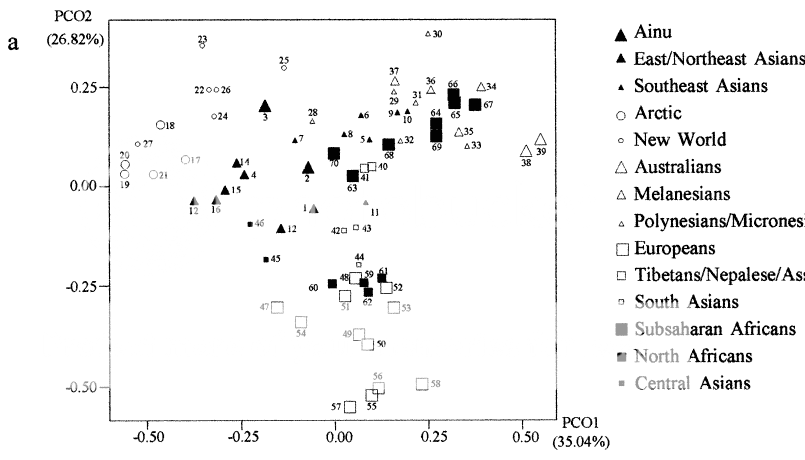
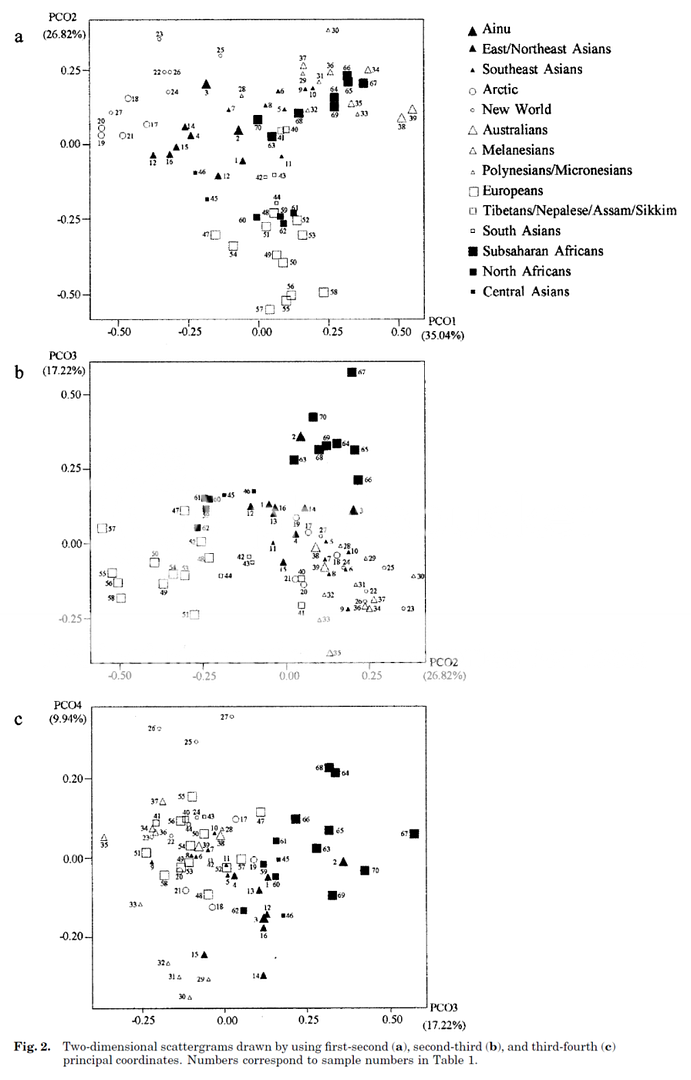
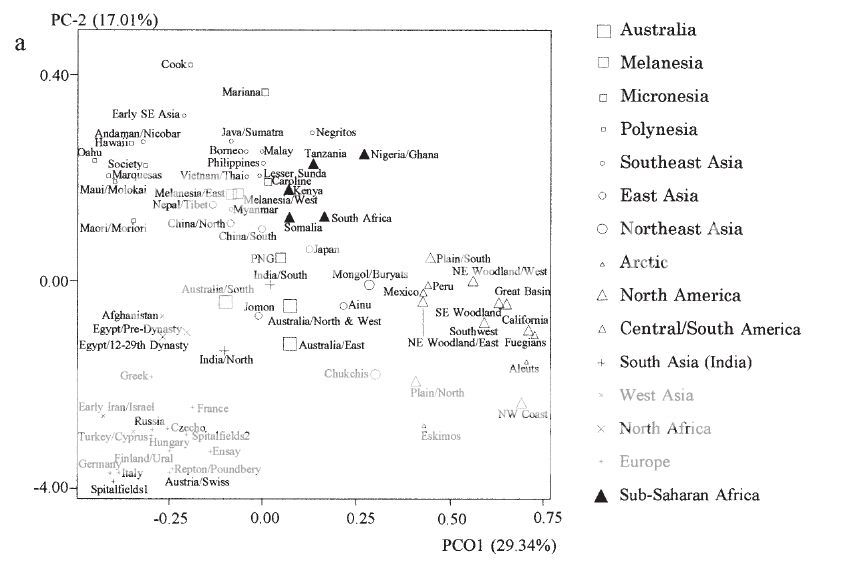
"Roughly three major constellations are evident. The Subsaharan African, Southeast Asian, and Oceanian samples form a cluster in one quadrant of Figure 2a. However, the Subsaharan African samples form a distinct grouping, well removed from the Southeast Asian and Oceanian samples on the third and fourth principal coordinates. In Figures 1 and 2, the Subsaharan African samples show significant separation from other regions, as well as diversity among themselves. The East/Northeast Asian and European samples form two additional discernable clusters. The New World and Arctic samples are peripheral subgroups in the large East/Northeast Asian cluster, and the two Ainu samples are outliers to other East Asians. The Central Asian samples are located between the Eastern Asian and European clusters. In the bottom half of Figure 2a, the South Asian samples are nearest to the center of all groups, the North African samples are a bit further removed, and the European samples are more separated, having the lowest scores on principal axis 2. Applying the neighbor-joining method to the MMD distances results in the dendrogram illustrated in Figure 3. The initial split, suggesting the greatest dissimilarity, is between Subsaharan Africans and the rest of the world. The Europeans, North Africans, and South Asians are then separated from the remaining groups. Oceania and the Southeast Asian groups form a separate branch that is separated from a large grouping of Central andEast/Northeast Asian, Arctic, and New World series clusters. The Arctic cluster, which includes groups from northeasternmost Siberia, is deep in a branch containing all New World groups. The Ainu samples are more similar to mainland groups from the Amur River basin and Lake Baikal than to the Japanese."
SOURCE : HANIHARA, TSUNEHIKO, HAJIME ISHIDA, AND YUKIO DODO. 2003. Characterization of biological diversity through analysis of discrete cranial traits. American Journal of Physical Anthropology 121:241-251.

LINK  PDF


3. Cranial Non-metric

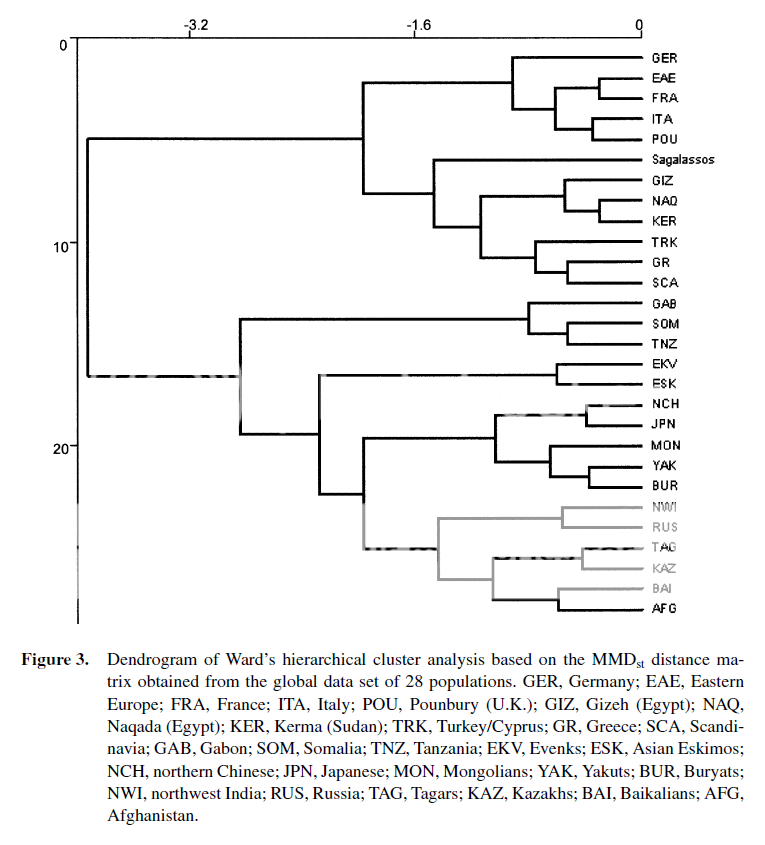
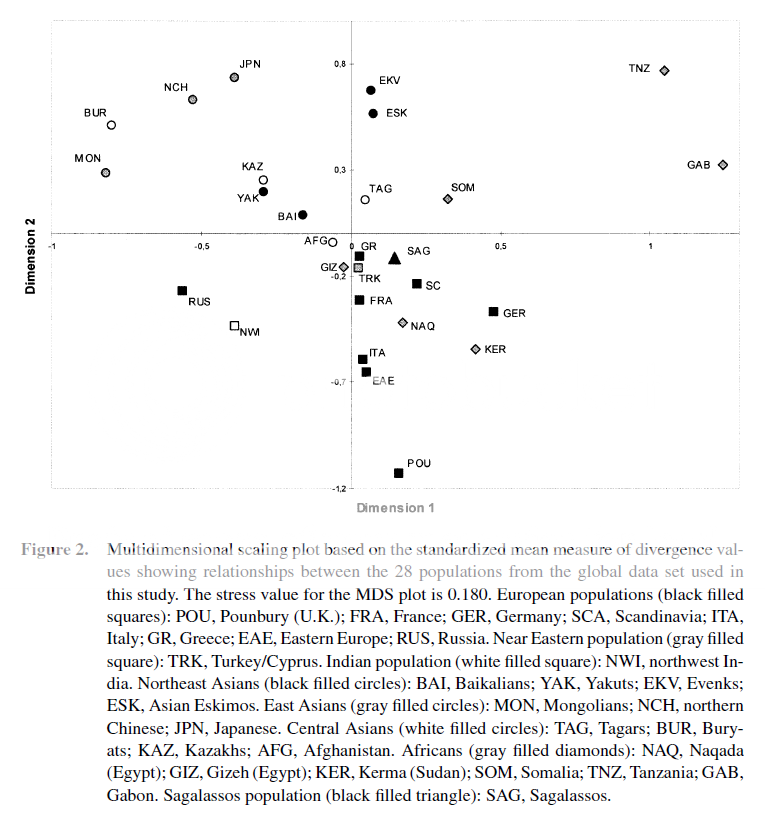
Pre-Dynastic Southern Egyptians from Naqada and late dynastic 26th-30th Dynasty Northern Egyptians from Gizeh cluster with Caucasoids [modern Europeans, ancient Byzantine Greeks, and modern Turks]. Note ancient Nubians from Kerma also cluster with Caucasoids and show strong ties with ancient pre dynastic Southern Egyptians. Also not modern sub-Saharan Africans including these East African Somalis do not.
"The dendrogram produced by Ward's clustering procedure for the global data set is shown in Figure 3 and provides a relatively similar representation of the MMD^sub st^ distance matrix than that provide by the MDS analysis. The populations clearly fall into two groups. The first main group can be broken down into two subgroups: (1) all the recent sub-Saharan populations and (2) mainly Central, East, and Northeast Eurasians. West Eurasians form the second main group, which is also subdivided into two subgroups. One of these subgroups includes all the eastern Mediterranean populations (three ancient Egyptian/Sudanese populations from Naqada, Gizeh, and Kerma as well as the Cypriot/Turkish, Greek, and Sagalassian populations) and the Scandinavian sample; the second subgroup includes the other West Eurasian populations."

SOURCE : Ricaut, F. X. and Waelkens, M (2008) "Cranial Discrete Traits in a Byzantine Population and Eastern Mediterranean Population Movements," Human Biology: Vol. 80: Iss. 5, Article 5.

LINK


Dental affinities

1. Dental Metric

Pre-Dynastic and 12th-29th Dynasty Egyptians cluster with modern Afghans and modern North Indians on the edge of a larger cluster of modern Europeans and modern West Asians.

It has been argued by Afrocentrists that dental data is insufficient because of  "tooth sized reduction" which indeed can undergo high change do to selective forces which have to do the diet of a population and other things, thus creating results that don't have much to do with genetic admixture or relatedness [for example see here]. However, in this study tooth size and it's effects were controlled and these relationships do indeed broadly match both cranio-facial and genetic data.
"It was asserted that tooth size has been exposed to strong natural selective force (Brace et al., 1991). It is true that overall tooth size plays a major role in odontometric variation, but when the effects of overall tooth size are eliminated with standardized data, several independent vectors with eigenvalues greater than 1.0 remain."
"Mesiodistal and buccolingual crown diameters of all teeth recorded in 72 major human population groups and seven geographic groups were analyzed. The results obtained are fivefold. First, the largest teeth are found among Australians, followed by Melanesians, Micronesians, sub-Saharan Africans, and Native Americans. Philippine Negritos, Jomon/Ainu, and Western Eurasians have small teeth, while East/Southeast Asians and Polynesians are intermediate in overall tooth size. Second, in terms of odontometric shape factors, world extremes are Europeans, aboriginal New World populations, and to a lesser extent, Australians. Third, East/Southeast Asians share similar dental features with sub-Saharan Africans, and fall in the center of the phenetic space occupied by a wide array of samples. Fourth, the patterning of dental variation among major geographic populations is more or less consistent with those obtained from genetic and craniometric data. Fifth, once differences in population size between sub-Saharan Africa, Europe, South/West Asia, Australia, and Far East, and genetic drift are taken into consideration, the pattern of sub-Saharan African distinctiveness becomes more or less comparable to that based on genetic and craniometric data. As such, worldwide patterning of odontometric variation provides an additional avenue in the ongoing investigation of the origin(s) of anatomically modern humans."

SOURCE : Hanihara T and Ishida H, (2005) Metric dental variation of major human populations American Journal of Physical Anthropology, Volume 128 Issue 2, Pages 287 - 298.

LINK 


2. Dental Non-metric

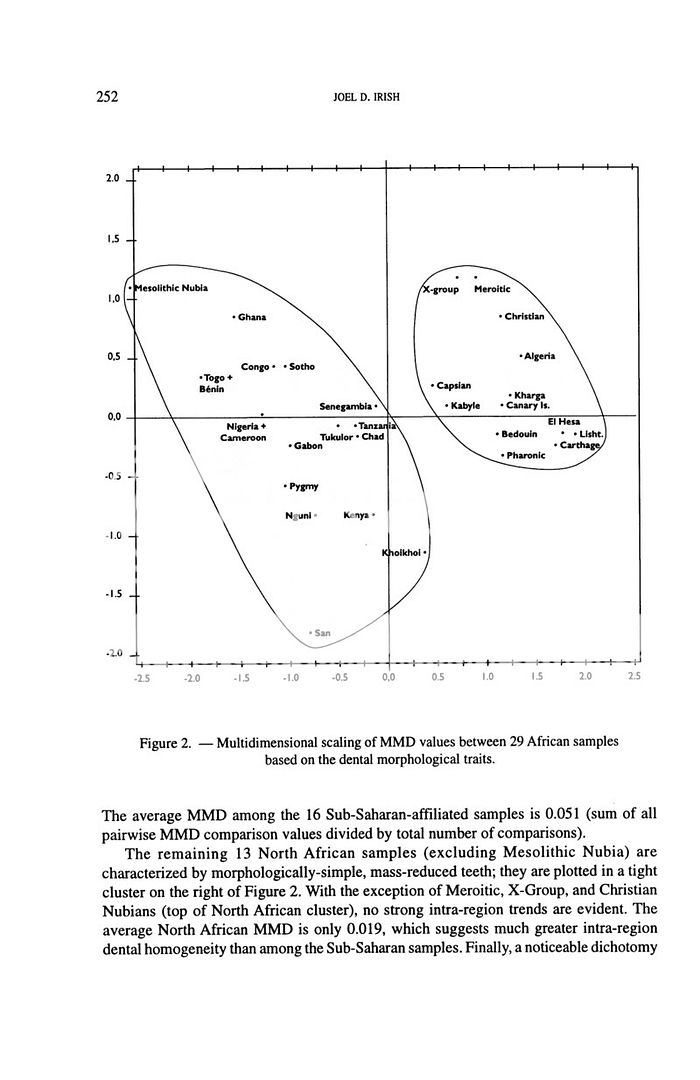
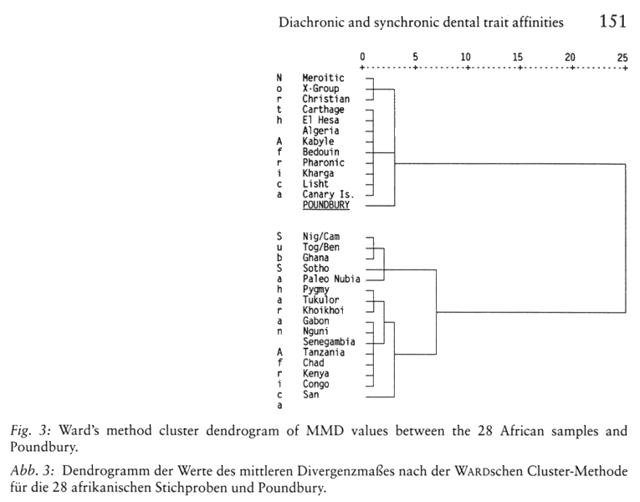
12th Dynasty Northern (Lisht), Roman/Byzantine (El Hesa), and Byzantine (Kharga) Egyptians cluster with other North Africans and Europeans (Poundbury, England).

"In several previous studies (e.g. IRISH 1993a, 1994, 1995, 1996, 1997) the biological affinities of Sub-Saharan and North African dental samples were estimated based on comparative analyses of morphological traits. A significant dichotomy between samples from the two geographic regions was revealed. However, intra-region trait homogeneity was observed, particularly within North Africa. Further analyses of the North Africans resulted in two additional findings. First, this homogeneity spans both space - from the Canary Islands to Egypt, and time - from recent Arabs and Berbers to West Asian-derived Carthaginians (751?-146 BC), 18th Dynasty (1575-1380 BC) Pharonic Nubians, and 12th Dynasty (1991-1783 BC) Egyptians. A small Capsian sample (ca. 8,500-5,000 BP) from Algeria and Tunisia also exhibits many trait similarities. Late Pleistocene Nubians (14,500-12,500 BP), however, are significantly different. Second, the post-Pleistocene North Africans are similar to Europeans in that they possess numerous dental features involving morphological simplification. Any North African deviations away from this pattern are in the direction of mass-additive Sub-Saharan traits. This finding supports the results of prior genetic-based studies that link North Africans to Europeans and western Asians, yet record several Sub-Saharan tendencies. Together, the two findings suggest that a morphologically simple dental pattern is shared by the indigenous peoples of North Africa, as well as Europe and perhaps western Asia, and this pattern has existed for the past 4,000 to perhaps 8,500+/- years."

SOURCE : Irish J.D. 1998b. Diachronic and synchronic dental trait affinities of late and post-pleistocene peoples from North Africa. Homo. 49(2) 138-155

LINK


Ancient Egyptians had simple, mass-reduced teeth like Caucasoids.
"However, all 15 samples exhibit morphologically simple, mass reduced dentitions that are similar to those in populations from greater North Africa (Irish, 1993, 1998a–c, 2000) and, to a lesser extent, western Asia and Europe (Turner, 1985a; Turner and Markowitz, 1990; Roler, 1992; Lipschultz, 1996; Irish, 1998a).Similar craniofacial measurements among samples from these regions were reported as well (Brace et al., 1993)"
SOURCE : Joel D. Irish (2006). Who Were the Ancient Egyptians? Dental Affinities Among Neolithic Through Postdynastic Peoples. Am J Phys Anthropol. 2006 Apr;129(4):529-43.

LINK  PDF 


This contrasts with the dental pattern of Sub-Saharan Africans who had massive complex teeth.
"Dentitions of Late Pleistocene Jebel Sahaba Nubians have extremely high frequencies of complex, mass-additive (and other) traits, including UI1 labial curvature, UI1 shoveling, Bushman Canine, UC distal accessory ridge, midline diastema, sixcusped LM1, LM2 Y-5, and LP1 Tome’s root. Furthermore, they exhibit low frequencies of typical North African features.This trait combination is ubiquitous in sub-Saharan Africans;(Irish & Turner, 1990; Irish, 1993, 1997, 1998a,b, for details)."
SOURCE : Irish, J.D., 2000. The Iberomaurusian enigma: North African progenitor or dead end? Journal of Human Evolution, 39(4), pp.393–410.

LINK


Forensic reconstruction of King Tut

Forensic anthropologists classify King Tut as being "Caucasian". 

May 10, 2005 
''Is this the true face of Tut? This silicone-skinned bust is billed as the most accurate forensic reconstruction ever of ancient Egypt's Pharaoh Tutankhamun. It was based on recent 3-D CT scans of the mummy of the "boy king," who is believed to have been about 19 when he died some 3,300 years ago. 
Led by Zahi Hawass, head of Egypt's Supreme Council of Antiquities, a National Geographic Society team commissioned French experts to create the lifelike bust. Using the CT scans (see "King Tut Mummy Scanned"), French forensic anthropologist Jean-Noël Vignal determined the basic measurements and features of Tutankhamun's face. Vignal deduced that Tutankhamun had a narrow nose, buck teeth, a receding chin, and Caucasian features. Such features are typical of European, North African, Middle Eastern, and Indian peoples. 
Paris-based forensic sculptor Elisabeth Daynès then created the bust shown above. She used Vignal's estimates of skin thickness and other data, plus wooden sculptures of Tut made in his youth. Soft-tissue features, such as the nose and ears, had to be guessed at, though within a scientifically determined range. Daynès based the skin tone on an average shade of Egyptians today and added the eyeliner that the king would have worn in life. 
Finally, National Geographic gave the CT data to a U.S. forensic team, who were to work "blind"—not knowing who the subject was. Their findings validated the French team's conclusions. And their plaster cast (see photo) turned out remarkably similar to the silicon bust. The reconstruction will be featured in the June issue of National Geographic, in the touring exhibit "Tutankhamun and the Golden Age of the Pharaohs," and on the National Geographic Channel's King Tut's Final Secrets, airing Sunday night." 
For the full story, see "King Tut's New Face: Behind the Forensic Reconstruction." 
See more pictures of the reconstruction.
—Ted Chamberlain
 LINK


EDIT 2017 - First Genome wide studies of Ancient Egyptian mummies!

Abstract 
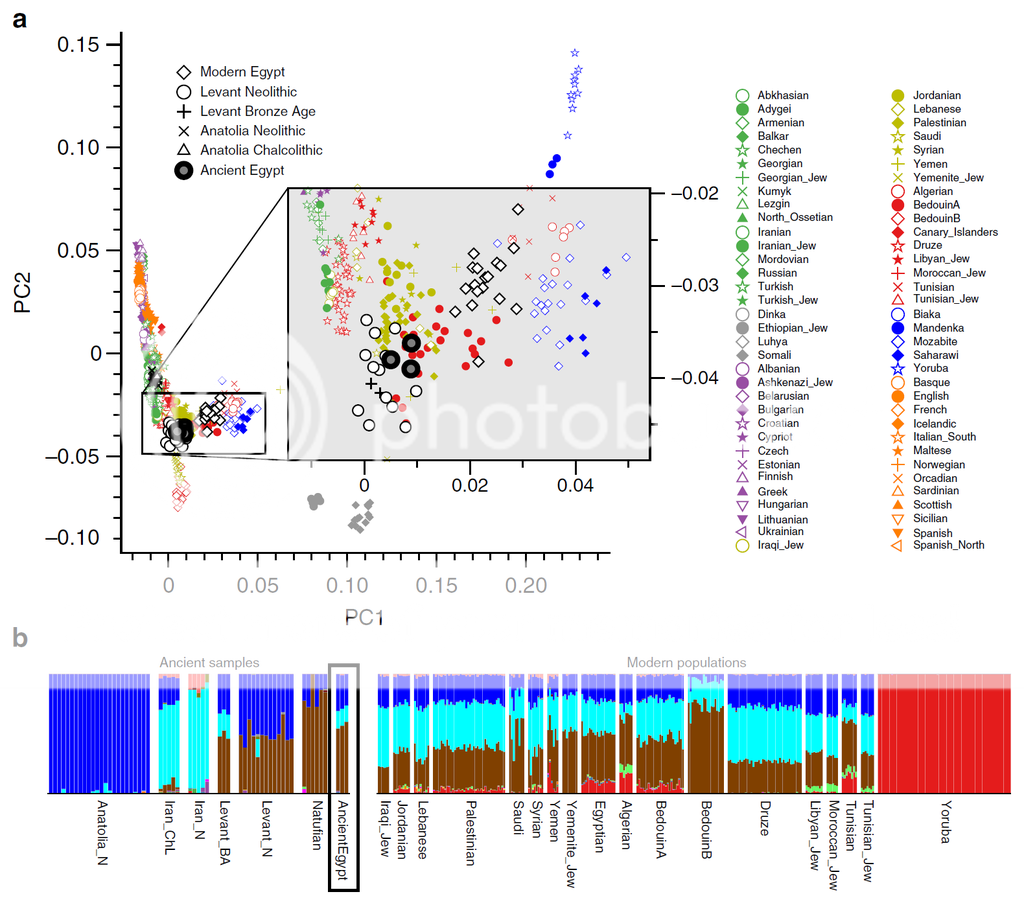
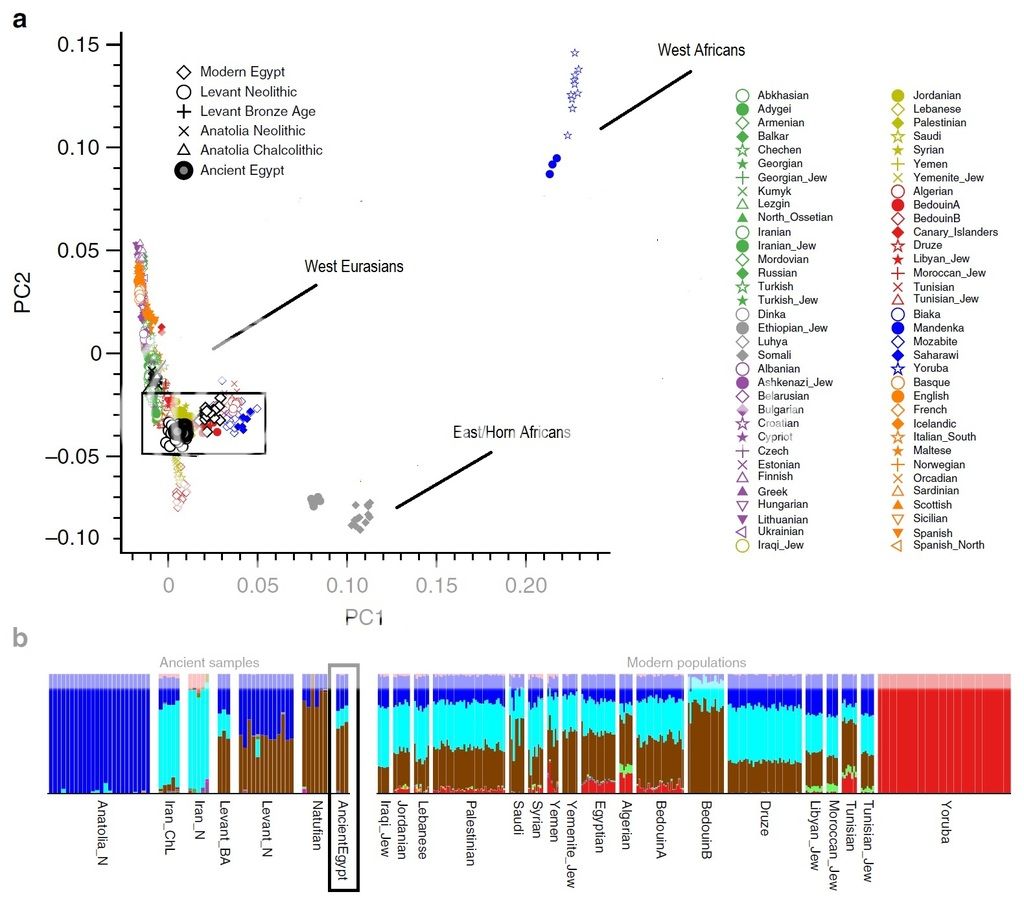
"Egypt, located on the isthmus of Africa, is an ideal region to study historical population dynamics due to its geographic location and documented interactions with ancient civilizations in Africa, Asia and Europe. Particularly, in the first millennium BCE Egypt endured foreign domination leading to growing numbers of foreigners living within its borders possibly contributing genetically to the local population. Here we present 90 mitochondrial genomes as well as genome-wide data sets from three individuals obtained from Egyptian mummies. The samples recovered from Middle Egypt span around 1,300 years of ancient Egyptian history from the New Kingdom to the Roman Period. Our analyses reveal that ancient Egyptians shared more ancestry with Near Easterners than present-day Egyptians, who received additional sub-Saharan admixture in more recent times. This analysis establishes ancient Egyptian mummies as a genetic source to study ancient human history and offers the perspective of deciphering Egypt’s past at a genome-wide level."
PCA plot in Figure a below reveals Ancient Egyptian clustering on a global scale. The magnified rectangle gives a detailed analysis of how the Ancient Egyptians cluster in a modern West Eurasian and North African context. 

Also ADMIXTURE analysis in Figure b reveals ancestral components that peak in Natufians, Neolithic Anatolians, and Neolithic Iranians..but do not exist in modern Sub-Saharan West Africans. Most modern North African samples, including modern Egyptians have a small but noticeable increase in Sub-Saharan ancestry [red] that ancient Egyptians and ancient Middle Easterners lacked during the Neolithic to Bronze age.


I thought I would edit the PCA and remove the magnified rectangle in Figure a for clarity. This gives us an idea how homogeneous the West Eurasian genetic cluster is, which includes present North Africans. It also demonstrates just how vast the differences are between the Ancient Egyptians and Modern Sub-Saharan groups. Even East Africans from the Horn such as Somalis show no strong ties to Ancient Egyptians.

SOURCE : Schuenemann et al. "Ancient Egyptian mummy genomes suggest an increase of Sub-Saharan African ancestry in post-Roman periods". Nature Communications, 2017.

LINK