Showing posts with label Nordicism. Show all posts

Saturday, October 10, 2015

Myth of the light pigmented "Nordic looking" Proto Indo-Europeans debunked.

So as it turns out, prehistoric North Pontic Steppe populations buried in Kurgan mounds are overwhelmingly dark pigmented (by modern Eurocentric standards). The populations of this area and time period are the most favored among linguists today to have been the speakers of the Proto Indo-European language (this hypothesis is known as the Kurgan hypothesis). See data below for details.
The table above represents frequencies found in ancient samples compared to modern Ukrainian ones. The dataset for the ancient sample is a combined pooling of both the Yamnaya culture and the succeeding Catacomb culture from the same area. Note the SNP rs12912832 [OCA2] in the HERC2 gene which predicts blue eyes is present in 65% of modern Ukrainians, but was only present in 16% of the ancient samples. Also note that the ancient samples have much lower frequencies in all three SNPs which predict light pigmentation including SNPs in the TYR gene which are associated with blondism. So while blue eyes and blondism were not completely unseen among the Proto Indo-European speakers...those phenotypical traits were indeed in the small minority.

SOURCE : Wilde et al., Direct evidence for positive selection of skin, hair, and eye pigmentation in Europeans during the last 5,000 y PNAS, Published online before print on March 10, 2014, DO:I10.1073/pnas.1316513111

Link  PDF


Another article released a year later basically revealed the same thing, although this study focused the pigmentation of many ancient European populations in comparison to modern ones including pre Neolithic Western Hunter Gatherers and early Neolithic Farmers in Europe. But the study did also include a sample set from the Yamnaya culture which is identified by most linguists as the speakers of the Proto Indo-European language on the eve of their great expansion. Only 11% of the Yamnaya in this sample from the Samar Oblast region carry alleles for light eyes, as they are noticeably darker pigmented in skin and eyes than contemporary Southern Europeans. See data below.


In graph A you'll see a timeline which consists of ancient samples all the way up to modern CEU (which represents White Americans from Utah who are mostly of Northwestern European origin). In graph B you'll see ancient samples represented as well, and you'll also see that the Yamnaya are represented in graph B. Graph C represents modern European populations. Notice the red bar which measures the frequency of light eye color pigmentation alles is extremely low in Yamnaya only scoring 11%, lower than modern Southern Europeans such as the Spanish and Italians (the Italian sample is from Tuscany). This means the Yamnaya, who were the likely speakers of late stage or 'classical' Proto Indo-European were around 90% dark eyed. You'll also notice that the blue and green bars represent the presence of light skin color alles, and their frequency in Yamnaya is lower than modern Southern Europeans as well. The blue bar in Yamnaya is equal to modern Europeans, but the green bar is lower. The data is clearly pointing to the idea that most of the presence of blue eyes in Europe derives from pre Neolithic and pre Indo-European speaking Western Hunter Gatherers, who are uniformly blue eyed. The data also points that natural selection has been favoring an increase in light skin over the past 5,000 in most areas of Europe, peaking in contemporary Northern Europe.

SOURCE : Mathieson, Iain, et al. "Eight thousand years of natural selection in Europe." bioRxiv (2015): 016477.

Link  PDF


Also of note, another 2015 major aDNA study was released just several months later. Interestingly enough, it found the same extremely high prevalence for brown eyes in the people of the Yamnaya culture. These aDNA samples were taken from the Kalmykia & Rostov Oblast regions, which are roughly 1,000 kilometers Southwest of the other Yamnaya group sampled in the earlier Maithieson et al study above, which were taken from the Samara Oblast region. However, the study and new sample locations yielded the same results.
"For rs12913832, a major determinant of blue versus brown eyes in humans, our results indicate the presence of blue eyes already in Mesolithic hunter-gatherers as previously described. We find it at intermediate frequency in Bronze Age Europeans, but it is notably absent from the Pontic-Caspian steppe populations, suggesting a high prevalence of brown eyes in these individuals."

Pretty much puts the nail in the coffin for the old idea of the Proto Indo-Europeans being a highly blonde and blue eyed group or phenotypically indistinguishable from present day Northern Europeans. Well, at least for those that support the Kurgan/steppe hypothesis for PIE origins. Of course, there is still the competing Armenian Highland hypothesis and (the now dying) Anatolian hypothesis, but there's no suspicion of predominately light pigmented populations in those prehistoric areas. 

SOURCE : Allentoft et al., Bronze Age population dynamics, selection, and the formation of Eurasian genetic structure, Nature 522, 167–172 (11 June 2015) doi:10.1038/nature14507

Link 


Those curious of what the geographic distribution of early Indo-European linguistic expansion looks like according to the Kurgan hypothesis, here are some great maps I found from a fellow blogger. 


All credit goes to the guy who runs this blog for making these maps.


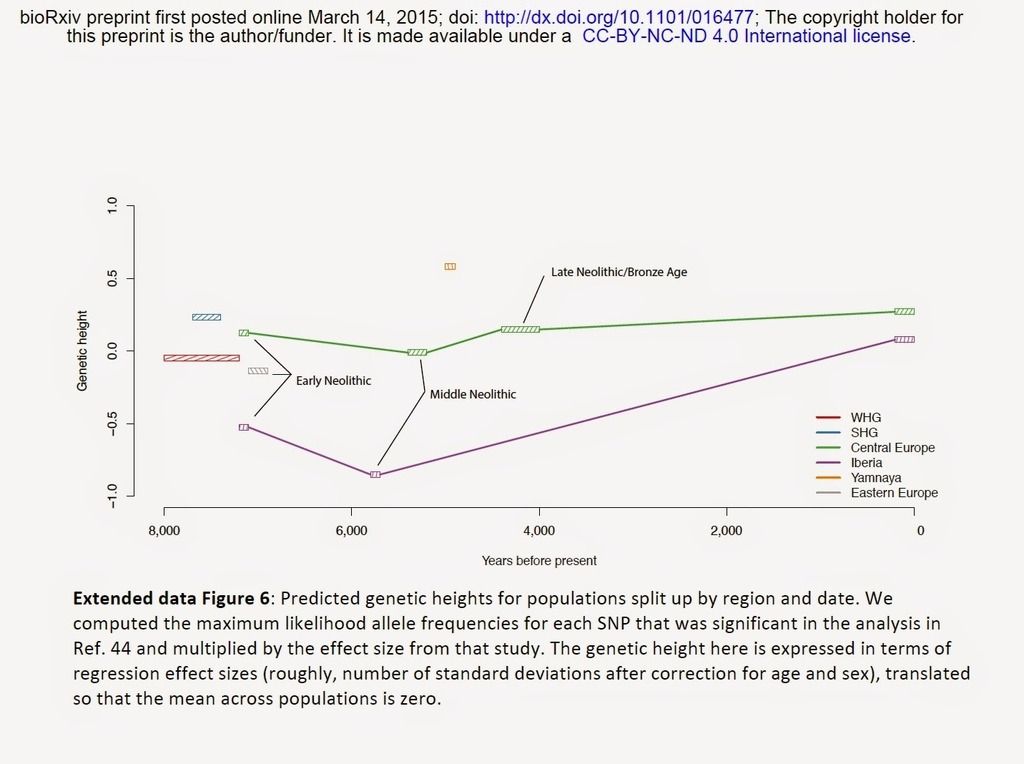
So what does this mean?  It means the long lasting and now hopelessly outdated conjectures from Nordicists about Proto Indo-European phenotype have been falsified. To be fair, we must not forget though that the Yamnaya had greater "genetic height" [Not actual height which is based on a complex combination of genetics and environmental/dietary upbringing] than modern Spaniards & Central Europeans, and perhaps one of the reasons modern Northern Europeans are on average the tallest in Europe is because they have the most Yamnaya like ancestry. 

But back to the point, let us not forget that these conjectures about pigmentation, and the idea of predominately light pigmented proto Indo-Europeans [such as John V. Day's hypothesis] were based on little more than select literature references of personalities (both real and mythological) from ancient Indo-European cultures that existed thousands of years after the Proto Indo-Europeans existed, and in most cases many hundreds to thousands of miles away from the Proto Indo-European urheimat. Of course, that's not even getting into the problem of the relativeness of color terminology nor vagueness of the descriptions. The point is none of these later distant and distinct Indo-European populations in which ancient literature mentions of light pigmented individuals spoke the original or even a pure Indo-European language, they merely spoke a language which shared an ultimate linguistic ancestor with Proto Indo-European. In the future more data from ancient DNA I'm sure will show these populations to not be fully genetically continuous to the early Bronze age Proto Indo-European steppe populations (or even the "elites"), though they definitely may have significant Bronze age steppe admixture like most modern Indo-European speaking populations in Europe do.

Keep in mind, just because the Proto Indo-Europeans were overwhelming dark eyed and rather dark skinned and haired by Eurocentric standards, does not mean all later particular Indo-European speaking cultures or populations were. I don't want anyone to fall into that trap. We of course know that modern Indo-European speaking populations vary greatly in phenotype and pigmentation. We also know that even by the late bronze age, that many later Indo-European peoples were evolving not only their own unique languages, but also their own unique genetic identities away from the Proto Indo-European identity as well. So with this in mind, there's no reason to believe they weren't developing their own unique phenotypes distinct from the original Indo-European phenotype either. Many later derived Indo-European cultures like the Proto Indo-Iranians or the Proto Germanics were probably predominately light pigmented.

The beauty of science strikes again and throws us another surprise. Any contemporary seeker of truth is lucky to live in this era of scientific inquiry when humanity has thrown off dogmatic and religious assertions in search for genuine knowledge. I know I am.


Sunday, August 17, 2014

Ashkenazi Jews - An East Mediterranean populace.

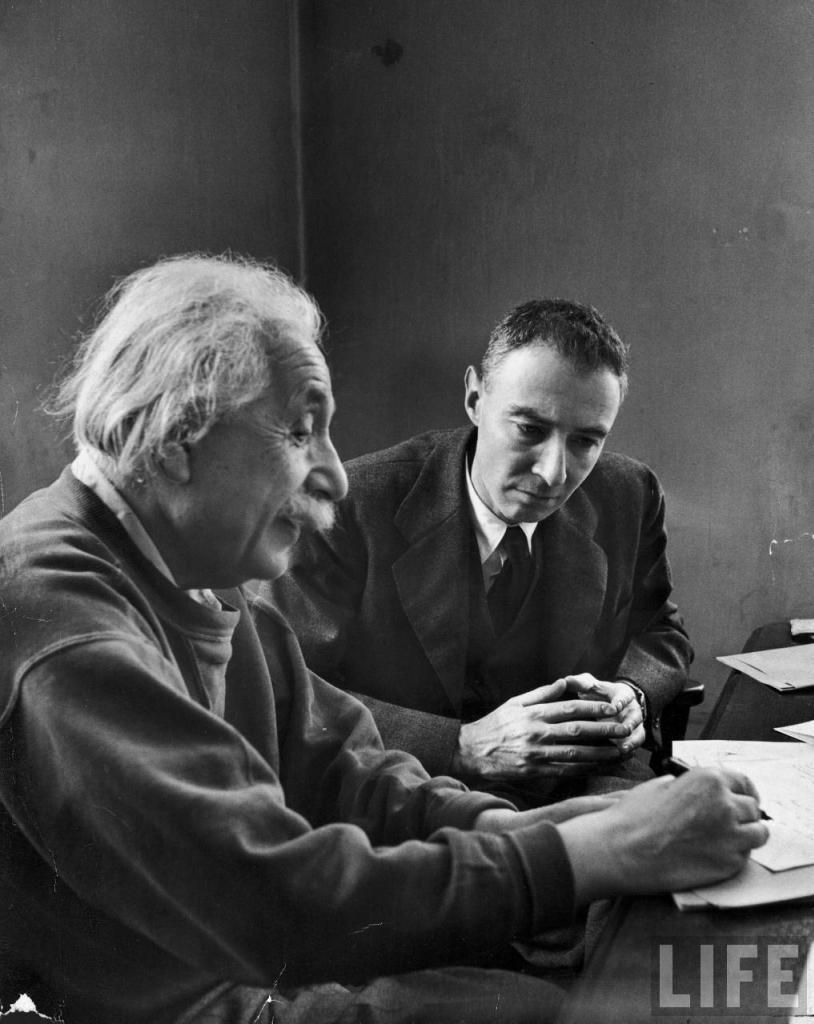
Above :  Notorious 2oth century Jewish physicists Albert Einstein and Robert Oppenheimer converse. 
 

Love them or hate them, no ethnic group has shown more intellectual achievement the last 2 and half centuries than the Jews. Dwarfing the competition, The Jews compromising only 0.2% of the world's population have accumulated 41% of all the Nobel prizes in economics, 28% of medicine, 26% of Physics, 19% of Chemistry, 13% in Literature, and even 9% in the less impressive "peace" prize.

Regardless of achievement, there still persists a few racial and anti Semitic myths regarding their ethnic origins.  It is often erroneously believed that Ashkenazi Jews are a heterogeneous cultural group and not a distinct ethnic group. Or that Jews, including the Ashkenazi, are recent converts who are genetically/ancestrally related to their Christian host populations they lived among in North/Central/Eastern Europe, or were ethnic Khazar converts to the Judaic religion. However, these notions have been completely falsified by modern genetic science. All genome wide genetic data shows that the Ashkenazi are an ethnic group with the predominant amount of their ancestry going back to the ancient Eastern Mediterranean region. The genetic data proves they are related to their fellow European and Levantine ethnic Jewish groups first and foremost, and secondly to Southeastern Europeans. All the while the data shows them clustering further away from their host populations in Northern, Central, and Eastern Europe than Southeastern Europeans, and also showing negligible Khazar/Turkic admixture. There exists a number of genome wide studies demonstrating these facts.   


European Population Substructure: Clustering of Northern and Southern Populations. Seldin et al (2006).
Abstract
"Using a genome-wide single nucleotide polymorphism (SNP) panel, we observed population structure in a diverse group of Europeans and European Americans. Under a variety of conditions and tests, there is a consistent and reproducible distinction between “northern” and “southern” European population groups: most individual participants with southern European ancestry (Italian, Spanish, Portuguese, and Greek) have >85% membership in the “southern” population; and most northern, western, eastern, and central Europeans have >90% in the “northern” population group. Ashkenazi Jewish as well as Sephardic Jewish origin also showed >85% membership in the “southern” population, consistent with a later Mediterranean origin of these ethnic groups. Based on this work, we have developed a core set of informative SNP markers that can control for this partition in European population structure in a variety of clinical and genetic studies."

Synopsis

"Two unrelated persons in the human population have hundreds of thousands of base pair differences between them in DNA sequence. Previous studies have shown that a small proportion of these sequence differences correlate with a person's continental ancestry: broadly, Asia, Africa Oceana, America, or continental Europe. In the current study, DNA differences within a particular continental group, Europe, were examined. Overall, the analysis of sequence variation allowed the authors to distinguish individuals with northern European ancestry (Swedish, English, Irish, German, and Ukrainian) from individuals with southern European ancestry (Italian, Spanish, Portuguese, and Greek). Interestingly, Ashkenazi Jewish individuals tend to group together with individuals from southern European countries. This study is important because it provides a method of taking into account these differences when searching for genetic variations that are associated with particular human traits, such as disease susceptibility, response to drug treatment, or side effects from therapy. Specifically, these methods may allow scientists to uncover disease-associated genetic variations that might be hidden unless differences related to European ancestry are considered "


Note above FIGURE 3 : The Ashkenazi are clustering overwhelmingly in the "Southern" population group along with Southern Europeans. A striking demonstration shown in (C) when 4 of 4 grandparents are verified. The Ashkenazi all range from red (90%+ 'southern') to orange (60-90% 'southern'), while none belong to any blue, green, or yellow cluster in complete contrast to their host populations in North/Central/Eastern Europe. 

In this pan European + European Jewish context, there's not a huge difference between Sephardi and Ashkenazim Jews, and both are similar to Italians and Greeks. 

FIGURE 4 below illustrates the same thing.


SOURCE : Seldin MF, Shigeta R, Villoslada P, Selmi C, Tuomilehto J, et al. (2006) European Population Substructure: Clustering of Northern and Southern Populations. PLoS Genet 2(9): e143. doi:10.1371/journal.pgen.0020143

Link PDF


The data doesn't stop there though, while Seldin et al. (2006) used between 5,000 and 749 SNPs in their various analysis using STRUCTURE, a year later Bauchet et al. (2007) corroborated these earlier results using 10,000 SNPs.


Measuring European Population Stratification with Microarray Genotype Data. Bauchet et al (2007).

Abstract
"A proper understanding of population genetic stratification—differences in individual ancestry within a population—is crucial in attempts to find genes for complex traits through association mapping. We report on genomewide typing of ∼10,000 single-nucleotide polymorphisms in 297 individuals, to explore population structure in Europeans of known and unknown ancestry. The results reveal the presence of several significant axes of stratification, most prominently in a northern-southeastern trend, but also along an east-west axis. We also demonstrate the selection and application of EuroAIMs (European ancestry informative markers) for ancestry estimation and correction. The Coriell Caucasian and CEPH (Centre d'Étude du Polymorphisme Humain) Utah sample panels, often used as proxies for European populations, are found to reflect different subsets of the continent’s ancestry."
"To address this issue further, we typed 297 individuals from 21 European and world populations for ∼10,000 autosomal SNPs, primarily using Affymetrix 10K mapping arrays. The European population samples represent a broad range of the geographic and linguistic diversity of the continent. In brief, they consisted of western Irish (n=6), eastern English (n=8), French (n=1), German (n=8), Valencian Spanish (n=20), Basque Spanish (n=8), Italian (n=9), Polish (n=8), Greek (n=8), Finnish (n=7), Armenian (n=8), and Ashkenazi Jewish (n=5) subjects. The Italian, Ashkenazi Jewish, and Greek samples include 2, 1, and 1 individuals, respectively, from the Coriell Cell Repository."

As stated by the authors above, the largest genetic split in Europe occurs between the North and Southeast, no doubt as a primary result of the Eurasian Neolithic's heavy genetic impact on the Southeast.

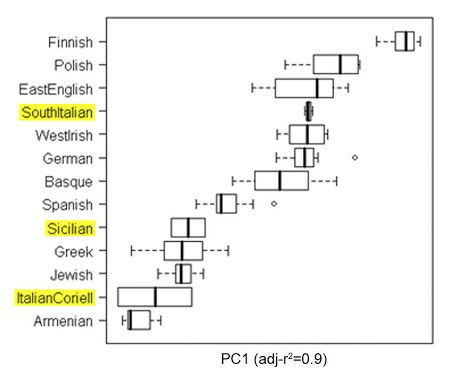
"PC1 largely separates northern from southeastern individuals and is consistent with the clines observed in classic gene-frequency, Y-chromosome, mtDNA,and whole-genome studies of European diversity. PC2 reflects mainly east-west geographic separation and, particularly, identifies the two Iberian populations (Spanish and Basques) in our analysis as distinct. Furthermore, PC3 and PC4 emphasize the separation of the Basques and Finns, respectively, from other Europeans. The Basques are known to have unusual allele frequencies for several marker systems and speak a unique non–Indo-European language. In line with their non–Indo-European Uralic language and previous study of their Y-chromosomes, the Finns show evidence of an increased affinity to the Central Asian populations when placed in an intercontinental context (fig.1A1A and 1B) ).


As we can also observe above in Figure 4A in the PCA, The Jewish sample which is Ashkenazi clusters deep into the Southeastern group roughly in between Greeks and Armenians. And as the authors state below, the STRUCTURE analysis results shown in Figure 4B below yield the same thing. 

"Overall, STRUCTURE analysis of the European populations is highly consistent with PCoA; for example, when the number of populations (K) is 3, the major divisions correspond to the northern, southeastern, and Iberian populations (fig. 4B). In cases of higher K values, first the Finns (K=4) and then the Basques (K=5) emerge as distinctive."

Continuing on as if the data in figure 4B wasn't clear enough, the authors state the Ashkenazi Jewish sample is shown shown to cluster with Greeks and Armenians, and not with Northern and Eastern Europeans like Germans, Poles, Irish, or English.
"Within the two broad northern (Polish, Irish, English, Germans, and some Italians) and southeastern (Greeks, Armenians, Jews, and some Italians) clusters, further reliable structure is less obvious because individuals from different population samples are often interspersed with each other. Thus, in some cases, geographic distance or physical barriers are not well reflected. For instance, despite their insular origin, Irish and English individuals cluster with the continental Germans and Poles. Similarly, large geographical gaps, such as that between Greece and Armenia, are much less obvious at the genetic level. Conversely, Italy appears to be a zone of sharp differentiation over small distances. Some Italians cluster with the northern Europeans, whereas others fall into the southeastern grouping (fig. 4A). The SKT confirms significant stratification within those metaclusters, as suggested by the wide amount of PCoA space occupied by each (fig. 4A). Significant SKT stratification is also observed within the Spanish and the Italian samples. However, Mantel correlations between genetic and geographic distance were not significant within northern and southeastern metaclusters. It is likely that additional populations, additional individuals for some populations, and an increased number of markers will be required to investigate the nature and extent of these more subtle patterns."
The only thing particularly bizarre here is that you may notice that 3 Italian outliers are clustering with Northern Europe. A lot of people without looking at the actual data [since the authors don't clarify] initially assumed they were Northern Italians, however it's actually 3 Southern Italian anomalies clustering in the northern cluster [clearly some sort extremely rare near pure remnants of Gothic/Vandal or Norman invasions] and the Sicilians and North-Central Italians from Tuscany labelled Italian-Coriell cluster where you'd expect, in the southeastern cluster. 

But more importantly and back to the point for this blog entry, this study again irrefutably proves the East Mediterranean affinity of the Ashkenazi Jews and their lack of any sort of strong ancestral ties with their former host populations.


SOURCE : Bauchet, M. et al. (2007) Measuring European Population Stratification using Microarray Genotype Data. American Journal of Human Genetics

Link PDF


With these 2 studies alone it was pretty clear, however even more markers were needed to give even more precise details about the specifics where the Ashkenazism genetically reside. And a few years later geneticists released several massive new studies on Eurasians and Jews based on hundreds of thousands of autosomal SNPs.

Refinement of ancestry informative markers in Europeans. Tian et al (2009).
"The definition of European population genetic substructure and its application to understanding complex phenotypes is becoming increasingly important. In the current study using over 4,000 subjects genotyped for 300,000 single-nucleotide polymorphisms (SNPs), we provide further insight into relationships among European population groups and identify sets of SNP ancestry informative markers (AIMs) for application in genetic studies. In general, the graphical description of these principal components analyses (PCA) of diverse European subjects showed a strong correspondence to the geographical relationships of specific countries or regions of origin. Clearer separation of different ethnic and regional populations was observed when northern and southern European groups were considered separately and the PCA results were influenced by the inclusion or exclusion of different self-identified population groups including Ashkenazi Jewish, Sardinian, and Orcadian ethnic groups. SNP AIM sets were identified that could distinguish the regional and ethnic population groups. Moreover, the studies demonstrated that most allele frequency differences between different European groups could be controlled effectively in analyses using these AIM sets. The European substructure AIMs should be widely applicable to ongoing studies to confirm and delineate specific disease susceptibility candidate regions without the necessity of performing additional genome-wide SNP studies in additional subject sets."

This particular study was of great value since it was not only based on a number of markers unseen before, it came with an excellent and useful Fst genetic distance table where the authors numerically valued the genetic relationships between Eurasian groups. The Ashkenazi Jews were included as seen in Table 1 labeled below as AJA [Ashkenazi Jewish Americans].


To Southeastern Europeans
Ashkenazi Jews to "Italian Americans" (Southern Italians) - 0.0040
Ashkenazi Jews to Greeks - 0.0042   

To Levantines 
Ashkenazi Jews to Druze - 0.0088
Ashkenazi Jews to Palestianians - 0.0093
* Unfortunetely for our Levantine samples all that were included in this study were Islamic groups which have received significant gene-flow from the Arabian Peninsula and even Sub-Saharan Africa. It would be nice to compare the Ashkenazi to other Jews like the Sephardi, and Levantine Christian groups as well.
 
To Central/North/Eastern Europeans 
Ashkenazi Jews to Germans - 0.0072
Ashkenazi Jews to Irish - 0.0109 
Ashkenazi Jews to Swedish - 0.0120 
Ashkenazi Jews to Russians - 0.0137
Askkenazi Jews to Orcardians - 0.0146

And as we can see, Southeastern Europeans like Greeks are closer and more ancestrally related to North/Central/Eastern Europeans than Ashkenazi Jews are to North/Central/Eastern Europeans.
Greeks to Germans - 0.0039
Greeks to Irish - 0.0067
Greeks to Swedish - 0.0084
Greeks to Russians - 0.0108
Greeks to Orcadians - 0.0103


So what can we honestly say with this knowledge? Well for 1 it appears when even greater amount of markers are used like in this study unlike the first 2 in this blog entry, the Ashkenazi show distinction from Southeastern Europeans. My guess is they cluster somewhere between Levantine Christian groups (who have not been effected by the geneflow the Islamic groups have) and Southeastern Europeans, and like other studies show they are most similar to their Sephardi Jewish cousins.


SOURCE : Tian et al. (2009). European Population Genetic Substructure: Further Definition of Ancestry Informative Markers for Distinguishing Among Diverse European Ethnic Groups. Mol Med; doi: 10.2119

Link PDF


Another genome wide study again showed Ashkenazi Jews clustering with Southern Europeans rather than their former host populations north of the Alps. Fortunately this study also includes other Jewish for compare and contrast, and non European Middle Eastern populations as well.

Abraham's Children in the Genome Era: Major Jewish Diaspora Populations Comprise Distinct Genetic Clusters with Shared Middle Eastern Ancestry. Gil Atzmon et al (2010).

"For more than a century, Jews and non-Jews alike have tried to define the relatedness of contemporary Jewish people. Previous genetic studies of blood group and serum markers suggested that Jewish groups had Middle Eastern origin with greater genetic similarity between paired Jewish populations. However, these and successor studies of monoallelic Y chromosomal and mitochondrial genetic markers did not resolve the issues of within and between-group Jewish genetic identity. Here, genome-wide analysis of seven Jewish groups (Iranian, Iraqi, Syrian, Italian, Turkish, Greek, and Ashkenazi) and comparison with non-Jewish groups demonstrated distinctive Jewish population clusters, each with shared Middle Eastern ancestry, proximity to contemporary Middle Eastern populations, and variable degrees of European and North African admixture. Two major groups were identified by principal component, phylogenetic, and identity by descent (IBD) analysis: Middle Eastern Jews and European/Syrian Jews. The IBD segment sharing and the proximity of European Jews to each other and to southern European populations suggested similar origins for European Jewry and refuted large-scale genetic contributions of Central and Eastern European and Slavic populations to the formation of Ashkenazi Jewry. Rapid decay of IBD in Ashkenazi Jewish genomes was consistent with a severe bottleneck followed by large expansion, such as occurred with the so-called demographic miracle of population expansion from 50,000 people at the beginning of the 15th century to 5,000,000 people at the beginning of the 19th century. Thus, this study demonstrates that European/Syrian and Middle Eastern Jews represent a series of geographical isolates or clusters woven together by shared IBD genetic threads."


Notice in the PCA above panel B from Figure 1 which shows the first two principal components in a regional context. The labels in bold red represent Jewish groups, while labels in light grey represent gentile groups. Notice the Ashkenazi Jews pull further away from more northerly populations like the French or Russians and pull further away in an Eastern direction than Northern Italians. Unfortunately for gentile groups Southern Italians and Greeks weren't sampled for a compare and contrast in this PCA analysis, but if they were they'd be in between Ashkenazi Jews and Northern Italians.

The authors also go on to suggest that although the Ashkenazi did pick up some noticeable gentile admixture on their way to Central Europe, the bulk of this ancestry must have been from around the Mediterranean region in Europe.
"Two major differences among the populations in this study were the high degree of European admixture (30%–60%) among the Ashkenazi, Sephardic, Italian, and Syrian Jews and the genetic proximity of these populations to each other compared to their proximity to Iranian and Iraqi Jews. This time of a split between Middle Eastern Iraqi and Iranian Jews and European/Syrian Jews, calculated by simulation and comparison of length distributions of IBD segments, is 100–150 generations, compatible with a historical divide that is reported to have occurred more than 2500 years ago.The Middle Eastern populations were formed by Jews in the Babylonian and Persian empires who are thought to have remained geographically continuous in those locales. In contrast, the other Jewish populations were formed more recently from Jews who migrated or were expelled from Palestine and from individuals who were converted to Judaism during Hellenic-Hasmonean times, when proselytism was a common Jewish practice. During Greco-Roman times, recorded mass conversions led to 6 million people practicing Judaism in Roman times or up to 10% of the population of the Roman Empire. Thus, the genetic proximity of these European/Syrian Jewish populations, including Ashkenazi Jews, to each other and to French, Northern Italian, and Sardinian populations favors the idea of non-Semitic Mediterranean ancestry in the formation of the European/Syrian Jewish groups and is incompatible with theories that Ashkenazi Jews are for the most part the direct lineal descendants of converted Khazars or Slavs. The genetic proximity of Ashkenazi Jews to southern European populations has been observed in several other recent studies."

And lastly a compare and contrast only between Jewish groups and European groups. The Jewish groups represented by the circular symbols labeled in bold red while the Europeans are square. Follow the key to for specifics on the Europeans. Some European groups have been pooled together.
Key: S - Italy, Swiss-Italian; SE - Albania, Bosnia-Herzegovina, Bulgaria, Croatia, Greece, Kosovo, Macedonia, Romania, Serbia, Slovenia, former Yugoslavia; SW - Portugal, Spain; E - Czech Republic, Hungary; ESE - Cyprus, Turkey; C - Austria, Germany, Netherlands, Swiss-German; W - Belgium, France, Swiss-French; N - Denmark, Norway, Sweden; NE - Poland (+ 6 Russians from Moscow, one Finn, one Latvian and one Ukrainian); NW - Ireland, Scotland, UK.

Following the PCA plot above we see the Syrian, Greek + Turkish, Italian, and Ashkenazi Jews form a major cluster. Basically a Syrian-Sephardi-Ashkenazi Jewish mega cluster distinct from Oriental Jews. Though the Ashkenazi represented by the bright red dots seem to be ever so slightly more northern influenced than the Sephari Jewish groups, they still plot below the majority of Southern Europe. The Italians represented by the hot pink squares show significant diversity and pull furthest south of all Europeans. More than likely the ones closest to Ashkenazi are Southern Italians and Sicilians and the Italian higher North are Northern Italians. The Italian samples are from all over Italy and even includes Swiss-Italians. Greeks meanwhile are pooled in with other Balkan groups and are represented by the dark blue square symbols. The Northern European groups remain in hyperboria compared the Ashkenazi Jews.


SOURCE : Gil Atzmon et al. Abraham's Children in the Genome Era: Major Jewish Diaspora Populations Comprise Distinct Genetic Clusters with Shared Middle Eastern Ancestry AJHG doi:10.1016/j.ajhg.2010.04.015

Link

Saturday, March 30, 2013

Roger Pearson's "The Greek Face" completely debunked.

Roger Pearson is a neo-Nordicist writer and co founder of two peer reviewed academic journals known as Mankind Quarterly and The Journal of Indo-European Studies. I for one do not consider those journals to be necessarily bad, even though both (and in particular Mankind Quarterly) have come under heavy attack by the more politically correct mainstream. Pearson himself is a known eugenicist and racialist; however he has not contributed to or edited either of those journals in decades, and both journals have featured plenty of accredited and prestigious anthropologists and linguists such as J.P. Mallory. 

      However, I do have a particular problem with an article by Pearson titled The Greek Face made back from 1974 which I continue to see surface and referenced on the web from time to time. Unlike Pearson's early delves into racial history where he simply re-tells (literally word for word) old Hans F.K. Guenther fantasies, this article attempts to reference the actual scientific work of other well respected anthropologists and scientists who have studied the question hands on. The article made by Pearson concerns the racial affiliation of ancient and aristocratic class Greeks, and he focuses primarily on the Eupatridaes of ancient Athens. The problem with the article is Pearson completely distorts and outright lies about the sources he attempts to use to support his Nordicist premise.

Pearson's premise can be basically outlined as follows.

1. The Proto Indo-European speakers lived in the North Pontic Steppe region, and thus Indo-Europeanization of Greece happened during the Bronze age.

2. The populations who Indo-Europeanized Greece had full genetic continuity with the Proto Indo-European speakers.

3. The Eupatridaes of classical Athens had full genetic continuity from the populations who Indo-Europeanized Greece, while the commoners of Athens and Greece in general were not descended from them at all or very little. Thus there was a racial caste system in classical Athens amongst the Athenians themselves.

     I'll start right off by saying premise 1 which was originally put forth by archeologist Marija Gimbutas is still very much up for debate. Regarding premise 1, I certainly wont delve into that question in this blog entry since I nor really anyone else at the moment has any hope in either outright refuting it or outright proving it. Also, since the anthropologists Pearson attempts to use as sources [in Particular J. Lawrence Angel] followed that model of PIE homeland and timescale breakdown, I'll just comply with it for the sake of making a long story short. But lets deal in particular with premises 2 and 3 since they deal with biological and not linguistic matters. Let's firstly deal with Premise 2.

Pearson writes
    "Several attempts have been made to discuss the physical anthropology of Greece from the point of view ol the available skeletal evidence. Some early references were made by pioneers such as Ripley (1899), Schuchhardt (1926), and J.L. Myres (1930). More recently Coon (1954) and Angel (1944, 1945, 1946 [a] [b]) have added considerable information. In his most recent work on the subject, a detailed analysis of the numerous skeletal remains found in different cemeteries in the excavations at Lerna, Angel (1971) concludes that the immigrant Hellenic or Indo-European population reflected a 'Nordic' type which probably arrived from the Danubian area, and also a related 'Iranic' type. This latter appears to reflect a separate Indo-European invasion from the direction of Anatolia, although Angel assumes that both these related types originated ultimately from the area of the Pontic steppes."

Now this is what I call a blatant distortion. Angel believed that the Indo-Europeanizers of Greece were partially descended from North Pontic Steppes populations. However, Angel also said that they had morphological overlap and genetic heritage from "Balkan mountain peoples" and Near Eastern "Iranians"!

The real quote from Angel (1971)
    "My subjective and extremely speculative survey suggests that origins of the population were mostly local, derived from the Neolithic and later pre-Greek populations, with the Near East and Upper Paleolithic Central and Eastern Europe as ultimate sources. But altogether too sketchy data for the period before 2,000 B.C. Plus an analysis of the Middle Bronze Age do suggest a double intrusion of peoples who must have introduced Indo-European languages : from the east (originating in Iran and the steppe country) and from the north (also originating in the steppe country and from among Balkan mountain peoples)."

So according to Angel the North Pontic Steppes was not the only genetic source for the earliest Greek speakers, but also the Near East and the Balkans.

Another thing, in Angel's taxa system they were not morphologically "Nordic" as Pearson's lies claim they were. They were a morphological mix of Nordic-Iranian, Eastern Alpine, European Alpine, and Dinaroid. As the very next sentence from Angel states.
    "They seem to have been themselves mixed and newly forming groups, and they produced slight trends in Nordic-Iranian plus Eastern and European Alpine and Dinaroid directions."

If I order a pizza with "extra cheese, pepperoni, and mushrooms" and when the pizza man gives me my pizza there is only extra cheese on it, did they get my order wrong? Yes, they did get my order wrong. So Pearson is simply reporting fraudulent information. Either that or he's grossly incompetent.

Pearson also lies and makes silly and unfounded "racial purity" claims about the early Indo-European Greek speakers when he says this.
    "In the course of some five or six millennia of expansion and conquest, an expanding IE upper caste may undoubtedly have preserved a high degree of genetic continuity, while simply superimposing itself upon the autochthonous populations."

How can he make such a claim when that was proven wrong by his own scientific source? Maybe I need to paste the the quote from Angel again.
    "They seem to have been themselves mixed and newly forming groups, and they produced slight trends in Nordic-Iranian plus Eastern and European Alpine and Dinaroid directions."

Key words : "mixed" and "newly forming". So the earliest Greeks certainly weren't undiluted remnants of the alleged Proto Indo-European Steppe populations, they only had partial ancestry from them. The point is the earliest Greeks didn't just develop their own unique culture and dialectical language from the Proto Indo-European culture and language (which would have preceded them by thousands of years) they had formed their own new and distinct genetic identity as well, and were sitting on a land pretty distant from the North Pontic Steppe. These early Bronze age Greeks then in turn mixed with and Hellenized the remainder of Greece soon forming Mycenaean and much later Classical Greek culture and genetic identities.

SOURCE for Angel's analysis (same sourced used by Pearson) : Angel, J. Lawrence, 1971, The people of Lerna; analysis of a prehistoric Aegean population (page 111), American School of Classical Studies, Athens.

LINK


Now as far as Premise 3 is concerned, Pearson states that the Eurapatrids in classical Athens would have been a racially distinct caste compared to the commoners based on supposed "Indo-European derived ancestry" (whatever that means) as compared to non Indo-European derived ancestry for the commoners.
    "From the point of view of physical anthropology the ethnic complexity of Greek society during the first millennium B.C. prohibits any attempt at a generalized statement of physical type based upon statistical averages of data derived from the available skeletal material. Substantial caste-like stratification, accompanied by relatively strict principles of caste endogamy separated the Indo-European-derived Eupatrids from the freemen and slave classes among whom the genetic influence of the autochthonous 'Pelasgian' population may have predominated. In addition the persistence of cremation among so very many of the aristocratic families from the time of Homer to well into the Classical period destroyed much of the physical evidence concerning this latter strata."

Firstly Pearson is somewhat misguided in saying that the freemen and slave classes in classical Athens would have descended from an autochthonous 'Pelasgian' [ie pre Greek] genetic strata. As Angel (1944) himself points out
"The Mycenaean blend seems to be fundamental in all later Greek populations down to the present day. Its formation was principally absorption of Middle Bronze Age intrusive strains by the pre-Greek racial substratum."
 
SOURCE : Angel, J. Lawrence, 1944, A racial analysis of the ancient Greeks: An essay on the use of morphological types, American Journal of Physical Anthropology

LINK 


Angel deduced based on skeletal analysis that the Mycenaean racial blend was a mixture and synthesis of a pre Greek [ie Neolithic and often called 'Pelasgian'] and intrusive Bronze age genetic strains (from the North and East) which brought Indo-European speech to Greece. Not only that, but the Mycenaean racial blend was still the fundamental blend of the later classical Greek population whom Pearson is talking about. It's important to note that Angel's skeletal analysis here is not on aristocratic Greeks, so the commoners in classical Athens would have been a mixture of the two genetic elements, and so would have not descended only from the Neolithic pre Greek genetic strata. Weird how Pearson sources this same study from Angel but he seems to ignore that, maybe because it doesn't fit his race fantasies? Ehh, who knows.


Pearson is correct in pointing out that by the time of Classical Greece the Athenian aristocrats practiced cremation (strangely, this is very different than the "Kurgan mound" burial method of the alleged Proto Indo-European Steppe populations practiced) and that any known physical remains of them are scanty. However, even John V. Day is forced to admit that nearly a thousand years earlier in Mycenaean times that the Greek aristocrats were racially similar to the commoners. Unlike the Classic era Athenians, The Mycenaean Greek aristocrats didn't practice cremation, they buried their dead in Shaft Graves. Not only does John V. Day give a summary of Angel's analysis of them (who hypothesized based on the data he had they were racially similar to the commoners), he also sources a more modern multidimensional cranio-metric analysis of the Mycenaean aristocrats as compared to the commoners of the Bronze Age.
     "On balance though, he attributes their size to a diet with plenty of meat and (as their teeth show) to good health, and to upwardly mobile rulers usually being larger and stronger than average (Angel 1973:386-7, 393;ef Xirotiris 1979a: 78; 1979b: 166). Angel concludes that 'except for their greater size and muscularity they differ from their subjects only in having relatively lower heads, probably relatively longer heads, and perhaps longer noses and more projecting mouths'  (1973:393). Others have tested Angel's hypothesis that the nobles in Grave Circle B resemble their subjects. Musgave and Evans carry out a principal component analysis on the Mycenae Grave Circle B series and 15 other eastern Mediterranean series [firgure 2.2]. Because Grave Circle B clusters so well with the two Early and Middle Bronze Age Greek series. Musgrave and Evans argue that 'these Bronze Age Greeks from Attica and the Argolid belonged to a single, homogeneous population.'"
Musgrave, J.H., Evans S.P., 1981, By strangers honor’d: a statistical study of ancient crania from Crete, mainland Greece, Cyprus, Israel and Egypt, Journal of Mediterranean Anthropology and Archaeology, 1(1), pp. 50-107

SOURCE : Day, J.V., 2000, Indo-European Origins: the Anthropological Evidence (page 198), Institute for the Study of Man, Washington D.C.

LINK

So, how can Classical era Ancient Athenian aristocrats descend from a distinct racial caste which genetically derive from the (supposed) Proto Indo-European steppe groups when we know

A. The Indo-Europeanization of Greece dates back at latest to the beginning of the second millennium B.C. [ie around 2,000 B.C. at latest].

B. J. Lawrence Angel who followed Majira Gimbutas' theory of the PIE homeland and timescale breakdown already believed the earliest Indo-European speakers in Greece were genetically descended in partial from not just Steppe groups but also Balkan mountain people and Near Easterners. Thus the earliest Indo-Europeans around the Aegean did not have complete genetic continuity from the alleged Proto Indo-Europeans of the North Pontic Steppe, only partial. The Proto Greeks were genetically "mixed" and "Newly formed" and were morphologically diverse.

C. The Mycenaean Greek racial blend itself didn't have complete genetic continuity with the earliest Greeks / Indo-Europeans around the Aegean, only partial. It predominated in all later Greeks and itself was just a synthesis of Proto Greek / Indo-European Bronze age intrusive strains with a Neolithic [pre Greek/'Pelasgian'] genetic substratum.   

D. The earliest Greek elites known are buried in the Mycenaean Royal Graves [Middle Bronze Age 1,600 BC] and are proven to cranio-metrically tie to the commoners of the Early and Middle Bronze Age.

E. Classical Athens post dates Mycenaean times by nearly a thousand years.

As we can see, Pearson is just a non objective, non empirical, pseudo scientific, dishonest and distorting ideologue. I think discrediting him by just shouting "Nordicist" or "Neo Nazi" is weak, but the proof is in the pudding that anything he says on the racial history of any ancient people is to be taken with vigilant skepticism.

Enough of the science, my two cents

     There exists 0 evidence that the upper classes in ancient Greece differed in race from the commoners, certainly none in classical Athens. The remainder of his article he just posts pictures of busts of Athenian aristocrats as compared to people who were not of aristocratic birth. The funny thing is, other than Socrates, Archilochus, and Menander... none of the people whom he considers "non Indo-European" and "racially distinct" from the Athenian aristocrats are even Greeks! A Phoenician named Zeno, an Ethiopian named Memnon, a Cilician named Chrysippus, some crappy picture of some Anatolian slave named Aesop. And in my opinion Archilochus and Menande look fine among the Athenian aristocrats, they could fit right in. Menande would just have to grow some facial hair. Only Socrates who's physical ugliness was well documented looked strange. Generally upper classes of any people are finer featured and better looking than the average population. Socrates was homely, so what? I don't see the "racial caste system" Pearson is conjuring up.

     Now, looking elsewhere the ancient Spartans did eventually turn themselves into a master caste in the Peloponessus after they had conquered the Messenians in the Messenian Wars, enslaving the bulk of Messenians turning them into Helots. But this didn't happen until about the 8th century B.C. Also these differences would have probably been more 'ethnic' as the Spartans descended from Doric Greeks who had first entered the Peloponnese during the Greek dark ages, while the Messenians were of earlier pre Doric Greek stock. I doubt there was much bigger racial difference between those two groups than there was between the Latini descended Romans and the Samnites in Italy who waged wars against one another. 


(EDIT 2017) Mycenaean Genomes

A recent full genome wide study using ancient DNA on the origins of the Mycenaeans has confirmed what Larry Angel and Musgrave & Evans stated decades ago.
"The Minoans could be modelled as a mixture of the Anatolia Neolithic-related substratum with additional ‘eastern’ ancestry, but the other two groups had additional ancestry: the Mycenaeans had approximately 4–16% ancestry from a ‘northern’ ultimate source related to the hunter–gatherers of eastern Europe and Siberia (Table 1), while the Bronze Age southwestern Anatolians may have had ~ 6% ancestry related to Neolithic Levantine populations. The elite Mycenaean individual from the ‘royal’ tomb at Peristeria in the western Peloponnese did not differ genetically from the other three Mycenaean individuals buried in common graves."

Also, it appears as if Angel's inferences of migration were broadly correct, and that the Aegean did see an influx from people from the North and East during the Early Bronze Age. 
"To identify more proximate sources ofthe distinctive eastern European/north Eurasian-related ancestry in Mycenaeans, we included later populations as candidate sources, and could model Mycenaeans as a mixture of the Anatolian Neolithic and Chalcolithic-to-Bronze Age populations from Armenia. Populations from Armenia possessed some ancestry related to eastern European hunter–gatherers so they, or similar unsampled populations of western Asia, could have contributed it to populations of the Aegean. This model makes geographical sense, since a population movement from the vicinity of Armenia could have admixed with Anatolian Neolithic-related farmers on either side of the Aegean. However, Mycenaeans can also be modelled as a mixture of Minoans and Bronze Age steppe populations, suggesting that, alternatively, ‘eastern’ ancestry arrived in both Crete and mainland Greece, followed by about 13–18% admixture with a ‘northern’ steppe population in mainland Greece only. Such a scenario is also plausible: first, it provides a genetic correlate for the distribution of shared toponyms in Crete, mainland Greece, and Anatolia discovered second, it postulates a single migration from the east; third, it proposes some gene flow from geographically contiguous areas to the northwhere steppe ancestry was present since at least the mid-third millennium."

So the average Mycenaean carried a small but definitely noticeable 13-18% Steppe ancestral component that entered mainland Greece during the Early Bronze Age. However, this ancestry was present at the same rate in the elite sample as it was in the 3 commoner samples. It wasn't present at close to 100% in the elites and totally lacking in the commoners as Pearson's wild fantasies would have us believe. The bulk of both aristocrat and commoner ancestry (>75%) goes back to Early Aegean-Anatolian Neolithic farmers. 

The idea that Athenian aristocrats nearly a millennium later somehow had this discrepancy in ancestral components seems to be near impossible. In short, Pearson's racialist conjectures about ancient Greece have yet to display any empirical or scientific credence about the past. 


SOURCE : Lazaridis, I., Mittnik, A., Patterson, N., Mallick, S., Rohland, N., Pfrengle, S., ... & McGeorge, P. J. P. (2017). Genetic origins of the Minoans and Mycenaeans. Nature, 548(7666), 214

LINK

Wednesday, June 8, 2011

Northern Italians are biologically SOUTHERN European.

Above : Pictures of Venice Italy

It is often stated that Northern Italians are "Germanic" (don't know why they single out Northern Italians as Germanic 'barbarians' also invaded and controlled the south of Italy and Sicily in historic times), or more related to Germans and Northern Europeans than to the Southern Italians or other Southern Europeans; this notion however is completely incorrect. More recent genome wide association studies generally show Northern Italians clustering with Southern Europeans, pulling further south and distant from Northern Europeans than Spaniards. Here are several genetic studies demonstrating this fact.


European Population Substructure: Clustering of Northern and Southern Populations. Seldin et al (2006).
"Using a genome-wide single nucleotide polymorphism (SNP) panel, we observed population structure in a diverse group of Europeans and European Americans. Under a variety of conditions and tests, there is a consistent and reproducible distinction between “northern” and “southern” European population groups: most individual participants with southern European ancestry (Italian, Spanish, Portuguese, and Greek) have >85% membership in the “southern” population; and most northern, western, eastern, and central Europeans have >90% in the “northern” population group. Ashkenazi Jewish as well as Sephardic Jewish origin also showed >85% membership in the “southern” population, consistent with a later Mediterranean origin of these ethnic groups. Based on this work, we have developed a core set of informative SNP markers that can control for this partition in European population structure in a variety of clinical and genetic studies."

The recent development of methodologies for defining population structure has provided the ability to identify the major ethnic contributions in individual participants in diverse populations. These statistical approaches utilize non-hierarchical clustering algorithms in which Markov chain Monte Carlo methods are used to infer ancestry, based solely on genotyping information. Furthermore, related algorithms provide methods for controlling for population stratification in genetic studies. These methods are important in assessing the results of case-control and other non–family-based association tests. In addition, defining population structure is potentially useful both in clinical outcome studies and in the examination of pharmacologic response and toxicity. Previous studies of human population structure have primarily considered different continental populations or admixed populations between two or more different continental populations. However, some of these studies have also suggested that sub-continental differences in population structure can be discerned. The examination of population differences within Europe using mitochondrial or Y chromosome haplogroups has been particularly useful in tracing part of the routes of migration and populating of Europe, but these haplogroups do not provide strong inferences on population genetic structure. Autosomal studies using small numbers of classical genetic markers (nuclear protein polymorphisms) have suggested broad genetic gradients across Europe, leading to the proposal of demic diffusion models. These include a principal component analysis of small numbers of classic genetic markers that suggested three clines accounting for a proportion of the genetic variation in the continent.

A total of 1,094 participants were genotyped with more than 5,700 SNPs distributed over the entire genome. After excluding participants with > 10% estimated non-European ancestry (see Methods), 928 participants were selected for further analysis.

Populations studied: First sample set.

European Americans of different regional European origins (681 participants), East Asian Americans (13), African Americans (22), South Asian Americans (48), Amerindians (48), and Swedish (92), Finnish (13), Italian (91), Portuguese (3), southern France (1), and Spanish participants (82) were included in this study. None of the individuals were first-degree relatives of other participants in the study. These populations were based on self-identified ethnic affiliation. The European Americans, African Americans, and East Asian Americans were recruited from across the United States, and the majority of the participants, including all of the European Americans, were RA probands identified as part of the North American Rheumatoid Arthritis Consortium (NARAC) as previously described (61). The South Asian American participants were recruited from Houston, Texas, and Amerindian participants were self-identified as Mayan (Kachiquel language group) and were recruited in Chimaltenango, Guatemala, as previously described. The Italian participants were normal healthy volunteers recruited from throughout Italy: 38 from northern Italy, 23 from central Italy, and 30 from southern Italy. The Swedish and Finnish participants were healthy normal controls collected in these countries. The other participants recruited in southwestern Europe included 86 from Spain, three from Portugal, and one from southern France. Of the Spanish participants, there were 43 from northern Spain, 12 from central Spain, and 19 from southern Spain. Of these participants from Spain and Portugal, 61 were probands for a multiple sclerosis study. Blood cell samples were obtained from all individuals, according to protocols and informed-consent procedures approved by institutional review boards, and were labeled with an anonymous code number linked only to demographic information.

For the European Americans, grandparental information was available for the majority of the participants. These included the following self-identifier classifications of grandparents: western European (United Kingdom, northern France, Holland, Belgium, and Switzerland), eastern European (Russia, Poland, Romania, Ukraine, Lithuania, Latvia, Estonia, and Czech Republic), central European (Germany, Austria, and Hungary), southern European (Spain, Portugal, Italy, and southern France), Scandinavian (Denmark, Norway, Sweden, and Finland), and eastern Mediterranean (Greece, Turkey, Croatia, Bosnia, Yugoslavia, and Albania), Sephardic Jewish American, and White French Canadian. All participants with any reported mixed-continental origins (e.g., African) were excluded".

"Grouping of individuals with different north–south contributions from the k = 2 analysis further illustrates this division of individual participants from different European population sets and some of the variability observed (Figure 2). Italy (84 of 86 individuals), Spain (66 of 74), Portugal (3 of 3), and Sephardic Jewish Americans (3 of 3) had majority contributions from the “southern” population group as defined by this population structure analysis. In addition, a large fraction of southern European Americans (7 of 11) without other reported European heritage had majority “southern” contribution. Those Americans with self-identified mixed “southern” and “northern” heritage showed a substantial but less impressive “southern” population component (8 of 23 with majority “southern”). Those American participants with mixed eastern Mediterranean–reported heritage also had two of ten individuals with a majority “southern” population component. All other groups showed only a few isolated participants with more than a limited “southern” population component.
Trends in both the Italian and Spanish participants were also consistent with this north–south pattern: ten of 32 participants from northern Italy had greater than a 10% “northern” component compared with two of 28 from southern Italy; and 23 of 43 from northern Spain had greater than a 10% “northern” contribution compared to five of 19 from southern Spain."Analyses were performed with 2,657 SNPs under the condition of two population (Pop) groups (k = 2)."
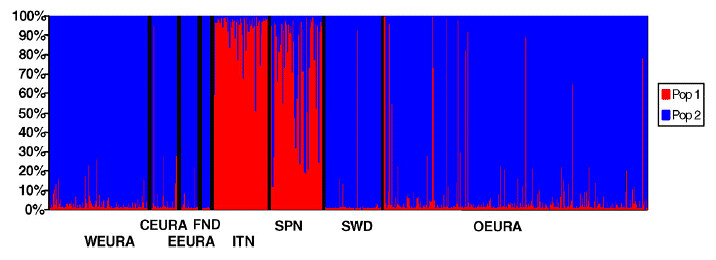
FIGURE 1 Analysis of Population Structure in Participants of European Ancestry"Analysis was performed without any prior population assignment using STRUCTURE. The European ancestry groups, western European American (WEURA), central European American (CEURA), eastern European American (EEURA), Finland (FND), Italy (ITN), Spain (SPN), Sweden (SWD), and other European American (OEURA) are indicated by color code. The latter group consisted of individuals with mixed European ancestry from several regions and additional smaller groups (see Methods)....In (D), the proportion of each cluster (ordinate) is shown for each individual."

As we see above, each little line represents 1 Italian. As we can see, the Italians are scorching red here, even the Northern Italians; it looks like 1 (possibly although not certainly Northern) Italian is half blue.
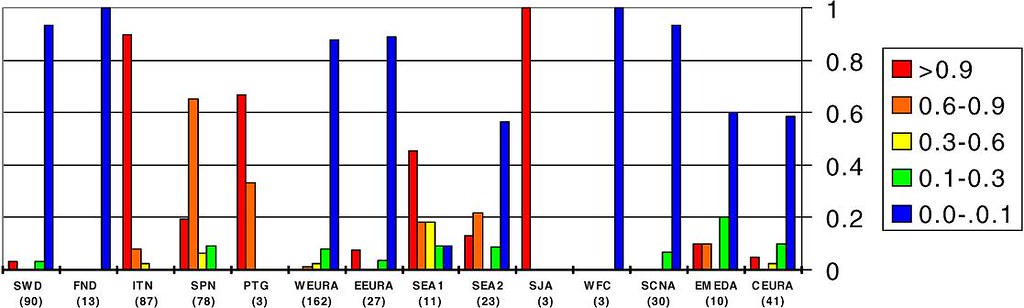

FIGURE 2 - Distribution of “Southern” Population Components among Participants with Various Self-Identified Ethnic or Regional European Origins
"For each self-identified group, the fraction of individual participants in each group with the color-coded frequency “southern” contribution is shown. For southern European American I (SEA1), only southern European grandparents were identified. For southern European American II (SEA2), grandparents were self-reported as being of both southern European decent and western, central, or eastern European decent. For the eastern Mediterranean American (EMEDA) group, four of ten were of mixed-European decent with one or more grandparents of western, central, or eastern European decent.

CEURA, central European American; EEURA, eastern European American; FND, Finland; ITN, Italy; PTG, Portugal; SCNA, Scandinavian; SJA, Sephardic Jewish American; SPN, Spain; SWD, Sweden; WEURA, western European American; WFC, White French Canadian."
 
As we can see above, the Italians (38 of 87 of whom are Northern Italians) are scorching red (90%+ 'Southern'), only a minority are orange (60-90% 'southern'), while none are entirely or predominately in the blue (Northern) cluster. There are more Swedes (1 outlier) who are in predominately 'Southern' cluster than Italians who are predominantly in the 'Northern' cluster.

So yes, virtually every Northern Italian clustered predominantly in the 'Southern' cluster, while only 10 of 32 Northern Italians showed less than a 90% contribution to the 'Southern' cluster (compared to 23 of 43 from Northern Spain, and 5 of 19 from Southern Spain), and only 2 of 28 participants from Southern Italy had less than a 90% contribution to the 'Southern' cluster. The remaining Italians were between 60% and 90% in the Southern cluster. Northern Italians are overwelmingly 'Southern' in biological affinity when speaking in a European wide context; Southern Italians more-so, but Spaniards slightly less. 

SOURCE : Seldin MF, Shigeta R, Villoslada P, Selmi C, Tuomilehto J, et al. (2006) European Population Substructure: Clustering of Northern and Southern Populations. PLoS Genet 2(9): e143. doi:10.1371/journal.pgen.0020143


Refinement of ancestry informative markers in Europeans. Tian et al (2009).
"The definition of European population genetic substructure and its application to understanding complex phenotypes is becoming increasingly important. In the current study using over 4,000 subjects genotyped for 300,000 single-nucleotide polymorphisms (SNPs), we provide further insight into relationships among European population groups and identify sets of SNP ancestry informative markers (AIMs) for application in genetic studies. In general, the graphical description of these principal components analyses (PCA) of diverse European subjects showed a strong correspondence to the geographical relationships of specific countries or regions of origin. Clearer separation of different ethnic and regional populations was observed when northern and southern European groups were considered separately and the PCA results were influenced by the inclusion or exclusion of different self-identified population groups including Ashkenazi Jewish, Sardinian, and Orcadian ethnic groups. SNP AIM sets were identified that could distinguish the regional and ethnic population groups. Moreover, the studies demonstrated that most allele frequency differences between different European groups could be controlled effectively in analyses using these AIM sets. The European substructure AIMs should be widely applicable to ongoing studies to confirm and delineate specific disease susceptibility candidate regions without the necessity of performing additional genome-wide SNP studies in additional subject sets."
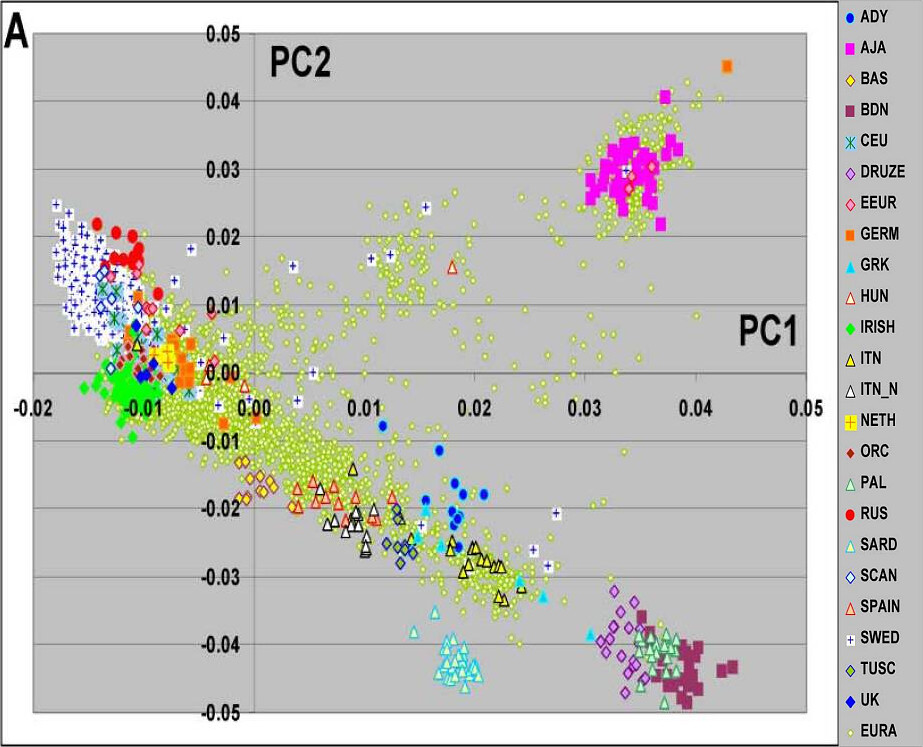
"Figure 1. Principal component analyses of substructure in a diverse set of subjects of European descent. Graphic representation of the first two PCs based on analysis with >250K SNPs are shown. Color code shows subgroup of subjects for each population group.
The subjects included Adygei (ADY, 12 subjects), Ashkenazi Jewish American (AJA, 40 subjects), Basque (BAS, 12 subjects), Bedouin (BDN, 23 subjects), CEPH European American (CEU, 48), Druze (20 subjects), Eastern European American (EEUR, 11 subjects), German American (GERM, 17 subjects), Greek American (GRK, 7), Hungarian American (HUN, 4 ), IRISH (84 subjects), Italian American (ITN, 20 subjects), northern Italian (ITN_N, 13 subjects), Dutch American (NETH, 3 subjects), Orcadian (ORC, 14 subjects), Palestinian (PAL, 22 subjects), Russian (RUS, 13 subjects), Sardinian (SARD, 28 subjects), Scandinavian American (SCAN, 6 subjects ), Spanish (SPAIN, 12 subjects), Swedish (SWED, 591 subjects), Tuscany (TUSC, 8 subjects), and United Kingdom American (UK, 5 subjects). Each of the specific country or ethnic color coded origins had consistent 4 grandparent origin information. The total number of individuals in this analysis was 4446. In panel A European Americans (EURA) without 4 grandparental information are shown (contains both NYCP and CHOP). Panels B and C illustrate the distribution of the EURA from NYCP (1873 subjects) and CHOP (1488 subjects), respectively."


As we can see by PCA analysis, Tuscans (TUSC) and Northern Italians (ITL N) group well within the Southern European cluster, far away from the Northern/Central/East European cluster. Italian Americans (ITN) with 4 Italian grandparents of Southern Italian/Sicilian origin overlap with the Greeks, while Northern Italians (ITL N) seem to be smack dab in the middle of the Southern European cluster, between Spaniards and Tuscans. Tuscans also pull even further south than the Northern Italians, between Southern Italians/Greeks and Northern Italians.

The lack of important European groups like the French and Swiss does seem to make the gap between Southern Europe and Northern/Central/Eastern Europe very large and not just gradual or clinal, but if those two populations were to be included the gap from Southern Europe to Central Europe would appear less significant with the alps showing a large (but not massive) barrier. Anyway, this study also irrefutably proves the Southern European biological affinities of Northern Italians and that is what is important.

Also, here is an interesting Fst genetic distance table from the study, although it unfortunately doesn't include Northern Italians it does include Tuscans (ie where the Renaissance first sprung up).
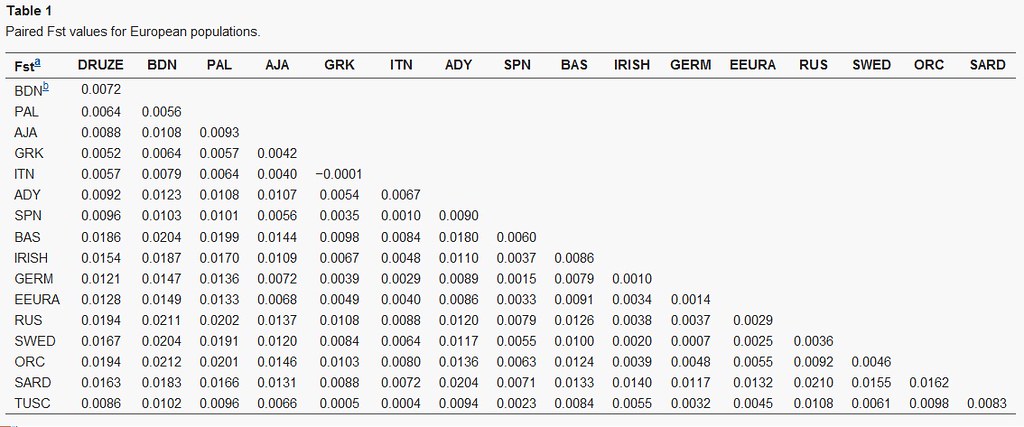


The results as seen in Table 1.


Tuscany to Southern Italy - 0.0004
Tuscany to Greece - 0.0005
Tuscany to Germany - 0.0032
Tuscany to Ireland - 0.0055
Tuscany to Sweden - 0.0061
Tuscany to Russia - 0.0108


SOURCE : Tian et al. (2009). European Population Genetic Substructure: Further Definition of Ancestry Informative Markers for Distinguishing Among Diverse European Ethnic Groups. Mol Med; doi: 10.2119

Link PDF


Genetic Structure of Europeans: A View from the North–East. Nelis et al (2009).
"Using principal component (PC) analysis, we studied the genetic constitution of 3,112 individuals from Europe as portrayed by more than 270,000 single nucleotide polymorphisms (SNPs) genotyped with the Illumina Infinium platform. In cohorts where the sample size was >100, one hundred randomly chosen samples were used for analysis to minimize the sample size effect, resulting in a total of 1,564 samples. This analysis revealed that the genetic structure of the European population correlates closely with geography. The first two PCs highlight the genetic diversity corresponding to the northwest to southeast gradient and position the populations according to their approximate geographic origin. The resulting genetic map forms a triangular structure with a) Finland, b) the Baltic region, Poland and Western Russia, and c) Italy as its vertexes, and with d) Central- and Western Europe in its centre. Inter- and intra- population genetic differences were quantified by the inflation factor lambda (λ) (ranging from 1.00 to 4.21), fixation index (Fst) (ranging from 0.000 to 0.023), and by the number of markers exhibiting significant allele frequency differences in pair-wise population comparisons. The estimated lambda was used to assess the real diminishing impact to association statistics when two distinct populations are merged directly in an analysis. When the PC analysis was confined to the 1,019 Estonian individuals (0.1% of the Estonian population), a fine structure emerged that correlated with the geography of individual counties. With at least two cohorts available from several countries, genetic substructures were investigated in Czech, Finnish, German, Estonian and Italian populations. Together with previously published data, our results allow the creation of a comprehensive European genetic map that will greatly facilitate inter-population genetic studies including genome wide association studies (GWAS)."
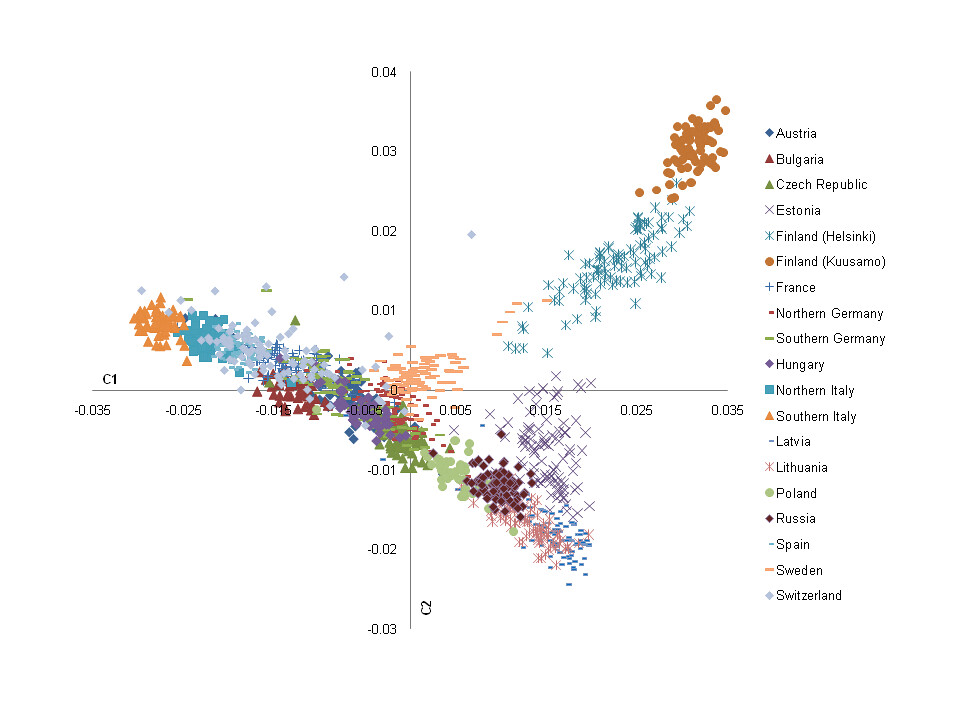
Yet again, as we can see by PCA analysis, Northern Italians blend perfectly in the Southern European area, and are the second most "southerly" population sampled here after the Southern Italians. Northern Italians pull further south than Spaniards from Madrid, and while they seem to be a little closer to the Spanish and some Swiss (who are partly Italian) than to Southern Italians, they are equidistant between Southern Italians and the French, and they're much closer to the Southern Italians than to Southern Germans. The Northern Italians also surprisingly pull quite a bit further to the south end of Europe than Bulgarians do, which might mean Bulgarians have substantial medieval Slavic admixture (Bulgarians are southern Slavs after all) which would have brought more "northerly" gene-flow into Bulgaria; there's no telling really regarding them. 

One more thing of note, unlike the other previous two studies, in this study the samples that represented Northern and Southern Italy only came from 2 different locations; here are the sample set locations as representative of "Northern Italy" and "Southern Italy".
Northern Italy:
"The Northern Italian samples have been randomly collected from the Borbera Valley. The Borbera Valley is located in Northern Italy, namely the northern part of the Apennines mountains, between Liguria and Piedmont, about 80 km south of Milan. For the current analysis, 96 individuals were selected from the database where all the samples have complete phenotypic data."

Southern Italy:
"The Italian samples were randomly chosen from those enrolled in a population study named Carlantino Project, which is focused on inhabitants arising from an isolated village at the border between Central and Southern Italy (Province of Foggia, Region of Apulia with 1200 inhabitants)."

Also, it is important to note that while genetic distance is often heavily correlated to geographical distance, genetic barriers can be created by substantial geographical barriers which limit gene flow and cause breeding isolation. In Europe the Alps represent such a genetic barrier and it is not surprising that this study confirms that.
"Barrier analysis revealed genetic barriers between Finland, Italy and other countries, as has been described before [12]. Interestingly, barriers could be demonstrated within Finland (between Helsinki and Kuusamo) and Italy (between northern and southern part). Another barrier emerged between the Eastern Baltic region and Sweden, but not between the Eastern Baltic region and Poland (Figure S4). The barrier between Bulgaria and Western Russia, Poland and Lithuania may have arisen due to the fact that several populations are missing in between those countries"
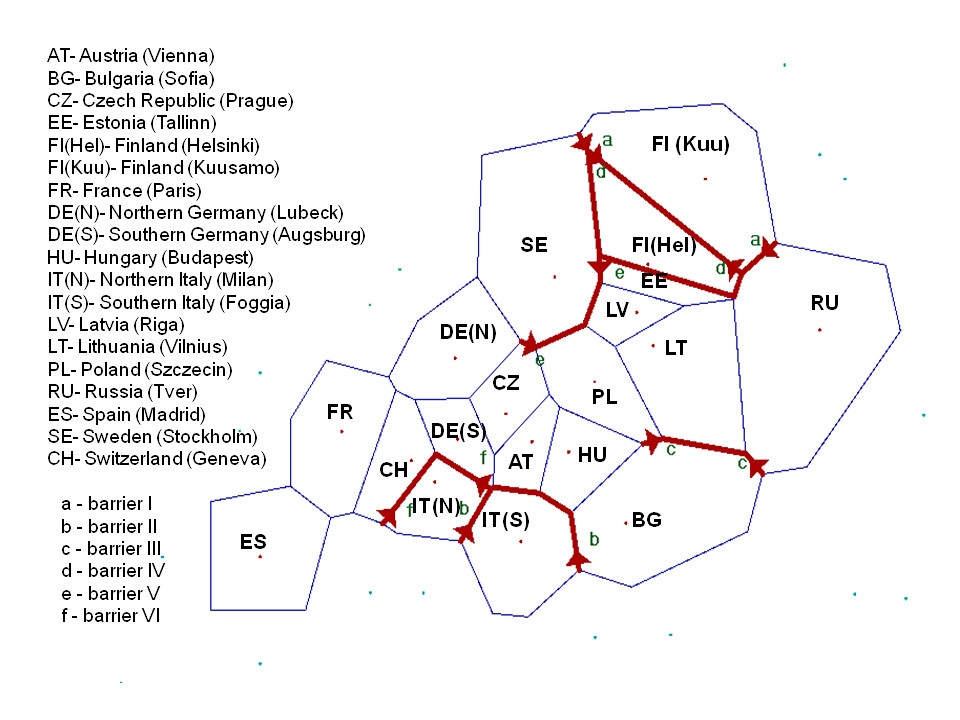
As stated above there is a noticeable difference between Northern and Southern Italians, according to PC analysis the medians of North and South Germans seem to be roughly 0.005 apart, while those of North and South Italians seem to be 0.005 apart. So no big difference among the ethnic stratification between the two countries. The biological difference between Northern and Southern Italians though rather noticeable, does seem to have been somewhat exaggerated by laymen 'racialists' of past and present.
"Interestingly, PC analysis was also capable of highlighting intra-population differences, such as between the two Finnish and the two Italian samples, respectively. A low level of intra-population differentiation in Germany has been reported previously, and was confirmed here. In addition, we detected intra-population differences within the Czech and Estonian samples."

SOURCE : Nelis M, Esko T, Mägi R, Zimprich F, Zimprich A, et al. (2009) Genetic Structure of Europeans: A View from the North–East. PLoS ONE 4(5): e5472. doi:10.1371/journal.pone.0005472


Also, other than the Greeks in Southern Italy, historical admixture seems to be quite minimal in Italians.
"An analysis of the genetic makeup of Italy's modern population argues that the various distinctive genetic combinations currently found in different regions within the peninsula by and large track the linguistic distribution that resulted from the migrations of the Iron Age. No data indicate the subsequent large-scale infusion of new genetic material into the populations of these regions except in the case of southern Italy and eastern Sicily, which is explained by the well-documented Greek migrations there."
SOURCE : Rosenstein, Nathan. Rome at War: Farms, Families, and Death in the Middle Republic. Chapel Hill: University of North Carolina Press, 2004.

Link 

 
The genetic article which that book used as a source for that statement is Piazza's "A Genetic History of Italy", and although unfortunately I don't have access to the entire study, the abstract is available online. It's conclusions are clear that the biological stratification seen in today's Italy is reflective of pre Roman times.

"Statistical techniques for displaying the geographical distribution of many genes in few synthetic images have been used to represent the various patterns of gene frequencies in Europe and in the world (Menozzi et al. 1978; Piazza et al. 1981a). It has also been shown that such synthetic displays are particularly useful in detecting clines of genetic differentiation associated with movements of populations like those accompanying the Neolithic expansion of farmers from the Near East or, in more recent times, the putative diffusion of Indo-European-speaking populations (Ammerman & Cavalli-Sforza, 1984; Gimbutas, 1973).

In this paper we use the same combination of statistical and graphical techniques to study the genetic structure of Italy, a European country whose unity of people and cultures was quite a recent event. The possibility of studying genetic differentiation in a small geographical area is tested and trends of genetic differences are tentatively interpreted in terms of historic and linguistic knowledge. The few demographic pieces of information taken from historical sources and compared with linguistic records support the hypothesis that the genetic structure of Italy still reflects the ethnic stratification of pre-Roman times."
SOURCE : Piazza, A., N. Cappello, E. Olivetti, and S. Rendine. 1988. A genetic history of Italy. Ann. Hum. Genet. 52:203-213.

Link


(EDIT 2015) Admixture ratios in modern populations based on prehistoric genomes

All populations in Europe can be modeled as being a mixture of 3 major and distinct ancestral strains from prehistoric migrations. These are 

1. Paleolithic West European Hunter Gatherers

2. Early European Farmers of the Neolithic revolution who had most their genetic origin in Mesolithic and Neolithic Anatolia and brought the earliest agricultural practices to Europe.

3. Early Bronze age Yamnaya steppe pastoralists from the Pontic-Caspian steppe, who's ancestors were the first to domesticate the horse. They were also one of the first groups on Earth who knew of and used wheeled vehicles. The Yamnaya steppe pastoralists are believed by most linguists to have been the speakers of the late stage proto Indo-European language (see Kurgan hypothesis). 


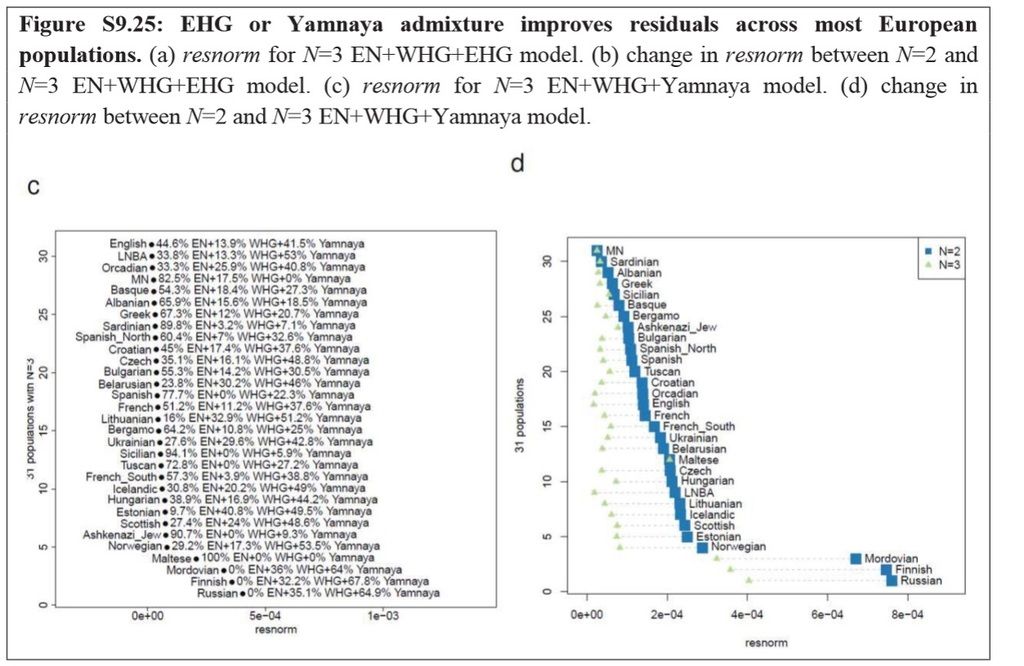
As we can see in Figure 3 below, all Europeans can basically be modeled as a composite of the same 3 ancestral mixtures, it's just that the ratios are different. We can also see that that the biggest differences in Europe are between the North of Europe, and the South of Europe. As we can see in their admixture ratios, the Northern Italians (here represented by a sample set from Bergamo Lombardy) are unsurprisingly most similar to other Southern Europeans (ie Northern Spanish, Greeks, Albanians, Bulgarians, etc) in their admixture ratios, and that is being of heavy Early Neolithic Farmer ancestry. Tuscans as anyone can see also come out very heavily Neolithic.


SOURCE : Haak, et al. (2015). "Massive migration from the steppe was a source for Indo-European languages in Europe". Nature. doi:10.1038/nature14317.edit

Link


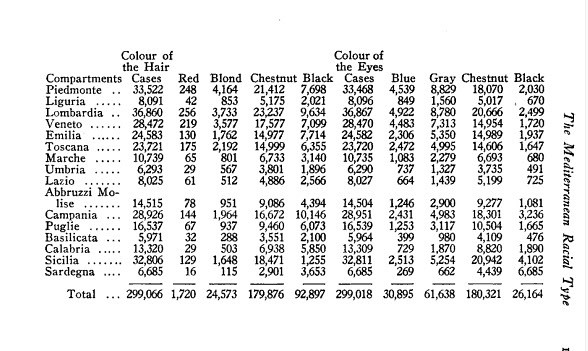
And lastly, for the most part irrelevant, I found some old hair and eye pigmentation data from Livi on Italian conscripts. Interesting stuff but for the most it's not that important.

SOURCE : Antropometria Militare. Ridolfo Livi. Two volumes, 4°, with atlas. Rome: Preso il Giornale Medico del Regio E Sercito, 1896, 1905..


Summary and conclusions
 
1. Northern and Central Italians are biologically SOUTHERN European...broadly speaking. In so far that they share their overall closest genetic relationships with other Southern Europeans, and that they are more distinct from Northern European groups than the Spanish.

2. Northern-Central Italians may be a bit closer to North/Central/East Europeans than Southern Italians are (just as Southern Germans are a bit closer to Southern Europeans than Northern Germans are), but Northern-Central Italians still biologically pull to Southern Europe quite strongly as seen that they ALWAYS pull further south than Spaniards, and also one study showed them a bit below Balkan Southern Slavs like Bulgarians. They also always structure with Southern Europeans in European exclusive STRUCTURE analysis studies. And their admixture ratios based on actual ancient genomes using formal admixture modeling is much more similar to the ratios present in other Southern Europeans than in Northern Europeans.

3. Slight Germanic admixture is possible for all Italian populations, not just the Northern Italians. I would venture that actual Germanic ancestry is larger in Northern Italy and that the Lombards in Northern Italy had a bigger impact than the Goths or Normans in Southern Italy. However one thing is for certain, and that is that large scale Germanic admixture in any Italian groups is certainly not the case and easily refuted by the data. Anything beyond that is total conjecture at this point.

4. There is a noticeable difference between the Northern Italians and Southern Italians, and I don't want people to think that Northern Italians cannot be argued to be a genetically distinct. Also, the genetic distance between Northern and Southern Italians, although pretty large from a single European 'nationality' point of view, is only roughly equal [marginally greater] to that of the genetic distance between Northern Germans and Southern Germans.