Saturday, March 30, 2013

Roger Pearson's "The Greek Face" completely debunked.

Roger Pearson is a neo-Nordicist writer and co founder of two peer reviewed academic journals known as Mankind Quarterly and The Journal of Indo-European Studies. I for one do not consider those journals to be necessarily bad, even though both (and in particular Mankind Quarterly) have come under heavy attack by the more politically correct mainstream. Pearson himself is a known eugenicist and racialist; however he has not contributed to or edited either of those journals in decades, and both journals have featured plenty of accredited and prestigious anthropologists and linguists such as J.P. Mallory. 

      However, I do have a particular problem with an article by Pearson titled The Greek Face made back from 1974 which I continue to see surface and referenced on the web from time to time. Unlike Pearson's early delves into racial history where he simply re-tells (literally word for word) old Hans F.K. Guenther fantasies, this article attempts to reference the actual scientific work of other well respected anthropologists and scientists who have studied the question hands on. The article made by Pearson concerns the racial affiliation of ancient and aristocratic class Greeks, and he focuses primarily on the Eupatridaes of ancient Athens. The problem with the article is Pearson completely distorts and outright lies about the sources he attempts to use to support his Nordicist premise.

Pearson's premise can be basically outlined as follows.

1. The Proto Indo-European speakers lived in the North Pontic Steppe region, and thus Indo-Europeanization of Greece happened during the Bronze age.

2. The populations who Indo-Europeanized Greece had full genetic continuity with the Proto Indo-European speakers.

3. The Eupatridaes of classical Athens had full genetic continuity from the populations who Indo-Europeanized Greece, while the commoners of Athens and Greece in general were not descended from them at all or very little. Thus there was a racial caste system in classical Athens amongst the Athenians themselves.

     I'll start right off by saying premise 1 which was originally put forth by archeologist Marija Gimbutas is still very much up for debate. Regarding premise 1, I certainly wont delve into that question in this blog entry since I nor really anyone else at the moment has any hope in either outright refuting it or outright proving it. Also, since the anthropologists Pearson attempts to use as sources [in Particular J. Lawrence Angel] followed that model of PIE homeland and timescale breakdown, I'll just comply with it for the sake of making a long story short. But lets deal in particular with premises 2 and 3 since they deal with biological and not linguistic matters. Let's firstly deal with Premise 2.

Pearson writes
    "Several attempts have been made to discuss the physical anthropology of Greece from the point of view ol the available skeletal evidence. Some early references were made by pioneers such as Ripley (1899), Schuchhardt (1926), and J.L. Myres (1930). More recently Coon (1954) and Angel (1944, 1945, 1946 [a] [b]) have added considerable information. In his most recent work on the subject, a detailed analysis of the numerous skeletal remains found in different cemeteries in the excavations at Lerna, Angel (1971) concludes that the immigrant Hellenic or Indo-European population reflected a 'Nordic' type which probably arrived from the Danubian area, and also a related 'Iranic' type. This latter appears to reflect a separate Indo-European invasion from the direction of Anatolia, although Angel assumes that both these related types originated ultimately from the area of the Pontic steppes."

Now this is what I call a blatant distortion. Angel believed that the Indo-Europeanizers of Greece were partially descended from North Pontic Steppes populations. However, Angel also said that they had morphological overlap and genetic heritage from "Balkan mountain peoples" and Near Eastern "Iranians"!

The real quote from Angel (1971)
    "My subjective and extremely speculative survey suggests that origins of the population were mostly local, derived from the Neolithic and later pre-Greek populations, with the Near East and Upper Paleolithic Central and Eastern Europe as ultimate sources. But altogether too sketchy data for the period before 2,000 B.C. Plus an analysis of the Middle Bronze Age do suggest a double intrusion of peoples who must have introduced Indo-European languages : from the east (originating in Iran and the steppe country) and from the north (also originating in the steppe country and from among Balkan mountain peoples)."

So according to Angel the North Pontic Steppes was not the only genetic source for the earliest Greek speakers, but also the Near East and the Balkans.

Another thing, in Angel's taxa system they were not morphologically "Nordic" as Pearson's lies claim they were. They were a morphological mix of Nordic-Iranian, Eastern Alpine, European Alpine, and Dinaroid. As the very next sentence from Angel states.
    "They seem to have been themselves mixed and newly forming groups, and they produced slight trends in Nordic-Iranian plus Eastern and European Alpine and Dinaroid directions."

If I order a pizza with "extra cheese, pepperoni, and mushrooms" and when the pizza man gives me my pizza there is only extra cheese on it, did they get my order wrong? Yes, they did get my order wrong. So Pearson is simply reporting fraudulent information. Either that or he's grossly incompetent.

Pearson also lies and makes silly and unfounded "racial purity" claims about the early Indo-European Greek speakers when he says this.
    "In the course of some five or six millennia of expansion and conquest, an expanding IE upper caste may undoubtedly have preserved a high degree of genetic continuity, while simply superimposing itself upon the autochthonous populations."

How can he make such a claim when that was proven wrong by his own scientific source? Maybe I need to paste the the quote from Angel again.
    "They seem to have been themselves mixed and newly forming groups, and they produced slight trends in Nordic-Iranian plus Eastern and European Alpine and Dinaroid directions."

Key words : "mixed" and "newly forming". So the earliest Greeks certainly weren't undiluted remnants of the alleged Proto Indo-European Steppe populations, they only had partial ancestry from them. The point is the earliest Greeks didn't just develop their own unique culture and dialectical language from the Proto Indo-European culture and language (which would have preceded them by thousands of years) they had formed their own new and distinct genetic identity as well, and were sitting on a land pretty distant from the North Pontic Steppe. These early Bronze age Greeks then in turn mixed with and Hellenized the remainder of Greece soon forming Mycenaean and much later Classical Greek culture and genetic identities.

SOURCE for Angel's analysis (same sourced used by Pearson) : Angel, J. Lawrence, 1971, The people of Lerna; analysis of a prehistoric Aegean population (page 111), American School of Classical Studies, Athens.

LINK


Now as far as Premise 3 is concerned, Pearson states that the Eurapatrids in classical Athens would have been a racially distinct caste compared to the commoners based on supposed "Indo-European derived ancestry" (whatever that means) as compared to non Indo-European derived ancestry for the commoners.
    "From the point of view of physical anthropology the ethnic complexity of Greek society during the first millennium B.C. prohibits any attempt at a generalized statement of physical type based upon statistical averages of data derived from the available skeletal material. Substantial caste-like stratification, accompanied by relatively strict principles of caste endogamy separated the Indo-European-derived Eupatrids from the freemen and slave classes among whom the genetic influence of the autochthonous 'Pelasgian' population may have predominated. In addition the persistence of cremation among so very many of the aristocratic families from the time of Homer to well into the Classical period destroyed much of the physical evidence concerning this latter strata."

Firstly Pearson is somewhat misguided in saying that the freemen and slave classes in classical Athens would have descended from an autochthonous 'Pelasgian' [ie pre Greek] genetic strata. As Angel (1944) himself points out
"The Mycenaean blend seems to be fundamental in all later Greek populations down to the present day. Its formation was principally absorption of Middle Bronze Age intrusive strains by the pre-Greek racial substratum."
 
SOURCE : Angel, J. Lawrence, 1944, A racial analysis of the ancient Greeks: An essay on the use of morphological types, American Journal of Physical Anthropology

LINK 


Angel deduced based on skeletal analysis that the Mycenaean racial blend was a mixture and synthesis of a pre Greek [ie Neolithic and often called 'Pelasgian'] and intrusive Bronze age genetic strains (from the North and East) which brought Indo-European speech to Greece. Not only that, but the Mycenaean racial blend was still the fundamental blend of the later classical Greek population whom Pearson is talking about. It's important to note that Angel's skeletal analysis here is not on aristocratic Greeks, so the commoners in classical Athens would have been a mixture of the two genetic elements, and so would have not descended only from the Neolithic pre Greek genetic strata. Weird how Pearson sources this same study from Angel but he seems to ignore that, maybe because it doesn't fit his race fantasies? Ehh, who knows.


Pearson is correct in pointing out that by the time of Classical Greece the Athenian aristocrats practiced cremation (strangely, this is very different than the "Kurgan mound" burial method of the alleged Proto Indo-European Steppe populations practiced) and that any known physical remains of them are scanty. However, even John V. Day is forced to admit that nearly a thousand years earlier in Mycenaean times that the Greek aristocrats were racially similar to the commoners. Unlike the Classic era Athenians, The Mycenaean Greek aristocrats didn't practice cremation, they buried their dead in Shaft Graves. Not only does John V. Day give a summary of Angel's analysis of them (who hypothesized based on the data he had they were racially similar to the commoners), he also sources a more modern multidimensional cranio-metric analysis of the Mycenaean aristocrats as compared to the commoners of the Bronze Age.
     "On balance though, he attributes their size to a diet with plenty of meat and (as their teeth show) to good health, and to upwardly mobile rulers usually being larger and stronger than average (Angel 1973:386-7, 393;ef Xirotiris 1979a: 78; 1979b: 166). Angel concludes that 'except for their greater size and muscularity they differ from their subjects only in having relatively lower heads, probably relatively longer heads, and perhaps longer noses and more projecting mouths'  (1973:393). Others have tested Angel's hypothesis that the nobles in Grave Circle B resemble their subjects. Musgave and Evans carry out a principal component analysis on the Mycenae Grave Circle B series and 15 other eastern Mediterranean series [firgure 2.2]. Because Grave Circle B clusters so well with the two Early and Middle Bronze Age Greek series. Musgrave and Evans argue that 'these Bronze Age Greeks from Attica and the Argolid belonged to a single, homogeneous population.'"
Musgrave, J.H., Evans S.P., 1981, By strangers honor’d: a statistical study of ancient crania from Crete, mainland Greece, Cyprus, Israel and Egypt, Journal of Mediterranean Anthropology and Archaeology, 1(1), pp. 50-107

SOURCE : Day, J.V., 2000, Indo-European Origins: the Anthropological Evidence (page 198), Institute for the Study of Man, Washington D.C.

LINK

So, how can Classical era Ancient Athenian aristocrats descend from a distinct racial caste which genetically derive from the (supposed) Proto Indo-European steppe groups when we know

A. The Indo-Europeanization of Greece dates back at latest to the beginning of the second millennium B.C. [ie around 2,000 B.C. at latest].

B. J. Lawrence Angel who followed Majira Gimbutas' theory of the PIE homeland and timescale breakdown already believed the earliest Indo-European speakers in Greece were genetically descended in partial from not just Steppe groups but also Balkan mountain people and Near Easterners. Thus the earliest Indo-Europeans around the Aegean did not have complete genetic continuity from the alleged Proto Indo-Europeans of the North Pontic Steppe, only partial. The Proto Greeks were genetically "mixed" and "Newly formed" and were morphologically diverse.

C. The Mycenaean Greek racial blend itself didn't have complete genetic continuity with the earliest Greeks / Indo-Europeans around the Aegean, only partial. It predominated in all later Greeks and itself was just a synthesis of Proto Greek / Indo-European Bronze age intrusive strains with a Neolithic [pre Greek/'Pelasgian'] genetic substratum.   

D. The earliest Greek elites known are buried in the Mycenaean Royal Graves [Middle Bronze Age 1,600 BC] and are proven to cranio-metrically tie to the commoners of the Early and Middle Bronze Age.

E. Classical Athens post dates Mycenaean times by nearly a thousand years.

As we can see, Pearson is just a non objective, non empirical, pseudo scientific, dishonest and distorting ideologue. I think discrediting him by just shouting "Nordicist" or "Neo Nazi" is weak, but the proof is in the pudding that anything he says on the racial history of any ancient people is to be taken with vigilant skepticism.

Enough of the science, my two cents

     There exists 0 evidence that the upper classes in ancient Greece differed in race from the commoners, certainly none in classical Athens. The remainder of his article he just posts pictures of busts of Athenian aristocrats as compared to people who were not of aristocratic birth. The funny thing is, other than Socrates, Archilochus, and Menander... none of the people whom he considers "non Indo-European" and "racially distinct" from the Athenian aristocrats are even Greeks! A Phoenician named Zeno, an Ethiopian named Memnon, a Cilician named Chrysippus, some crappy picture of some Anatolian slave named Aesop. And in my opinion Archilochus and Menande look fine among the Athenian aristocrats, they could fit right in. Menande would just have to grow some facial hair. Only Socrates who's physical ugliness was well documented looked strange. Generally upper classes of any people are finer featured and better looking than the average population. Socrates was homely, so what? I don't see the "racial caste system" Pearson is conjuring up.

     Now, looking elsewhere the ancient Spartans did eventually turn themselves into a master caste in the Peloponessus after they had conquered the Messenians in the Messenian Wars, enslaving the bulk of Messenians turning them into Helots. But this didn't happen until about the 8th century B.C. Also these differences would have probably been more 'ethnic' as the Spartans descended from Doric Greeks who had first entered the Peloponnese during the Greek dark ages, while the Messenians were of earlier pre Doric Greek stock. I doubt there was much bigger racial difference between those two groups than there was between the Latini descended Romans and the Samnites in Italy who waged wars against one another. 


(EDIT 2017) Mycenaean Genomes

A recent full genome wide study using ancient DNA on the origins of the Mycenaeans has confirmed what Larry Angel and Musgrave & Evans stated decades ago.
"The Minoans could be modelled as a mixture of the Anatolia Neolithic-related substratum with additional ‘eastern’ ancestry, but the other two groups had additional ancestry: the Mycenaeans had approximately 4–16% ancestry from a ‘northern’ ultimate source related to the hunter–gatherers of eastern Europe and Siberia (Table 1), while the Bronze Age southwestern Anatolians may have had ~ 6% ancestry related to Neolithic Levantine populations. The elite Mycenaean individual from the ‘royal’ tomb at Peristeria in the western Peloponnese did not differ genetically from the other three Mycenaean individuals buried in common graves."

Also, it appears as if Angel's inferences of migration were broadly correct, and that the Aegean did see an influx from people from the North and East during the Early Bronze Age. 
"To identify more proximate sources ofthe distinctive eastern European/north Eurasian-related ancestry in Mycenaeans, we included later populations as candidate sources, and could model Mycenaeans as a mixture of the Anatolian Neolithic and Chalcolithic-to-Bronze Age populations from Armenia. Populations from Armenia possessed some ancestry related to eastern European hunter–gatherers so they, or similar unsampled populations of western Asia, could have contributed it to populations of the Aegean. This model makes geographical sense, since a population movement from the vicinity of Armenia could have admixed with Anatolian Neolithic-related farmers on either side of the Aegean. However, Mycenaeans can also be modelled as a mixture of Minoans and Bronze Age steppe populations, suggesting that, alternatively, ‘eastern’ ancestry arrived in both Crete and mainland Greece, followed by about 13–18% admixture with a ‘northern’ steppe population in mainland Greece only. Such a scenario is also plausible: first, it provides a genetic correlate for the distribution of shared toponyms in Crete, mainland Greece, and Anatolia discovered second, it postulates a single migration from the east; third, it proposes some gene flow from geographically contiguous areas to the northwhere steppe ancestry was present since at least the mid-third millennium."

So the average Mycenaean carried a small but definitely noticeable 13-18% Steppe ancestral component that entered mainland Greece during the Early Bronze Age. However, this ancestry was present at the same rate in the elite sample as it was in the 3 commoner samples. It wasn't present at close to 100% in the elites and totally lacking in the commoners as Pearson's wild fantasies would have us believe. The bulk of both aristocrat and commoner ancestry (>75%) goes back to Early Aegean-Anatolian Neolithic farmers. 

The idea that Athenian aristocrats nearly a millennium later somehow had this discrepancy in ancestral components seems to be near impossible. In short, Pearson's racialist conjectures about ancient Greece have yet to display any empirical or scientific credence about the past. 


SOURCE : Lazaridis, I., Mittnik, A., Patterson, N., Mallick, S., Rohland, N., Pfrengle, S., ... & McGeorge, P. J. P. (2017). Genetic origins of the Minoans and Mycenaeans. Nature, 548(7666), 214

LINK

Monday, March 4, 2013

J. Lawrence Angel on the Racial History of Greeks.

More like typological history (or a chronology of morphological change), a now abandoned science. But I did find what he had to say somewhat interesting. 

     "No type frequency predictions have been worked out for the small
series of living Greeks from around the isthmian region, since estimated skull measurements like those of the next to last column of table 8 can never be certain, although they allow comparison. The average is a well-filled and fairly high-headed brachycephaly, with high and broad forehead and nonprotuberant occiput. The face is broad and not excessively high, somewhat square in outline, and marked by broad jowls, strong chin and cheekbones, long, thick, and straight (-convex) nose, and poor teeth with a developed overbite. Alpine dominance is linked with a pervasive though limited Dinaric trend and contrasts with a strong Basic White minority. Gracile Mediterraneans are common, and Nordic-Iranians not absent though rarer than in north Greece. The modern Greek series resembles the Roman more than the Byzantine sample and continues Roman period trends away from the Classical period norm. This shows the racial continuity between ancient and modern Greeks, though the modern sample differs considerably from ancient Greeks taken as a whole.
     Next to their heterogeneity, this unbroken racial continuity of the Greeks is the most important conclusion from the outline of their racial history. Continuity does not mean stasis. And several long-term trends are perceptible in tables 6, 7. 8 and 9 in addition to the period by period racial fluctuations.
     The major racial trend is a gradual shift from a virtually longheaded, “Mediterranean” mode toward an Alpine norm, with incipient Dinaric features subtly added 26 as suggested in figure 13. Inclusion of Alpines with southeastern as well as with northern immigrations into Greece may well be one reason for this trend, which derives inextricably from alternation of two contrasting racial complexes. One is a dolichomorph and mainly Mediterranean blend, generally unified, and characteristic of periods of cultural unity such as the Mycenaean and Classical, with weaker effect in the Early Bronze Age. The other is marked by Alpines either mixed with or next to Nordic-Iranians, heterogeneous, and occurring in phases of invasions and confusion such as the Middle Bronze Age, Early Iron Age, and Roman period. The Byzantine sample These fluctuations have been linked with sea-borne immigrations from south and southeast and with invasions from north, northeast, or east respectively, and with the absorption of such intruders by the established population of Greece. This forms a regular cycle of racial change so timed that the fluctuations describe an irregularly spiral patharound the central racial trend.
     Two less sweeping trends are interesting because the type predictions in table 7 show them incompletely or not at all, and they are therefore emphasized by their departure from prediction. The first of these is a steady increase in nose size from Middle Bronze down to Roman times, and then down to the present day. Roman period nose height significantly exceeds Middle Bronze or Mycenaean values, and nose breadth almost does so. This is shown weakly in the predictions from Mycenaean times onward, and must be some sort of Dinaric-Iranian genetic recombination. 
     The second trend is a rather sharp rise in bigonial breadth starting
earlier than the slight Alpine increase in other face breadths and continuing less markedly down to modern times. This shows a steady departure from predicted values. It springs apparently from Nordic-
Iranian and Basic White recombination of linked genes, with secondary
association with Alpine features.
 
     The major non-racial trend is a general increase in stature, especially from prehistoric into historic times, utterly unpredicted by morphological type changes, and supported by a less clearcut increase in head size, involving horizontal circumference and skull base length especially, up to Roman times, with a definite drop in the Byzantine period. Byzantine stature may be overestimated. And it is virtually certain that this size increase is environmentally caused by a steady improvement in diet and hygiene from prehistoric to Classical and Roman times, followed by a medieval lapse.
     The dentition of ancient Greeks shows many interesting chronological fluctuations, with one major trend worth stressing. This is a morphological complex involving more overbites, slightly deeper
glenoid fossae, probably more crowded teeth and more alveolar absorption, degeneration of the third molar, and shallower and slightly
more prominent chins. It develops from prehistoric to historic times,
reaching full bloom in the Roman period and again among living
Greeks. This masticatory degeneration clearly is linked with use of
more “civilized” food, with other causes less obvious, though a connection with increasing Alpine influence seems unlikely.
 
     From a broad anthropological standpoint fluctuations in variability
are the most interesting ones. Mycenaean and Classical periods of
commercial success and high cultural achievement both show a “normal”, relatively low, variability with dominance by a single “Mediterranean” racial amalgam : a smooth pan-mixia of potentially contrasting genetic tendencies. These periods follow and precede historic phases of invasions, isolation, and cultural confusion marked by high variability with an even balance between contrasting types or a struggle for dominance between two divergent type complexes. Thus a pattern of vigorous outbreeding and rapid racial fusion marks the transition from Middle Bronze Age to Mycenaean and less extremely from Early Iron Age to Classical period: formation of a successful culture is linked with formation of a smooth racial blend. The relatively slight rise in Early Iron Age variability 29 is a function of the relatively short duration of the Dorian invasions with less complete cultural depression than in other periods of turmoil. Hence the major trend in variability is a significant drop from the elevated Middle Bronze Age level followed by a stress on racial fusion into the Classical period, with subsequent rise in variability and in racial heterogeneity. This trend makes clearer the association of reduced variability and racial fusion with such things as population increase and free intercommunication between easily isolated harbors and valleys, as well as general high level of culture.
 
     Thus although the use of types allows a more dynamic understanding than otherwise possible of the connection of changes in variability with race mixture, it does not show the ultimate causes of racial fusion nor the precise relation of this process to cultural achievement. These things obviously would be of great psychological, social, and historical interest. Without a more detailed sociological analysis it is impossible to draw far-reaching conclusions along these lines. But race mixture is a genetically stimulating process (Ashley Montagu, '42, pp. 98-1W), and the facts arrayed by typological analysis of Greek racial history support the historical principle that great peoples are as intensely mixed biologically as culturally."
So basically what has happened in a typological perspective is the average Greek cephalic structure has increased. The Classical Greeks were on average low Mesocephalic, while today's Greeks are low brachycephalic or maybe approaching high Mesocephalic. This seemed to happen in the Middle ages, and it didn't happen just in Greece, but in many countries like Poland and Germany. It doesn't necessarily mean significant geneflow from the outside or North from Slavs, that of course is a question that population genetics can and will eventually answer.  However, there are still plenty of low mesocephalic and dolichocephalic Greeks, brachycephalization is concentrated mostly in the North. 


SOURCE : Balkan Worlds: The First and Last Europe. Armonk, New York, and London, England: M.E. Sharpe, 1994.

Link 


Also Angel claims Greeks have grown taller over history, which he attributes to improvement of a healthy diet and better hygiene. And lastly despite all these changes he claims today's Greeks are still a fundamental product of the Mycenaean racial blend.
"The Mycenaean blend seems to be fundamental in all later Greek populations down to the present day. Its formation was principally absorption of Middle Bronze Age intrusive strains by the pre-Greek racial substratum."
Basically a mix of the Neolithic farmers who had settled the Aegean (and had all but completely replaced the low population density Paleolithic population) who's distant ancestry was from the Fertile Crescent region, with migrations and geneflow soon coming in from the North who's distant ancestry came in from the more mountainous Balkan regions and Central Europe. Which of course if we were to look at the Y haplogroup diversity of today's Greeks, we would see Angel's conclusion makes a lot of sense. R1a1a-M17 [M458 and Z280 subclades] and I-M423 carrying males coming in and mixing with R1b, G2, J2, and E1b1b carrying populations. Broadly speaking without getting too technical, that is how it went down in my opinion.

SOURCE : Angel, J. Lawrence, 1944, A racial analysis of the ancient Greeks: An essay on the use of morphological types, American Journal of Physical Anthropology

Link

Friday, March 1, 2013

Lack of significant Northern geneflow into the Italian and Iberian peninsulas over the last 1500 years.

Everyone who is a student of history knows that after the fall of the Roman empire, there was a "migration period" where Germanic groups migrated all over Europe, including the Italian and Iberian peninsulas, setting up and reigning over Kingdoms there. However, it appears that after the fall of those Kingdoms they were quickly absorbed into the local population and have had a minimal genetic impact (probably because they were very outnumbered as a whole). A recent genome wide IBD (Identity-By-Descent) study shows that Italian [which includes Northern, Central, and Southern Italians] and Iberians have very minimal IBD sharing with Northern Europeans over the last 1,500 years. 


The geography of recent genetic ancestry across Europe

Peter Ralph, Graham Coop
(Submitted on 16 Jul 2012)

"The recent genealogical history of human populations is a complex mosaic formed by individual migration, large-scale population movements, and other demographic events. Population genomics datasets can provide a window into this recent history, as rare traces of recent shared genetic ancestry are detectable due to long segments of shared genomic material. We make use of genomic data for 2,257 Europeans (the POPRES dataset) to conduct one of the first surveys of recent genealogical ancestry over the past three thousand years at a continental scale. We detected 1.9 million shared genomic segments, and used the lengths of these to infer the distribution of shared ancestors across time and geography. We find that a pair of modern Europeans living in neighboring populations share around 10-50 genetic common ancestors from the last 1500 years, and upwards of 500 genetic ancestors from the previous 1000 years. These numbers drop off exponentially with geographic distance, but since genetic ancestry is rare, individuals from opposite ends of Europe are still expected to share millions of common genealogical ancestors over the last 1000 years. There is substantial regional variation in the number of shared genetic ancestors: especially high numbers of common ancestors between many eastern populations likely date to the Slavic and/or Hunnic expansions, while much lower levels of common ancestry in the Italian and Iberian peninsulas may indicate weaker demographic effects of Germanic expansions into these areas and/or more stably structured populations. Recent shared ancestry in modern Europeans is ubiquitous, and clearly shows the impact of both small-scale migration and large historical events. Population genomic datasets have considerable power to uncover recent demographic history, and will allow a much fuller picture of the close genealogical kinship of individuals across the world." 

Notice in the figure below, appreciable IBD sharing between Italy and Iberia with Northern Europe is only from the 1515-2535 years ago period. It's interesting that Italy does share some noticeable IBD sharing with the Balkans from the 555-1500 years ago period. Perhaps genetic exchange happen between the two groups during population movements in the Byzantine era.


SOURCE :  Peter Ralph, Graham Coop, The geography of recent genetic ancestry across Europe Populations and Evolution, arXiv:1207.3815v2 [q-bio.PE]

LINK

Monday, November 12, 2012

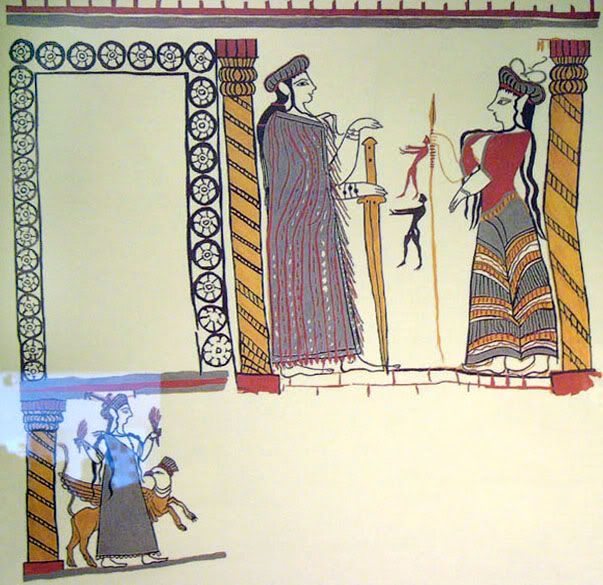
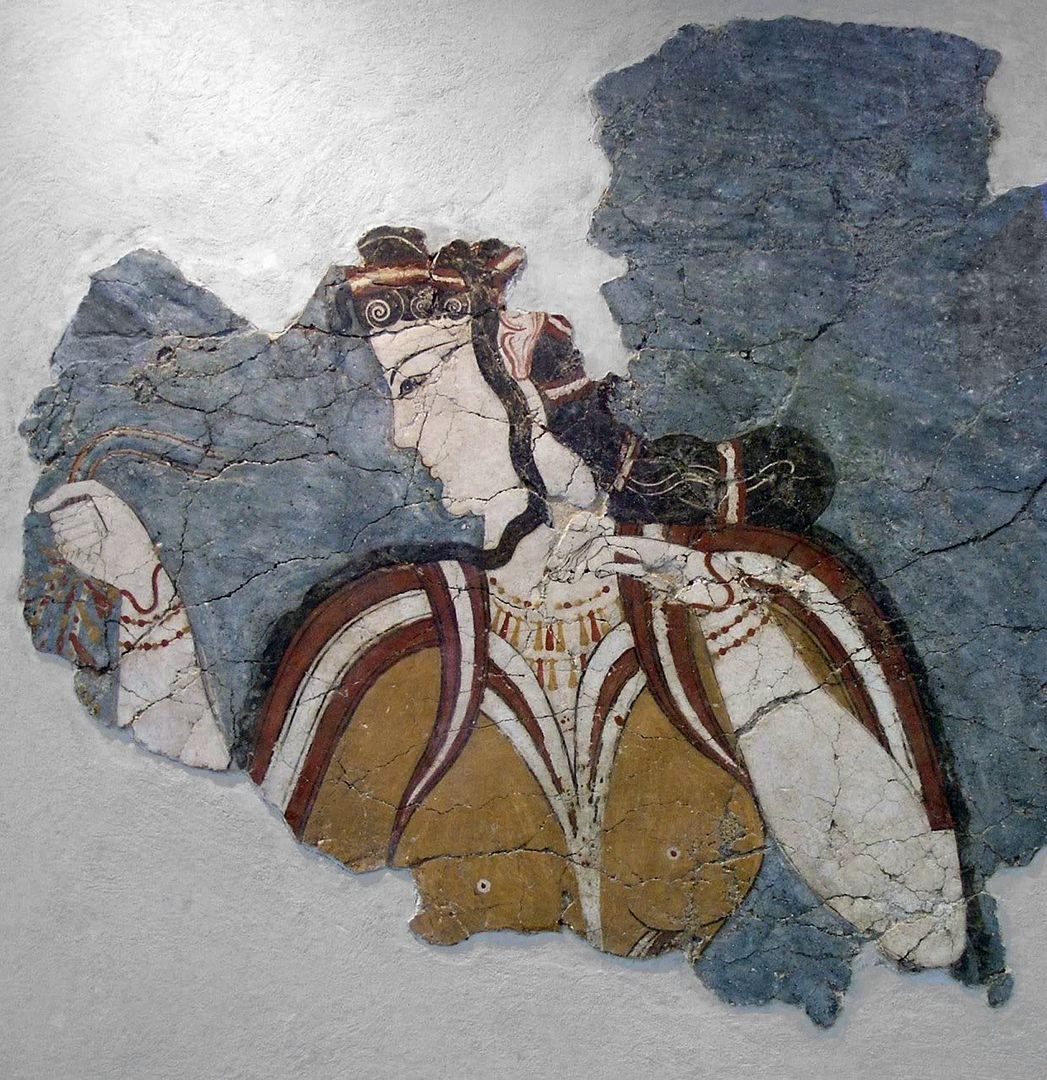
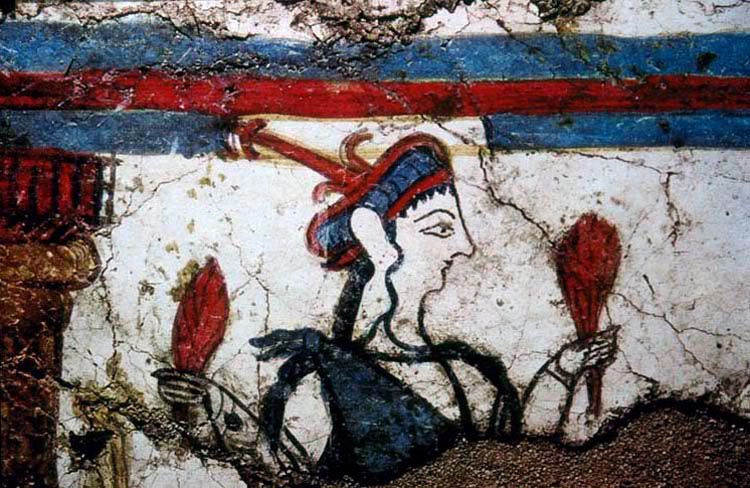
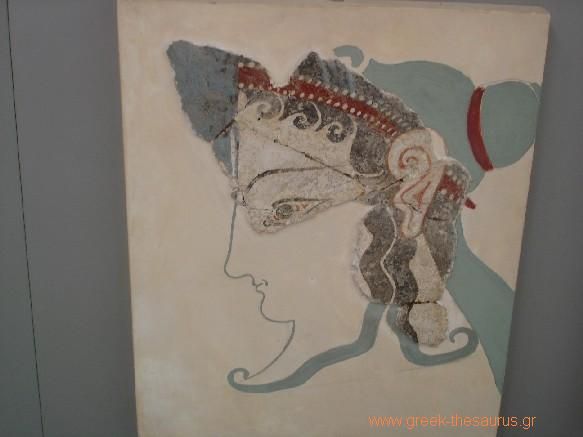
Ancient Greek art - The Mycenaeans.

 
 Above : Map of Mycenaean culture


I'm going to be making some upcoming blog posts on ancient Greek art, and I'd figure I'd start with the earliest known Greeks, the Mycenaeans [1600-1100 BC].

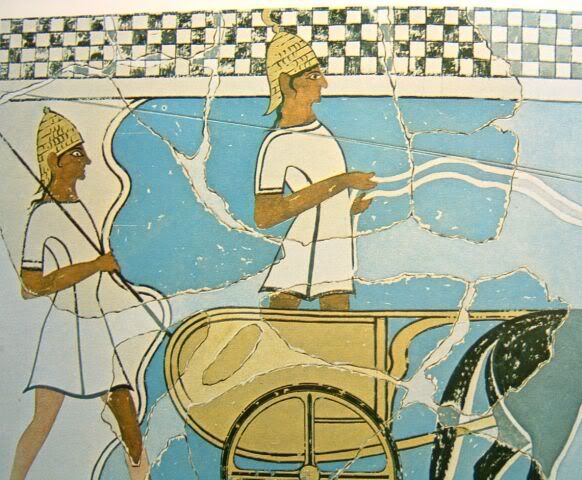
Two Greek warriors on a 13th c. BC fresco from Pylos. (National Archaeological Museum, Athens)


Pylos battle scene.


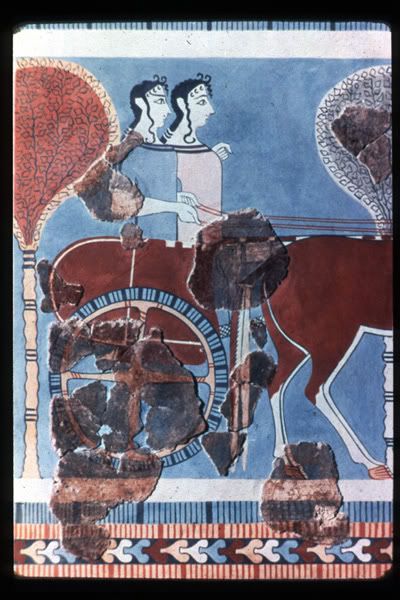
Two Mycenaean female charioteers from Pylos.


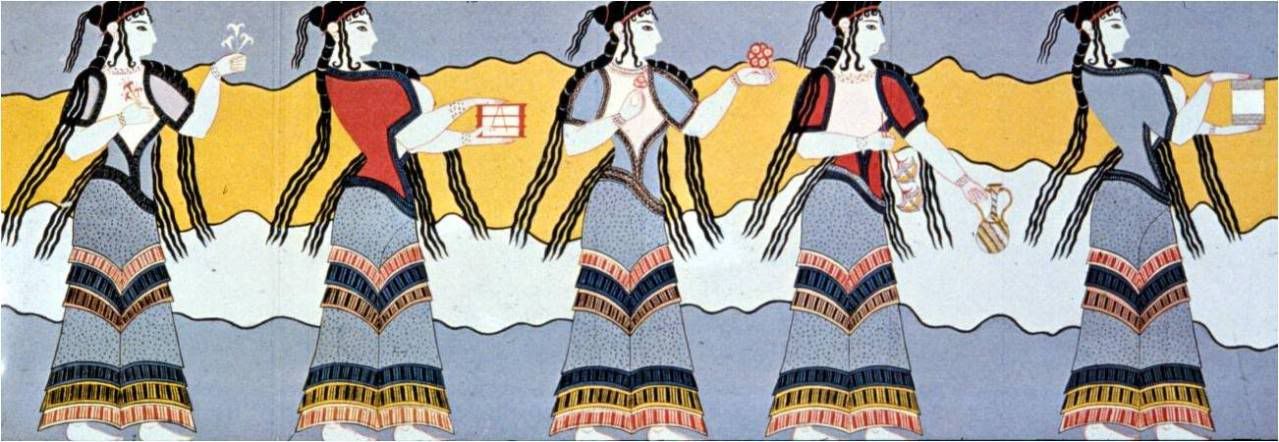
Mycenaean women shown in a fresco from Thebes.  


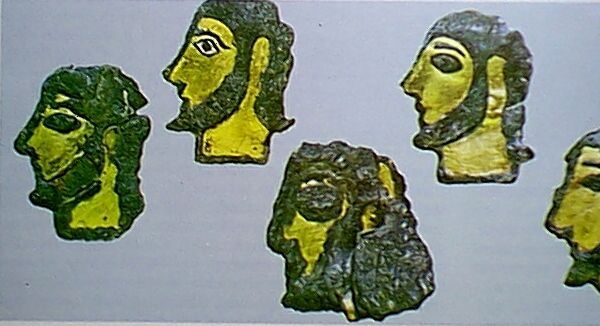
Head artwork from Greek Mycenaean swords.


Reconstructed Greek Mycenaean fresco.


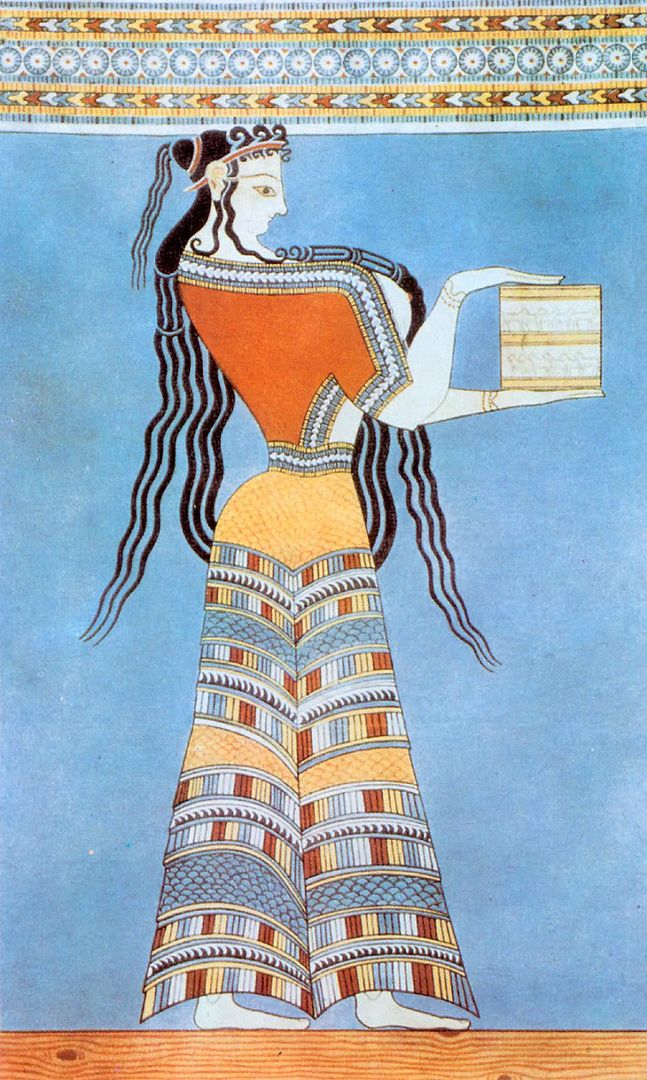
Mycenaean Greek female.


Mycenaean Priestess 


Mycenaean Greek woman from fresco.  


Mycenaean Greek woman brings offerings.   


Mycenaean daughters.


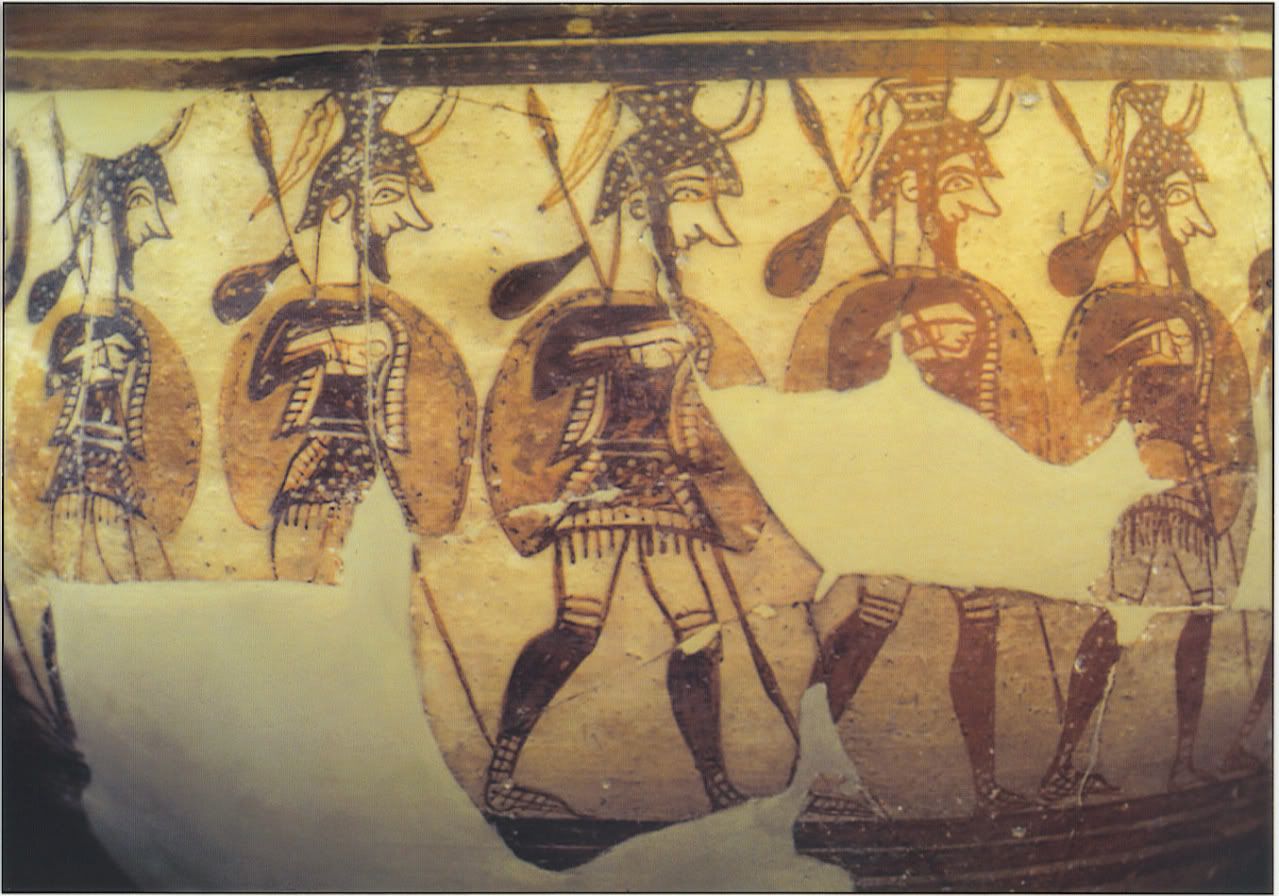
Greek soldiers on Mycenaean mural. 


Monday, March 12, 2012

Distinguishing Science and Pseudoscience.

Excellent write up by a physics professor on the differences between real and fake science, I had to put it on my blog.

"The word "pseudo" means fake. The surest way to spot a fake is to know as much as possible about the real thing—in this case, about science itself. Knowing science does not mean simply knowing scientific facts (such as the distance from earth to sun, the age of the earth, the distinction between mammal and reptile, etc.) It means understanding the nature of science—the criteria of evidence, the design of meaningful experiments, the weighing of possibilities, the testing of hypotheses, the establishment of theories, the many aspects of scientific methods that make it possible to draw reliable conclusions about the physical universe.

Because the media bombard us with nonsense, it is useful to consider the earmarks of pseudoscience. The presence of even one of these should arouse great suspicion. On the other hand, material displaying none of these flaws might still be pseudoscience, because its adherents invent new ways to fool themselves every day. Most of the examples in this article are related to my field of physics, but similar beliefs and behavior are associated with iridology, medical astrology, meridian therapy, reflexology, subluxation-based chiropractic, therapeutic touch, and other health-related pseudosciences."

Pseudoscience displays an indifference to facts.
Instead of bothering to consult reference works or investigating directly, its advocates simply spout bogus "facts" where needed. These fictions are often central to the pseudoscientist's argument and conclusions. Moreover, pseudoscientists rarely revise. The first edition of a pseudoscience book is almost always the last, even though the book remains in print for decades or even centuries. Even books with obvious mistakes, errors, and misprints on every page may be reprinted as is, over and over. Compare this to science textbooks that see a new edition every few years because of the rapid accumulation of new facts and insights.

Pseudoscience "research" is invariably sloppy.
Pseudoscientists clip newspaper reports, collect hearsay, cite other pseudoscience books, and pore over ancient religious or mythological works. They rarely or never make an independent investigation to check their sources.

Pseudoscience begins with a hypothesis—usually one which is appealing emotionally,and spectacularly implausible—and then looks only for items which appear to support it.
Conflicting evidence is ignored. Generally speaking, the aim of pseudoscience is to rationalize strongly held beliefs, rather than to investigate or to test alternative possibilities. Pseudoscience specializes in jumping to "congenial conclusions," grinding ideological axes, appealing to preconceived ideas and to widespread misunderstandings.

Pseudoscience is indifferent to criteria of valid evidence.
The emphasis is not on meaningful, controlled, repeatable scientific experiments. Instead it is on unverifiable eyewitness testimony, stories and tall tales, hearsay, rumor, and dubious anecdotes. Genuine scientific literature is either ignored or misinterpreted.

Pseudoscience relies heavily on subjective validation.
Joe Blow puts jello on his head and his headache goes away. To pseudoscience, this means jello cures headaches. To science this means nothing, since no experiment was done. Many things were going on when Joe Blow's headache went away—the moon was full, a bird flew overhead, the window was open, Joe had on his red shirt, etc.—and his headache would have gone away eventually in any case, no matter what. A controlled experiment would put many people suffering from headaches in identical circumstances, except for the presence or absence of the remedy it is desired to test, and compare the results which would then have some chance of being meaningful. Many people think there must be something to astrology because a newspaper horoscope describes them perfectly. But close examination would reveal that the description is general enough to cover virtually everyone. This phenomenon, called subjective validation, is one of the foundations of popular support for pseudoscience.

Pseudoscience depends on arbitrary conventions of human culture, rather than on unchanging regularities of nature.
For instance, the interpretations of astrology depend on the names of things, which are accidental and vary from culture to culture. If the ancients had given the name Mars to the planet we call Jupiter, and vice versa, astronomy could care less but astrology would be totally different, because it depends solely on the name and has nothing to do with the physical properties of the planet itself.

Pseudoscience always achieves a reduction to absurdity if pursued far enough.
Maybe dowsers can somehow sense the presence of water or minerals under a field, but almost all claim they can dowse equally well from a map! Maybe Uri Geller is "psychic," but are his powers really beamed to him on a radio link with a flying saucer from the planet Hoova, as he has claimed? Maybe plants are "psychic," but why does a bowl of mud respond in exactly the same way, in the same "experiment?"

Pseudoscience always avoids putting its claims to a meaningful test.
Pseudoscientists never carry out careful, methodical experiments themselves—and they also generally ignore results of those carried out by scientists. Pseudoscientists also never follow up. If one pseudoscientist claims to have done an experiment (such as the "lost" biorhythm studies of Hermann Swoboda that are alleged basis of the modern pseudoscience of biorhythms), no other pseudoscientist ever tries to duplicate it or to check him, even when the original results are missing or questionable! Further, where a pseudoscientist claims to have done an experiment with a remarkable result, he himself never repeats it to check his results and procedures. This is in extreme contrast with science, where crucial experiments are repeated by scientists all over the world with ever-increasing precision.

Pseudoscience often contradicts itself, even in its own terms.
Such logical contradictions are simply ignored or rationalized away. Thus, we should not be surprised when Chapter 1 of a book on dowsing says that dowsers use newly cut twigs, because only "live" wood can channel and focus the "earth-radiation" that makes dowsing possible, whereas Chapter 5 states that nearly all dowsers use metal or plastic rods.

Pseudoscience deliberately creates mystery where none exists, by omitting crucial information and important details.
Anything can be made "mysterious" by omitting what is known about it or presenting completely imaginary details. The "Bermuda Triangle" books are classic examples of this tactic.

Pseudoscience does not progress.
There are fads, and a pseudoscientist may switch from one fad to another (from ghosts to ESP research, from flying saucers to psychic studies, from ESP research to looking for Bigfoot). But within a given topic, no progress is made. Little or no new information or uncovered. New theories are seldom proposed, and old concepts are rarely modified or discarded in light of new "discoveries," since pseudoscience rarely makes new "discoveries." The older the idea, the more respect it receives. No natural phenomena or processes previously unknown to science have ever been discovered by pseudoscientists. Indeed, pseudoscientists almost invariably deal with phenomena well known to scientists, but little known to the general public—so that the public will swallow whatever the pseudoscientist wants to claim. Examples include firewalking and "Kirlian" photography.

Pseudoscience attempts to persuade with rhetoric, propaganda, and
misrepresentation rather than valid evidence (which presumably does not exist).
Pseudoscience books offer examples of almost every kind of fallacy of logic and reason known to scholars and have invented some new ones of their own. A favorite device is the non sequitur. Pseudoscientists also love the "Galileo Argument." This consists of the pseudoscientist comparing himself to Galileo, and saying that just as the pseudoscientist is believed to be wrong, so Galileo was thought wrong by his contemporaries therefore the pseudoscientist must be right too, just as Galileo was. Clearly the conclusion does not follow! Moreover, Galileo's ideas were tested, verified, and accepted promptly by his scientific colleagues. The rejection came from the established religion which favored the pseudoscience that Galileo's findings contradicted.

Pseudoscience argues from ignorance, an elementary fallacy.
Many pseudoscientists base their claims on incompleteness of information about nature, rather than on what is known at present. But no claim can possibly be supported by lack of information. The fact that people don't recognize what they see in the sky means only that they don't recognize what they saw. This fact is not evidence that flying saucers are from outer space. The statement "Science cannot explain" is common in pseudoscience literature. In many cases, science has no interest in the supposed phenomena because there is no evidence it exists; in other cases, the scientific explanation is well known and well established, but the pseudoscientist doesn't know this or deliberately ignores it to create mystery.

Pseudoscience argues from alleged exceptions, errors, anomalies, strange events,
and suspect claims—rather than from well-established regularities of nature.
The experience of scientists over the past 400 years is that claims and reports that describe well-understood objects behaving in strange and incomprehensible ways tend to reduce upon investigation to deliberate frauds, honest mistakes, garbled accounts, misinterpretations, outright fabrications, and stupid blunders. It is not wise to accept such reports at face value, without checking them. Pseudoscientists always take such reports as literally true, without independent verification.

Pseudoscience appeals to false authority, to emotion, sentiment, or distrust of established fact.
A high-school dropout is accepted as an expert on archaeology, though he has never made any study of it! A psychoanalyst is accepted as an expert on all of human history, not to mention physics, astronomy, and mythology, even though his claims are inconsistent with everything known in all four fields. A movie star swears it's true, so it must be. A physicist says a "psychic" couldn't possibly have fooled him with simple magic tricks, although the physicist knows nothing about magic and sleight of hand. Emotional appeals are common. ("If it makes you feel good, it must be true." "In your heart you know it's right.") Pseudoscientists are fond of imaginary conspiracies. ("There's plenty of evidence for flying saucers, but the government keeps it secret.") And they argue from irrelevancies: When confronted by inconvenient facts, they simply reply, "Scientists don't know everything!"

Pseudoscience makes extraordinary claims and advances fantastic theories that contradict what is known about nature.
They not only provide no evidence that their claims are true. They also ignore all findings that contradict their conclusions. ("Flying saucers have to come from somewhere—so the earth is hollow, and they come from inside." "This electric spark I'm making with this electrical apparatus is actually not a spark at all, but rather a supernatural manifestation of psycho-spiritual energy." "Every human is surrounded by an impalpable aura of electromagnetic energy, the auric egg of the ancient Hindu seers, which mirrors the human's every mood and condition.")

Pseudoscientists invent their own vocabulary in which many terms lack precise or unambiguous definitions, and some have no definition at all.
Listeners are often forced to interpret the statements according to their own preconceptions. What, for for example, is "biocosmic energy?" Or a "psychotronic amplification system?" Pseudoscientists often attempt to imitate the jargon of scientific and technical fields by spouting gibberish that sounds scientific and technical. Quack "healers" would be lost without the term "energy," but their use of the term has nothing whatsoever to do with the concept of energy used by physicists.

Pseudoscience appeals to the truth-criteria of scientific methodology while simultaneously denying their validity.
Thus, a procedurally invalid experiment which seems to show that astrology works is advanced as "proof" that astrology is correct, while thousands of procedurally sound experiments that show it does not work are ignored. The fact that someone got away with simple magic tricks in one scientific lab is "proof" that he is a psychic superman, while the fact that he was caught cheating in several other labs is ignored.

Pseudoscience claims that the phenomena it studies are "jealous."
The phenomena appear only under certain vaguely specified but vital conditions (such as when no doubters or skeptics are present; when no experts are present; when nobody is watching; when the "vibes" are right; or only once in human history.) Science holds that genuine phenomena must be capable of study by anyone with the proper equipment and that all procedurally valid studies must give consistent results. No genuine phenomenon is "jealous" in this way. There is no way to construct a TV set or a radio that will function only when no skeptics are present! A man who claims to be a concert-class violinist, but does not appear to have ever owned a violin and who refuses to play when anyone is around who might hear him, is most likely lying about his ability to play the violin.

Pseudoscientific "explanations" tend to be by scenario.
That is, we are told a story, but nothing else; we have no description of any possible physical process. For instance, Immanuel Velikovsky (1895-1979) claimed that another planet passing near the earth caused the earth's spin axis to flip upside down. This is all he said. He gave no mechanisms. But the mechanism is all-important, because the laws of physics rule out the process as impossible. That is, the approach of another planet cannot cause a planet's spin axis to flip. If Velikovsky had discovered some way that a planet could flip another's spin axis, he would presumably have described the mechanism by which it can happen. The bald statement itself, without the underlying mechanism, conveys no information at all. Velikovsky said that Venus was once a comet, and this comet was spewed out of a volcano on Jupiter. Since planets do not resemble comets (which are rock/ice snowball-like debris with connection whatsoever to volcanoes) and since Jupiter is not known to have volcanoes anyway (or even a solid surface!), no actual physical process could underlie Velikovsky's assertions. He gave us words, related to one another within a sentence, but the relationships were alien to the universe we actually live in, and he gave no explanation for how these could exist. He provided stories, not genuine theories.

Pseudoscientists often appeal to the ancient human habit of magical thinking.
Magic, sorcery, witchcraft—these are based on spurious similarity, false analogy, false cause-and-effect connections, etc. That is, inexplicable influences and connections between things are assumed from the beginning—not found by investigation. (If you step on a crack in the sidewalk without saying a magic word, your mother will crack a bone in her body; eating heart-shaped leaves is good for heart ailments; shining red light on the body increases blood production; rams are aggressive so someone born in the sign of the ram is aggressive; fish are "brain food" because the meat of the fish resembles brain tissue, etc.)

Pseudoscience relies heavily on anachronistic thinking.
The older the idea, the more attractive it is to pseudoscience—it's the wisdom of the ancients!—especially if the idea is transparently wrong and has long been discarded by science. Many journalists have trouble in comprehending this point. A typical reporter writing about astrology may think a thorough job can be done by interviewing six astrologers and one astronomer. The astronomer says it's all bunk; the six astrologers say it's great stuff and really works and for $50 they'll be glad to cast anyone's horoscope. (No doubt!) To many reporters, and apparently to many editors and their readers, this would confirm astrology six to one!


This table contrasts some of the characteristics of science and pseudoscience

Science vs Pseudoscience


1. (science) - Their findings are expressed primarily through scientific journals that are peer-reviewed and maintain rigorous standards for honesty and accuracy.

1. (pseudoscience) - The literature is aimed at the general public. There is no review, no standards, no pre-publication verification, no demand for accuracy and precision.


2. (science) - Reproducible results are demanded; experiments must be precisely described so that they can be duplicated exactly or improved upon.

2. (pseudoscience) - Results cannot be reproduced or verified. Studies, if any, are always so vaguely described that one can't figure out what was done or how it was done.


3. (science) - Failures are searched for and studied closely, because incorrect theories can often make correct predictions by accident, but no correct theory will make incorrect predictions.

3. (pseudoscience) - Failures are ignored, excused, hidden, lied about, discounted, explained away, rationalized, forgotten, avoided at all costs.


4. (science) - As time goes on, more and more is learned about the physical processes under study.

4. (pseudoscience) - No physical phenomena or processes are ever found or studied. No progress is made; nothing concrete is learned.


5. (science) - Convinces by appeal to the evidence, by arguments based upon logical and/or mathematical reasoning, by making the best case the data permit. When new evidence contradicts old ideas, they are abandoned.

5. (pseudoscience) - Convinces by appeal to faith and belief. Pseudoscience has a strong quasi-religious element: it tries to convert, not to convince. You are to believe in spite of the facts, not because of them. The original idea is never abandoned, whatever the evidence.


6. (science) - Does not advocate or market unproven practices or products.

6. (pseudoscience) - Generally earns some or all of his living by selling questionable products (such as books, courses, and dietary supplements) and/or pseudoscientific services (such as horoscopes, character readings, spirit messages, and predictions).


This table could be greatly expanded, because science and pseudoscience are precisely opposed ways of viewing nature. Science relies on—and insists on—self-questioning, testing and analytical thinking that make it hard to fool yourself or to avoid facing facts. Pseudoscience, on the other hand, preserves the ancient, natural, irrational, unobjective modes of thought that are hundreds of thousands of years older than science—thought processes that have given rise to superstitions and other fanciful and mistaken ideas about man and nature—from voodoo to racism; from the flat earth to the house-shaped universe with God in the attic, Satan in the cellar and man on the ground floor; from doing rain dances to torturing and brutalizing the mentally ill to drive out the demons that possess them. Pseudoscience encourages people to believe anything they want. It supplies specious "arguments" for fooling yourself into thinking that any and all beliefs are equally valid. Science begins by saying, let's forget about what we believe to be so, and try by investigation to find out what actually is so. These roads don't cross; they lead in completely opposite directions.

Some confusion on this point is caused by what we might call "crossover." "Science" is not an honorary badge you wear, it's an activity you do. Whenever you cease that activity, you cease being a scientist. A distressing amount of pseudoscience is generated by scientists who are well trained in one field but plunge into another field of which they are ignorant. A physicist who claims to have found a new principle of biology—or a biologist who claims to have found a new principle of physics—is almost invariably doing pseudoscience. And so are those who forge data, or suppresses data that clash with their preconceptions, or refuse to let others see their data for independent evaluation. Science is like a high peak of intellectual integrity, fairness, and rationality. The peak is slippery and smooth. It requires a tremendous effort to remain near it. Slacking of effort carries one away and into pseudoscience. Some pseudoscience is generated by individuals with a small amount of specialized scientific or technical training who are not professional scientists and do not comprehend the nature of the scientific enterprise—yet think of themselves as "scientists."

One might wonder if there are not examples of "crossovers" in the other direction; that is people who have been thought by scientists to be doing pseudoscience, who eventually were accepted as doing valid science, and whose ideas were ultimately accepted by scientists. From what we have just outlined, one would expect this to happen extremely rarely, if ever. In fact, neither I nor any informed colleague I have ever asked about this, knows of any single case in which this has happened during the hundreds of years the full scientific method has been known to and used by scientists. There are many cases in which a scientist has been thought wrong by colleagues but later—when new information comes in—is shown to be correct. Like anyone else, scientists can get hunches that something is possible without having enough evidence to convince their associates that they are correct. Such people do not become pseudoscientists, unless they continue to maintain that their ideas are correct when contradictory evidence piles up. Being wrong or mistaken is unavoidable; we are all human, and we all commit errors and blunders. True scientists, however, are alert to the possibility of blunder and are quick to correct mistakes. Pseudoscientists do not. In fact, a short definition of pseudoscience is "a method for excusing, defending, and preserving errors."

Pseudoscience often strikes educated, rational people as too nonsensical and preposterous to be dangerous and as a source of amusement rather than fear. Unfortunately, this is not a wise attitude. Pseudoscience can be extremely dangerous.

Penetrating political systems, it justifies atrocities in the name of racial purity
Penetrating the educational system, it can drive out science and sensibility;
In the field of health, it dooms thousands to unnecessary death or suffering
Penetrating religion, it generates fanaticism, intolerance, and holy war
Penetrating the communications media, it can make it difficult for voters to obtain factual information on important public issues.

Recommended Reading

Science and Unreason, D. & M. Radner, Wadsworth, California, 1982.
Exploring the Unknown, Charles J. Cazeau & Stuart D. Scott, Jr., Plenum, New York, 1979.
Fact, Fraud and Fantasy, Morris Goran, A. S. Barnes, New Jersey, 1979.
Flim-Flam! By James Randi, Prometheus, Amherst, N.Y., 1982.
How to Think about Wierd Things: Critical Thinking for a New Age, Theodore Schick, Jr., Lewis Vaughn, Mayfield, Mountain View, Calif., 1995.
Paranormal Borderlands of Science, Ed. by Kendrick Frazier, Prometheus, Amherst, N.Y., 1981.
Science as falsification, Karl R. Popper (1963)
Science Confronts the Paranormal, Ed. by Kendrick Frazier, Prometheus, Amherst, N.Y., 1985.
Science, Good, Bad and Bogus, Martin Gardner, Prometheus, New York, 1981; Avon, New York, 1982.
Science and the Paranormal, Ed. by George O. Abell and Barry Singer, Scribners, New York, 1981.
Extrasensory Deception, Henry Gordon, Prometheus, Amherst, N.Y.,1987.
Pseudoscience and the Paranormal, Terence Hines, Prometheus, Amherst, N.Y., 1988.

________________________

Dr. Coker is Professor of Physics, University of Texas at Austin.


LINK

Saturday, August 6, 2011

Proto-Greek homeland.

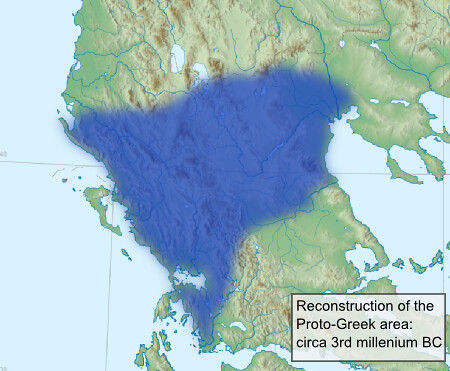
The following map represents the hypothesized 'Proto-Greek' homeland, ie where the earliest form of Greek speech was located, thus where the earliest Greek peoples were located. 


Indo-European linguist
V. I. Georgiev.
"The Proto-Greek region included Epirus, approximately up to Αυλών in the north including Paravaia, Tymphaia, Athamania, Dolopia, Amphilochia, and Acarnania), west and north Thessaly (Hestiaiotis,, Perrhaibia, Tripolis, and Pieria), i.e. more or less the territory of contemporary northwestern Greece)"
SOURCE : Georgiev, Vladimir Ivanov (1981). Introduction to the history of the Indo-European languages. Pub. House of the Bulgarian Academy of Sciences. pp. 156.

Link


Proto-Greek was probably spoken in North/Northwestern Greece at latest in the late 3rd millennium BC. Why? Because Mycenaean Greek which is documented to be have been spoken at around 1600 BC is already fully recognizable Greek, so it must have been Greek for quite a while before. Not to mention Mycenaean Greek was also dialectal Greek, so its divergence from Proto-Greek must be pushed into the past, certainly in the 3rd millennium BC at the latest.

It should be noted that this linguistic timescale and Proto-Greek homeland map is going by the still somewhat speculative Kurgan hypothesis for the breakdown of Indo-European.

Of course, the Greek language shares a common ancestor with other Indo-European languages and that common ancestral language (known as Proto Indo-European) was almost certainly originally spoken outside of Greece. But this blog entry isn't about that homeland, it's about the Proto Greek homeland.