Monday, March 12, 2012

Distinguishing Science and Pseudoscience

Excellent write up by a physics professor on the differences between real and fake science, I had to put it on my blog.

"The word "pseudo" means fake. The surest way to spot a fake is to know as much as possible about the real thing—in this case, about science itself. Knowing science does not mean simply knowing scientific facts (such as the distance from earth to sun, the age of the earth, the distinction between mammal and reptile, etc.) It means understanding the nature of science—the criteria of evidence, the design of meaningful experiments, the weighing of possibilities, the testing of hypotheses, the establishment of theories, the many aspects of scientific methods that make it possible to draw reliable conclusions about the physical universe.

Because the media bombard us with nonsense, it is useful to consider the earmarks of pseudoscience. The presence of even one of these should arouse great suspicion. On the other hand, material displaying none of these flaws might still be pseudoscience, because its adherents invent new ways to fool themselves every day. Most of the examples in this article are related to my field of physics, but similar beliefs and behavior are associated with iridology, medical astrology, meridian therapy, reflexology, subluxation-based chiropractic, therapeutic touch, and other health-related pseudosciences."

Pseudoscience displays an indifference to facts.
Instead of bothering to consult reference works or investigating directly, its advocates simply spout bogus "facts" where needed. These fictions are often central to the pseudoscientist's argument and conclusions. Moreover, pseudoscientists rarely revise. The first edition of a pseudoscience book is almost always the last, even though the book remains in print for decades or even centuries. Even books with obvious mistakes, errors, and misprints on every page may be reprinted as is, over and over. Compare this to science textbooks that see a new edition every few years because of the rapid accumulation of new facts and insights.

Pseudoscience "research" is invariably sloppy.
Pseudoscientists clip newspaper reports, collect hearsay, cite other pseudoscience books, and pore over ancient religious or mythological works. They rarely or never make an independent investigation to check their sources.

Pseudoscience begins with a hypothesis—usually one which is appealing emotionally,and spectacularly implausible—and then looks only for items which appear to support it.
Conflicting evidence is ignored. Generally speaking, the aim of pseudoscience is to rationalize strongly held beliefs, rather than to investigate or to test alternative possibilities. Pseudoscience specializes in jumping to "congenial conclusions," grinding ideological axes, appealing to preconceived ideas and to widespread misunderstandings.

Pseudoscience is indifferent to criteria of valid evidence.
The emphasis is not on meaningful, controlled, repeatable scientific experiments. Instead it is on unverifiable eyewitness testimony, stories and tall tales, hearsay, rumor, and dubious anecdotes. Genuine scientific literature is either ignored or misinterpreted.

Pseudoscience relies heavily on subjective validation.
Joe Blow puts jello on his head and his headache goes away. To pseudoscience, this means jello cures headaches. To science this means nothing, since no experiment was done. Many things were going on when Joe Blow's headache went away—the moon was full, a bird flew overhead, the window was open, Joe had on his red shirt, etc.—and his headache would have gone away eventually in any case, no matter what. A controlled experiment would put many people suffering from headaches in identical circumstances, except for the presence or absence of the remedy it is desired to test, and compare the results which would then have some chance of being meaningful. Many people think there must be something to astrology because a newspaper horoscope describes them perfectly. But close examination would reveal that the description is general enough to cover virtually everyone. This phenomenon, called subjective validation, is one of the foundations of popular support for pseudoscience.

Pseudoscience depends on arbitrary conventions of human culture, rather than on unchanging regularities of nature.
For instance, the interpretations of astrology depend on the names of things, which are accidental and vary from culture to culture. If the ancients had given the name Mars to the planet we call Jupiter, and vice versa, astronomy could care less but astrology would be totally different, because it depends solely on the name and has nothing to do with the physical properties of the planet itself.

Pseudoscience always achieves a reduction to absurdity if pursued far enough.
Maybe dowsers can somehow sense the presence of water or minerals under a field, but almost all claim they can dowse equally well from a map! Maybe Uri Geller is "psychic," but are his powers really beamed to him on a radio link with a flying saucer from the planet Hoova, as he has claimed? Maybe plants are "psychic," but why does a bowl of mud respond in exactly the same way, in the same "experiment?"

Pseudoscience always avoids putting its claims to a meaningful test.
Pseudoscientists never carry out careful, methodical experiments themselves—and they also generally ignore results of those carried out by scientists. Pseudoscientists also never follow up. If one pseudoscientist claims to have done an experiment (such as the "lost" biorhythm studies of Hermann Swoboda that are alleged basis of the modern pseudoscience of biorhythms), no other pseudoscientist ever tries to duplicate it or to check him, even when the original results are missing or questionable! Further, where a pseudoscientist claims to have done an experiment with a remarkable result, he himself never repeats it to check his results and procedures. This is in extreme contrast with science, where crucial experiments are repeated by scientists all over the world with ever-increasing precision.

Pseudoscience often contradicts itself, even in its own terms.
Such logical contradictions are simply ignored or rationalized away. Thus, we should not be surprised when Chapter 1 of a book on dowsing says that dowsers use newly cut twigs, because only "live" wood can channel and focus the "earth-radiation" that makes dowsing possible, whereas Chapter 5 states that nearly all dowsers use metal or plastic rods.

Pseudoscience deliberately creates mystery where none exists, by omitting crucial information and important details.
Anything can be made "mysterious" by omitting what is known about it or presenting completely imaginary details. The "Bermuda Triangle" books are classic examples of this tactic.

Pseudoscience does not progress.
There are fads, and a pseudoscientist may switch from one fad to another (from ghosts to ESP research, from flying saucers to psychic studies, from ESP research to looking for Bigfoot). But within a given topic, no progress is made. Little or no new information or uncovered. New theories are seldom proposed, and old concepts are rarely modified or discarded in light of new "discoveries," since pseudoscience rarely makes new "discoveries." The older the idea, the more respect it receives. No natural phenomena or processes previously unknown to science have ever been discovered by pseudoscientists. Indeed, pseudoscientists almost invariably deal with phenomena well known to scientists, but little known to the general public—so that the public will swallow whatever the pseudoscientist wants to claim. Examples include firewalking and "Kirlian" photography.

Pseudoscience attempts to persuade with rhetoric, propaganda, and
misrepresentation rather than valid evidence (which presumably does not exist).
Pseudoscience books offer examples of almost every kind of fallacy of logic and reason known to scholars and have invented some new ones of their own. A favorite device is the non sequitur. Pseudoscientists also love the "Galileo Argument." This consists of the pseudoscientist comparing himself to Galileo, and saying that just as the pseudoscientist is believed to be wrong, so Galileo was thought wrong by his contemporaries therefore the pseudoscientist must be right too, just as Galileo was. Clearly the conclusion does not follow! Moreover, Galileo's ideas were tested, verified, and accepted promptly by his scientific colleagues. The rejection came from the established religion which favored the pseudoscience that Galileo's findings contradicted.

Pseudoscience argues from ignorance, an elementary fallacy.
Many pseudoscientists base their claims on incompleteness of information about nature, rather than on what is known at present. But no claim can possibly be supported by lack of information. The fact that people don't recognize what they see in the sky means only that they don't recognize what they saw. This fact is not evidence that flying saucers are from outer space. The statement "Science cannot explain" is common in pseudoscience literature. In many cases, science has no interest in the supposed phenomena because there is no evidence it exists; in other cases, the scientific explanation is well known and well established, but the pseudoscientist doesn't know this or deliberately ignores it to create mystery.

Pseudoscience argues from alleged exceptions, errors, anomalies, strange events,
and suspect claims—rather than from well-established regularities of nature.
The experience of scientists over the past 400 years is that claims and reports that describe well-understood objects behaving in strange and incomprehensible ways tend to reduce upon investigation to deliberate frauds, honest mistakes, garbled accounts, misinterpretations, outright fabrications, and stupid blunders. It is not wise to accept such reports at face value, without checking them. Pseudoscientists always take such reports as literally true, without independent verification.

Pseudoscience appeals to false authority, to emotion, sentiment, or distrust of established fact.
A high-school dropout is accepted as an expert on archaeology, though he has never made any study of it! A psychoanalyst is accepted as an expert on all of human history, not to mention physics, astronomy, and mythology, even though his claims are inconsistent with everything known in all four fields. A movie star swears it's true, so it must be. A physicist says a "psychic" couldn't possibly have fooled him with simple magic tricks, although the physicist knows nothing about magic and sleight of hand. Emotional appeals are common. ("If it makes you feel good, it must be true." "In your heart you know it's right.") Pseudoscientists are fond of imaginary conspiracies. ("There's plenty of evidence for flying saucers, but the government keeps it secret.") And they argue from irrelevancies: When confronted by inconvenient facts, they simply reply, "Scientists don't know everything!"

Pseudoscience makes extraordinary claims and advances fantastic theories that contradict what is known about nature.
They not only provide no evidence that their claims are true. They also ignore all findings that contradict their conclusions. ("Flying saucers have to come from somewhere—so the earth is hollow, and they come from inside." "This electric spark I'm making with this electrical apparatus is actually not a spark at all, but rather a supernatural manifestation of psycho-spiritual energy." "Every human is surrounded by an impalpable aura of electromagnetic energy, the auric egg of the ancient Hindu seers, which mirrors the human's every mood and condition.")

Pseudoscientists invent their own vocabulary in which many terms lack precise or unambiguous definitions, and some have no definition at all.
Listeners are often forced to interpret the statements according to their own preconceptions. What, for for example, is "biocosmic energy?" Or a "psychotronic amplification system?" Pseudoscientists often attempt to imitate the jargon of scientific and technical fields by spouting gibberish that sounds scientific and technical. Quack "healers" would be lost without the term "energy," but their use of the term has nothing whatsoever to do with the concept of energy used by physicists.

Pseudoscience appeals to the truth-criteria of scientific methodology while simultaneously denying their validity.
Thus, a procedurally invalid experiment which seems to show that astrology works is advanced as "proof" that astrology is correct, while thousands of procedurally sound experiments that show it does not work are ignored. The fact that someone got away with simple magic tricks in one scientific lab is "proof" that he is a psychic superman, while the fact that he was caught cheating in several other labs is ignored.

Pseudoscience claims that the phenomena it studies are "jealous."
The phenomena appear only under certain vaguely specified but vital conditions (such as when no doubters or skeptics are present; when no experts are present; when nobody is watching; when the "vibes" are right; or only once in human history.) Science holds that genuine phenomena must be capable of study by anyone with the proper equipment and that all procedurally valid studies must give consistent results. No genuine phenomenon is "jealous" in this way. There is no way to construct a TV set or a radio that will function only when no skeptics are present! A man who claims to be a concert-class violinist, but does not appear to have ever owned a violin and who refuses to play when anyone is around who might hear him, is most likely lying about his ability to play the violin.

Pseudoscientific "explanations" tend to be by scenario.
That is, we are told a story, but nothing else; we have no description of any possible physical process. For instance, Immanuel Velikovsky (1895-1979) claimed that another planet passing near the earth caused the earth's spin axis to flip upside down. This is all he said. He gave no mechanisms. But the mechanism is all-important, because the laws of physics rule out the process as impossible. That is, the approach of another planet cannot cause a planet's spin axis to flip. If Velikovsky had discovered some way that a planet could flip another's spin axis, he would presumably have described the mechanism by which it can happen. The bald statement itself, without the underlying mechanism, conveys no information at all. Velikovsky said that Venus was once a comet, and this comet was spewed out of a volcano on Jupiter. Since planets do not resemble comets (which are rock/ice snowball-like debris with connection whatsoever to volcanoes) and since Jupiter is not known to have volcanoes anyway (or even a solid surface!), no actual physical process could underlie Velikovsky's assertions. He gave us words, related to one another within a sentence, but the relationships were alien to the universe we actually live in, and he gave no explanation for how these could exist. He provided stories, not genuine theories.

Pseudoscientists often appeal to the ancient human habit of magical thinking.
Magic, sorcery, witchcraft—these are based on spurious similarity, false analogy, false cause-and-effect connections, etc. That is, inexplicable influences and connections between things are assumed from the beginning—not found by investigation. (If you step on a crack in the sidewalk without saying a magic word, your mother will crack a bone in her body; eating heart-shaped leaves is good for heart ailments; shining red light on the body increases blood production; rams are aggressive so someone born in the sign of the ram is aggressive; fish are "brain food" because the meat of the fish resembles brain tissue, etc.)

Pseudoscience relies heavily on anachronistic thinking.
The older the idea, the more attractive it is to pseudoscience—it's the wisdom of the ancients!—especially if the idea is transparently wrong and has long been discarded by science. Many journalists have trouble in comprehending this point. A typical reporter writing about astrology may think a thorough job can be done by interviewing six astrologers and one astronomer. The astronomer says it's all bunk; the six astrologers say it's great stuff and really works and for $50 they'll be glad to cast anyone's horoscope. (No doubt!) To many reporters, and apparently to many editors and their readers, this would confirm astrology six to one!


This table contrasts some of the characteristics of science and pseudoscience

Science vs Pseudoscience


1. (science) - Their findings are expressed primarily through scientific journals that are peer-reviewed and maintain rigorous standards for honesty and accuracy.

1. (pseudoscience) - The literature is aimed at the general public. There is no review, no standards, no pre-publication verification, no demand for accuracy and precision.


2. (science) - Reproducible results are demanded; experiments must be precisely described so that they can be duplicated exactly or improved upon.

2. (pseudoscience) - Results cannot be reproduced or verified. Studies, if any, are always so vaguely described that one can't figure out what was done or how it was done.


3. (science) - Failures are searched for and studied closely, because incorrect theories can often make correct predictions by accident, but no correct theory will make incorrect predictions.

3. (pseudoscience) - Failures are ignored, excused, hidden, lied about, discounted, explained away, rationalized, forgotten, avoided at all costs.


4. (science) - As time goes on, more and more is learned about the physical processes under study.

4. (pseudoscience) - No physical phenomena or processes are ever found or studied. No progress is made; nothing concrete is learned.


5. (science) - Convinces by appeal to the evidence, by arguments based upon logical and/or mathematical reasoning, by making the best case the data permit. When new evidence contradicts old ideas, they are abandoned.

5. (pseudoscience) - Convinces by appeal to faith and belief. Pseudoscience has a strong quasi-religious element: it tries to convert, not to convince. You are to believe in spite of the facts, not because of them. The original idea is never abandoned, whatever the evidence.


6. (science) - Does not advocate or market unproven practices or products.

6. (pseudoscience) - Generally earns some or all of his living by selling questionable products (such as books, courses, and dietary supplements) and/or pseudoscientific services (such as horoscopes, character readings, spirit messages, and predictions).


This table could be greatly expanded, because science and pseudoscience are precisely opposed ways of viewing nature. Science relies on—and insists on—self-questioning, testing and analytical thinking that make it hard to fool yourself or to avoid facing facts. Pseudoscience, on the other hand, preserves the ancient, natural, irrational, unobjective modes of thought that are hundreds of thousands of years older than science—thought processes that have given rise to superstitions and other fanciful and mistaken ideas about man and nature—from voodoo to racism; from the flat earth to the house-shaped universe with God in the attic, Satan in the cellar and man on the ground floor; from doing rain dances to torturing and brutalizing the mentally ill to drive out the demons that possess them. Pseudoscience encourages people to believe anything they want. It supplies specious "arguments" for fooling yourself into thinking that any and all beliefs are equally valid. Science begins by saying, let's forget about what we believe to be so, and try by investigation to find out what actually is so. These roads don't cross; they lead in completely opposite directions.

Some confusion on this point is caused by what we might call "crossover." "Science" is not an honorary badge you wear, it's an activity you do. Whenever you cease that activity, you cease being a scientist. A distressing amount of pseudoscience is generated by scientists who are well trained in one field but plunge into another field of which they are ignorant. A physicist who claims to have found a new principle of biology—or a biologist who claims to have found a new principle of physics—is almost invariably doing pseudoscience. And so are those who forge data, or suppresses data that clash with their preconceptions, or refuse to let others see their data for independent evaluation. Science is like a high peak of intellectual integrity, fairness, and rationality. The peak is slippery and smooth. It requires a tremendous effort to remain near it. Slacking of effort carries one away and into pseudoscience. Some pseudoscience is generated by individuals with a small amount of specialized scientific or technical training who are not professional scientists and do not comprehend the nature of the scientific enterprise—yet think of themselves as "scientists."

One might wonder if there are not examples of "crossovers" in the other direction; that is people who have been thought by scientists to be doing pseudoscience, who eventually were accepted as doing valid science, and whose ideas were ultimately accepted by scientists. From what we have just outlined, one would expect this to happen extremely rarely, if ever. In fact, neither I nor any informed colleague I have ever asked about this, knows of any single case in which this has happened during the hundreds of years the full scientific method has been known to and used by scientists. There are many cases in which a scientist has been thought wrong by colleagues but later—when new information comes in—is shown to be correct. Like anyone else, scientists can get hunches that something is possible without having enough evidence to convince their associates that they are correct. Such people do not become pseudoscientists, unless they continue to maintain that their ideas are correct when contradictory evidence piles up. Being wrong or mistaken is unavoidable; we are all human, and we all commit errors and blunders. True scientists, however, are alert to the possibility of blunder and are quick to correct mistakes. Pseudoscientists do not. In fact, a short definition of pseudoscience is "a method for excusing, defending, and preserving errors."

Pseudoscience often strikes educated, rational people as too nonsensical and preposterous to be dangerous and as a source of amusement rather than fear. Unfortunately, this is not a wise attitude. Pseudoscience can be extremely dangerous.

Penetrating political systems, it justifies atrocities in the name of racial purity
Penetrating the educational system, it can drive out science and sensibility;
In the field of health, it dooms thousands to unnecessary death or suffering
Penetrating religion, it generates fanaticism, intolerance, and holy war
Penetrating the communications media, it can make it difficult for voters to obtain factual information on important public issues.

Recommended Reading

Science and Unreason, D. & M. Radner, Wadsworth, California, 1982.
Exploring the Unknown, Charles J. Cazeau & Stuart D. Scott, Jr., Plenum, New York, 1979.
Fact, Fraud and Fantasy, Morris Goran, A. S. Barnes, New Jersey, 1979.
Flim-Flam! By James Randi, Prometheus, Amherst, N.Y., 1982.
How to Think about Wierd Things: Critical Thinking for a New Age, Theodore Schick, Jr., Lewis Vaughn, Mayfield, Mountain View, Calif., 1995.
Paranormal Borderlands of Science, Ed. by Kendrick Frazier, Prometheus, Amherst, N.Y., 1981.
Science as falsification, Karl R. Popper (1963)
Science Confronts the Paranormal, Ed. by Kendrick Frazier, Prometheus, Amherst, N.Y., 1985.
Science, Good, Bad and Bogus, Martin Gardner, Prometheus, New York, 1981; Avon, New York, 1982.
Science and the Paranormal, Ed. by George O. Abell and Barry Singer, Scribners, New York, 1981.
Extrasensory Deception, Henry Gordon, Prometheus, Amherst, N.Y.,1987.
Pseudoscience and the Paranormal, Terence Hines, Prometheus, Amherst, N.Y., 1988.

________________________

Dr. Coker is Professor of Physics, University of Texas at Austin.


LINK

Saturday, August 6, 2011

Proto-Hellenic homeland

The following map represents the 'Proto-Hellenic' homeland, ie where the earliest form of Greek/Hellenic speech was located, thus where the earliest Greek peoples were located.


Indo-European linguist
V. I. Georgiev.
"The Proto-Greek region included Epirus, approximately up to Αυλών in the north including Paravaia, Tymphaia, Athamania, Dolopia, Amphilochia, and Acarnania), west and north Thessaly (Hestiaiotis,, Perrhaibia, Tripolis, and Pieria), i.e. more or less the territory of contemporary northwestern Greece)"
SOURCE : Georgiev, Vladimir Ivanov (1981). Introduction to the history of the Indo-European languages. Pub. House of the Bulgarian Academy of Sciences. pp. 156.

Link


EDIT : What a coincidence Epirus (my ancestral homeland) is at the center of where the likely original Greeks were from, not trying to brag of course. : )

Proto-Greek was probably spoken in North/Northwestern Greece at latest in the late 3rd millennium BC. Why? Because Mycenaean Greek which is documented to be have been spoken at around 1600 BC is already fully recognizable Greek, so it must have been Greek for quite a while before. Not to mention Mycenaean Greek was also dialectal Greek, so its divergence from Proto-Greek must be pushed into the past, certainly in the 3rd millennium BC at the latest.

It should be noted that this linguistic timescale and Proto-Greek homeland map is going by the still somewhat speculative Kurgan hypothesis for the breakdown of Indo-European. The Neolithic Anatolian hypothesis is still very much alive and an interesting one as new linguistic time divergence methods like Glottochronology agree with it (see here). If that model were true, proto-Greek speech would be pushed back perhaps several millennia, but the homeland would still be somewhere in the vicinity of Greece (just perhaps not Northwestern Greece).

Tuesday, July 26, 2011

European Population Structure - Another genome wide association study


In my Northern Italians are biologically SOUTHERN European entry, I posted 3 genome wide association studies showing where Northern Italians (and Tuscans) plotted (via Principal Component Analysis) and structured (via STRUCTURE Analysis) compared to other European groups. However, there are still more European exclusive genome wide association studies out there; with this next study by Lao et al. being one of them. The reason why I chose not to include this in the Northern Italian post is because strangely, there are two different Italian samples and only one is of known specific origin. The Italian sample labeled "IT2" is a Central Italian sample from Marches Italy, however the other Italian sample which is labeled "IT1" is from the POPRES database. The PORRES Italian sample is unfortunately of unspecific origin and includes people from all over the country; from Southern Italians, to Northern Italians, and even Swiss-Italians.
"2. Combined PCA of CEU, YRI and all Italian populations shows that there are three significant clusters among the Italian populations: Sardinian, Northern-Italy and Southern-Italy. The "Southern-Italy" group mainly consists of individuals from the POPRES Italy population that appear to be sampled from the south of Italy based on the clustering seen in PCA. The "Northern-Italians" group contains data from POPRES Italy and Swiss-Italians and HGDP-CEPH Bergamo and Tuscany and "Sardinians" include individuals from HGDP-CEPH Sardinia and POPRES Italy population, which appear to be closely related to this group (Figure S1C). Individuals that did not fall into these three main clusters were excluded from all further analysis."
Link for more information on the PORPES database.


Correlation between Genetic and Geographic Structure in Europe
Lao et al. (2008).

"Understanding the genetic structure of the European population is important, not only from a historical perspective, but also for the appropriate design and interpretation of genetic epidemiological studies. Previous population genetic analyses with autosomal markers in Europe either had a wide geographic but narrow genomic coverage [1] and [2], or vice versa [3], [4], [5] and [6]. We therefore investigated Affymetrix GeneChip 500K genotype data from 2,514 individuals belonging to 23 different subpopulations, widely spread over Europe. Although we found only a low level of genetic differentiation between subpopulations, the existing differences were characterized by a strong continent-wide correlation between geographic and genetic distance. Furthermore, mean heterozygosity was larger, and mean linkage disequilibrium smaller, in southern as compared to northern Europe. Both parameters clearly showed a clinal distribution that provided evidence for a spatial continuity of genetic diversity in Europe. Our comprehensive genetic data are thus compatible with expectations based upon European population history, including the hypotheses of a south-north expansion and/or a larger effective population size in southern than in northern Europe. By including the widely used CEPH from Utah (CEU) samples into our analysis, we could show that these individuals represent northern and western Europeans reasonably well, thereby confirming their assumed regional ancestry."
(click above ^ to enlarge PCA plot for better clarification)

Some observations.

1. Clear clustering of individuals from different ethnic groups within the European continuum, indicating that ethnic groups are not only cultural, but to a large extent biological entities.

2. The Finns (FI) are the biggest genetic outlier in Europe. There is no smooth transition from the Scandinavian countries like Norway (NO) and Sweden (SE) or the Baltic countries into Finland. This is not surprising based on previous studies showing they have about a 10% 'Mongoloid' or 'Uralic' component. However, this has nothing to do with Mongols or other Mongoloid historic groups coming in and raping the originally Europid natives. It is rather due to a pre-historic and gradual synthesis of Central Asian- Siberian migrations into Northeastern Europe over the last 5,000 years at least.

3. Once again this shows the largest genetic differences in Europe are easily between the North and South. The South to North cline between Italy and Scandinavia looks to be about 2 and half to 3 times greater than that of the West to East cline, which is between Britain (UK) and Poland (PO). Unfortunately, no Russians were sampled in this study.

4. The Italians (IT1, IT2) are the major contributors to this North/South divide. They pull significantly further South than even Central Spaniards from Madrid (ES1) and Northeastern Spaniards from Barcelona (ES2).


5. There is significant diversity in Italy, the Italian sample (IT1) shows some Italians clustering way up close with Spaniards (ES1, ES2) while others considerably below even Northern Greeks (EL). As was stated earlier, the Italian sample labeled (IT1) is a sample of unknown specifics and includes Italians from all over the country and also Swiss-Italians. More than likely, the ones pulling furthest North with the Spaniards are Swiss-Italians and to a lessor extent Northern Italians. While others pulling below the Greeks and the other Italian sample (IT2) are likely Southern Italians. You'll notice there is no such diversity in the other Italian sample
(IT2) which is simply from Marches.

6. The Greek sample (EL) is a northern one from the Macedonia region. I am surprised they plot higher than Central Italians
(IT2) from Marches. But they still plot fairly far South and they only over lap with Southern Yugoslavs. The Yugoslavs (YU) are intermediate between northern Greeks (EL) and Czechs (CZ). Southern Greeks generally overlap with Sicily and South Italy as most Greek colonists into Southern Italy and Sicily were from the Peloponnese. Unfortunately, Southern Greeks were not sampled here to see where they would plot. My guess would be Southern Greeks would plot with those Italians from the PORPES database whom are pulling so far south, and are likely to be of predominately southern origin.

7. The French are in between Southern Germans (DE2) and Northeastern Spaniards (ES2). The French are also most related to the Swiss (CH) and over lap heavily with them. The Swiss also over lap slightly with Southern Germans and Austrians. In my opinion the French are essentially the middle group population of Europe, and cannot be defined really as 'Northern' or 'Southern'. Perhaps the Northern French could be classified as starting the North while the Southern French ending the South. On the other hand, while Central Europeans like Germans (DE1, DE2), Poles (PO), and Hungarians (HU) are clearly biologically a much more 'Northerly' population than a 'Southerly' one.

8. There is significant
diversity in Germany, The Southern Germans (DE2) and Austrians (AT) are very similar and heavily overlap. I have always considered the Austrians as simply a Southern German people and the genetics seems to basically support that. Another interesting thing is the Northern Germans (DE1) mostly overlap with Swedes (SE) and Danes (DK), and seem to be more related to Swedes than to Southern Germans (DE2) whom only slightly overlap with them.

More from the literature

Results and Discussion

"According to current theory, the autosomal gene pool of extant human populations in Europe lacks sharp discontinuities [1, 2], with the exception of known isolates such as the Finns [6, 7]. For classical genetic markers including, for example, erythrocyte antigens, changes in population genetic structure have been observed to follow a predominantly southeast-northwest gradient [1, 2], thereby apparently matching the Pleistocene settlement of Europe, the Neolithic expansion from the Fertile Crescent, and (at least in part) the postglacial resettlement of Europe during the Mesolithic. Such gradient was also observed with particular haplogroups derived from the nonrecombining part of the Y chromosome (NRY), but other NRY data revealed additional population structure in Europe that has been associated with various demographic events in prehistoric, historic, and modern times [8–10]. In contrast, the European mitochondrial DNA pool has been found to be rather homogeneous [11]. Here, we investigated the genetic structure of the European population by using 309,790 single-nucleotide polymorphisms (SNPs) in 2,457 individuals, ascertained at 23 sampling sites (henceforth referred to as ‘‘subpopulations’’) in 20 different European countries. The data emerged from the genotyping of 2,514 European samples with the GeneChip Human Mapping 500K Array, followed by stringent quality control (see Table 1 and Experimental Procedures for details) and represent the largest Europe-wide genetic study to date. First, we quantified the amount of information that each SNP could potentially provide about an individual’s subpopulation affiliation by using the ancestry informativeness index In (Figure S1 available online) [12]. The maximum In value (0.09) was observed for rs6730157 in the RAB3GAP1 gene located about 68 kb away from the Lactase (LCT) gene. Furthermore, nine of the 20 (45%) most ancestry-informative SNPs, and 17 of the top 100 (Table S1), were from the LCT region and previously showed signatures of a selective sweep inCEU(Centre d’Etudedu Polymorphism Humain from Utah) samples [13]. The average In across markers was 0.0064 (standard deviation: 0.0032), which represents only 0.93% of the maximum possible In of 0.69 in our study. (Note that this maximum would be attained if a SNP was fixed for one allele in 12 subpopulations and for the other allele in the remaining 11 subpopulations). Second, we performed a principal-component analysis (PCA) in which the first two PCs were found to account for 31.6% and 17.3%, respectively, of the total variation, an amount similar to that reported in previous studies [1, 5]. In our study, the first two PCs revealed a SNP-based grouping of European subpopulations that was strongly reminiscent of the geographic map of Europe (Figure 1; Figure S2). The first PC aligned subpopulations according to latitude, with the two Italian subpopulations at one end and the Finnish subpopulation at the other. The second PC tended to separate subpopulations more according to longitude, with the Finnish subpopulation showing the largest values and the Irish and UK subpopulations showing the lowest values. The apparent geographic footing of the two PCs received additional support from an observed statistically significant positive correlation (Pearson r2 = 0.632, two-tailed p < 10215) between the genetic distance (Euclidian distance between the median first two eigenvectors of the PCA) and the geographic (great-circle) distance between the analyzed subpopulations. Third, we searched for genetic barriers [14] in our dataset by using the same genetic and geographic distance matrices. This analysis identified two statistically significant barriers for the 23 subpopulations. One barrier was observed between the Finnish and all other subpopulations (first PC considering FI against the rest: r2 = 0.074, two-tailed p < 10215; second PC considering FI against the rest: r2 = 0.33, two-tailed p <10215) and the other one between the two Italian and all other subpopulations (first PC considering IT1 and IT2 against the rest: r2 = 0.37, two-tailed p < 10215; second PC considering IT1 and IT2 against the rest: r2 = 0.014, two-tailed p = 2.31 3 1029). Fourth, we studied the geographic distribution of genetic diversity by computing mean heterozygosity and mean linkage disequilibrium (LD) based upon HR2 [15] between markers at a distance < 10 kb for each subpopulation. Results from both analyses showed that the genetic diversity tended to be larger, and the LD smaller, in southern Europe as compared to northern Europe (Figure 2). Moreover, both analyses supported a genetic gradient of south-north orientation (r2 adjusted for the number of data points between the mean observed heterozygosity and latitude: 0.76, p = 3.80 3 1028; adjusted r2 between HR2 and latitude: 0.71, two-tailed p = 4.33 31027) but not of west-east orientation (adjusted r2 between heterozygosity and longitude: 0.03, two-tailed p = 0.416; adjusted r2 between HR2 and longitude: 0.099, two-tailed p = 0.078). Spatial autocorrelation analysis of both variables revealed statistically significant (p < 0.05) patterns compatible with a clinal distribution as indicated by the presence of positive and statistically significant autocorrelation values for small pair-wise distances and negative and statistically significant Moran’s I values for large distances (see Figure 2). Bearing analysis [16] revealed for the heterozygosity measure the maximal angular correlations (r = 0.69) at 87 and the minimal (r = 20.153) at 165 , as well as for HR2 the maximal at 55 (r = 0.67) and the minimal (r = 20.167) at 160 , thus also suggesting a south-to-north spatial distribution of both variable. These results are compatible with larger effective population sizes in the south than in the north of Europe and/or a population expansion from southern toward northern Europe.

Hierarchical analysis of molecular variance (AMOVA) [17] revealed that clustering the individuals according to four geographic groups—north (NO, SE, FI), north-west/central (IE, UK, DK, NL, DE1, DE2, AT, CH, FR), east (HU, RO, PO, CZ), and south (PT, ES1, ES2, IT1, IT2, YU, EL)—explained an average of 0.17% (95% coefficient interval: 0.0% to 0.91%) of the total genetic variance, whereas individual subpopulation affiliation explained 0.25% (95% coefficient interval: 0.0% to 1.25%).

Overall, our study showed that the autosomal gene pool in Europe is comparatively homogeneous but at the same time revealed that the small genetic differentiation that is present
between subpopulations is characterized by a significant correlation between genetic and geographic distance. Furthermore, the qualitative nature of these results is in close agreement with expectations based on human migration history in Europe. The major prehistoric waves of human migration in Europe followed south and southeastern to north and northwestern directions [1], including the first Paleolithic settlement of the continent by anatomically modern humans [18], most of the postglacial resettlement during the Mesolithic [19], and the farming-related population expansion during the Neolithic [18,20]. Thus, both the level and the change in neutral autosomal variation in Europe can be expected to roughly follow southernto-northern gradients as we observed, with the possible exception of population isolates as observed for the Finns. On the other hand, migration events in more recent (i.e., historic) times are presumed to have had a more homogenizing effect upon the previously established genetic landscape, as a result of their sporadic nature and haphazard geographic orientation [2]. This implies that genetic differences between extant European subpopulations can be expected to be small indeed. The genetic landscape described by the 300,000 autosomal SNPs analyzed here closely resembles that previously obtained with 128 alleles from 49 classical markers (see Table 1.3.1 in [1]). This similarity is highlighted by a significant correlation (r = 0.516; two-tailed Mantel test p = 0.0042, performed with 10,000 Monte Carlo permutations) between the pair-wise FST values [21] computed for the 19 European subpopulations that overlapped between the two datasets (Danish, Dutch, Yugoslavian, Hungarian, Irish, Italian, Portuguese, Spanish, Swiss, English, German, Austrian, Finnish, French, Greek, Norwegian, Polish, Swedish, and Czechoslovakian). This notwithstanding, a stronger correlation between FST and great-circle geographic distances was observed for the subpopulations when the SNPs from our study were used (r = 0.661; two-tailed Mantel test p = 0.00010, performed with 10,000 Monte Carlo permutations) as compared to the classical markers (r =0.503, two-tailed Mantel test p = 0.00020, performed with 10,000 Monte Carlo permutations). Previous studies based on genome-wide SNP diversity reported differences between individuals of southern and northern/central European ancestry [3, 5, 6] and, to a lesser extent, between those of eastern and western European ancestry [3]."
SOURCE : Oscar Lao et al. Correlation between Genetic and Geographic Structure In Europe, Current Biology, Volume 18, Issue 16, 1241-1248, 26 August 2008, doi:10.1016/j.cub.2008.07.049

Link PDF

Thursday, June 23, 2011

J Lawrence Angel on Nordic-Iranian types in Greece

The physical anthropologist Larry Angel examined and classified ancient and modern Greek skulls into 6 different morphological types. The 6 types were Basic Whites (Type A), Classic Mediterraneans (Type B), Alpines (Type C), Nordic-Iranians (Type D), Mixed Alpines (Type E), and Dinaric-Mediterraneans (Type F).

Type D (Nordic-Iranians) he characterized as thus
"Nordic-Iranians (Type D: Plate XL, m-q) have long and high heads with peculiarly deep occiputs, smooth ovoid-ellipsoid contour, sharply-cut muscle impressions, strong browridges, and tilted and capacious foreheads. Marked facial height and narrowness of cheeks compared to wide forehead and jowls makes a rectangular, horse-faced impression. Large but slightly retreating cheekbones enclose drooping orbits, and big, salient, and aquiline noses, long-arched palates, muscular jaws wide at the angles, and cleft chins lacking prominence all add to the same effect. Nordic-Iranians were tall and muscular, strong-necked, and probably included tawny-haired blue- or green-eyed blonds as well as brunets. Approximate identity, and noteworthy resemblances to North Iranian Bronze Age Proto-Nordics, to Anglo-Saxons, and to medieval Irish Monks show the divided eastern and northern relations of this Greek type. And although Type D has low variability, it includes four slightly different tendencies: a cylindrical-skulled, slab-faced Iron-Age Nordic one (D1: Chalcidian and E. Thracian, in Plate XL, n and o), a high-skulled, ellipsoid, “Corded” tendency (D2: Chalcidian in Plate XL, p slightly “dinaricised”), a long byrsoid, deep-skulled, huge-nosed, convex-profiled Iranian trend (D4: Athenian of Arcadian parentage, in Plate XL, m), and a small-faced Iranian-Mediterranean divergence approaching Coon's Cappadocian and Danubian types (D3: Athenian in Plate XL, q)."
Here are presented five modern Greeks, which represented according to Angel, the Nordic-Iranian morphological type as found among the ancient Greeks.

D1: Chalcidian and E. Thracian


D2: Chalcidian


D3: Athenian


D4: Athenian of Arcadian parentage


SOURCE : Angel, J.L., 1945, Skeletal Material from Attica, Hesperia, 14(4), pp. 279-363

Link


Also, here represent a breakdown by Angel of the frequencies of the 6 different morphological types found in Greeks stemming from the Neolithic to the end of the Byzantine era.


SOURCE : Angel, J. Lawrence, 1946, Social Biology of Greek Culture Growth, American Anthropologist

Wednesday, June 8, 2011

Northern Italians are biologically SOUTHERN European

Above : Pictures of Venice Italy

It is often stated that Northern Italians are "Germanic" (don't know why they single out Northern Italians as Germanic 'barbarians' also invaded and controlled the south of Italy and Sicily in historic times), or more related to Germans and Northern Europeans than to the Southern Italians or other Southern Europeans; this notion however is completely incorrect. More recent genome wide association studies generally show Northern Italians clustering with Southern Europeans, pulling further south and distant from Northern Europeans than Spaniards. Here are several genetic studies demonstrating this fact.


European Population Substructure: Clustering of Northern and Southern Populations
Seldin et al (2006).
"Using a genome-wide single nucleotide polymorphism (SNP) panel, we observed population structure in a diverse group of Europeans and European Americans. Under a variety of conditions and tests, there is a consistent and reproducible distinction between “northern” and “southern” European population groups: most individual participants with southern European ancestry (Italian, Spanish, Portuguese, and Greek) have >85% membership in the “southern” population; and most northern, western, eastern, and central Europeans have >90% in the “northern” population group. Ashkenazi Jewish as well as Sephardic Jewish origin also showed >85% membership in the “southern” population, consistent with a later Mediterranean origin of these ethnic groups. Based on this work, we have developed a core set of informative SNP markers that can control for this partition in European population structure in a variety of clinical and genetic studies."

The recent development of methodologies for defining population structure has provided the ability to identify the major ethnic contributions in individual participants in diverse populations. These statistical approaches utilize non-hierarchical clustering algorithms in which Markov chain Monte Carlo methods are used to infer ancestry, based solely on genotyping information. Furthermore, related algorithms provide methods for controlling for population stratification in genetic studies. These methods are important in assessing the results of case-control and other non–family-based association tests. In addition, defining population structure is potentially useful both in clinical outcome studies and in the examination of pharmacologic response and toxicity. Previous studies of human population structure have primarily considered different continental populations or admixed populations between two or more different continental populations. However, some of these studies have also suggested that sub-continental differences in population structure can be discerned. The examination of population differences within Europe using mitochondrial or Y chromosome haplogroups has been particularly useful in tracing part of the routes of migration and populating of Europe, but these haplogroups do not provide strong inferences on population genetic structure. Autosomal studies using small numbers of classical genetic markers (nuclear protein polymorphisms) have suggested broad genetic gradients across Europe, leading to the proposal of demic diffusion models. These include a principal component analysis of small numbers of classic genetic markers that suggested three clines accounting for a proportion of the genetic variation in the continent.

A total of 1,094 participants were genotyped with more than 5,700 SNPs distributed over the entire genome. After excluding participants with > 10% estimated non-European ancestry (see Methods), 928 participants were selected for further analysis.

Populations studied: First sample set.

European Americans of different regional European origins (681 participants), East Asian Americans (13), African Americans (22), South Asian Americans (48), Amerindians (48), and Swedish (92), Finnish (13), Italian (91), Portuguese (3), southern France (1), and Spanish participants (82) were included in this study. None of the individuals were first-degree relatives of other participants in the study. These populations were based on self-identified ethnic affiliation. The European Americans, African Americans, and East Asian Americans were recruited from across the United States, and the majority of the participants, including all of the European Americans, were RA probands identified as part of the North American Rheumatoid Arthritis Consortium (NARAC) as previously described (61). The South Asian American participants were recruited from Houston, Texas, and Amerindian participants were self-identified as Mayan (Kachiquel language group) and were recruited in Chimaltenango, Guatemala, as previously described. The Italian participants were normal healthy volunteers recruited from throughout Italy: 38 from northern Italy, 23 from central Italy, and 30 from southern Italy. The Swedish and Finnish participants were healthy normal controls collected in these countries. The other participants recruited in southwestern Europe included 86 from Spain, three from Portugal, and one from southern France. Of the Spanish participants, there were 43 from northern Spain, 12 from central Spain, and 19 from southern Spain. Of these participants from Spain and Portugal, 61 were probands for a multiple sclerosis study. Blood cell samples were obtained from all individuals, according to protocols and informed-consent procedures approved by institutional review boards, and were labeled with an anonymous code number linked only to demographic information.

For the European Americans, grandparental information was available for the majority of the participants. These included the following self-identifier classifications of grandparents: western European (United Kingdom, northern France, Holland, Belgium, and Switzerland), eastern European (Russia, Poland, Romania, Ukraine, Lithuania, Latvia, Estonia, and Czech Republic), central European (Germany, Austria, and Hungary), southern European (Spain, Portugal, Italy, and southern France), Scandinavian (Denmark, Norway, Sweden, and Finland), and eastern Mediterranean (Greece, Turkey, Croatia, Bosnia, Yugoslavia, and Albania), Sephardic Jewish American, and White French Canadian. All participants with any reported mixed-continental origins (e.g., African) were excluded".

"Grouping of individuals with different north–south contributions from the k = 2 analysis further illustrates this division of individual participants from different European population sets and some of the variability observed (Figure 2). Italy (84 of 86 individuals), Spain (66 of 74), Portugal (3 of 3), and Sephardic Jewish Americans (3 of 3) had majority contributions from the “southern” population group as defined by this population structure analysis. In addition, a large fraction of southern European Americans (7 of 11) without other reported European heritage had majority “southern” contribution. Those Americans with self-identified mixed “southern” and “northern” heritage showed a substantial but less impressive “southern” population component (8 of 23 with majority “southern”). Those American participants with mixed eastern Mediterranean–reported heritage also had two of ten individuals with a majority “southern” population component. All other groups showed only a few isolated participants with more than a limited “southern” population component.
Trends in both the Italian and Spanish participants were also consistent with this north–south pattern: ten of 32 participants from northern Italy had greater than a 10% “northern” component compared with two of 28 from southern Italy; and 23 of 43 from northern Spain had greater than a 10% “northern” contribution compared to five of 19 from southern Spain."Analyses were performed with 2,657 SNPs under the condition of two population (Pop) groups (k = 2)."
FIGURE 1 Analysis of Population Structure in Participants of European Ancestry"Analysis was performed without any prior population assignment using STRUCTURE. The European ancestry groups, western European American (WEURA), central European American (CEURA), eastern European American (EEURA), Finland (FND), Italy (ITN), Spain (SPN), Sweden (SWD), and other European American (OEURA) are indicated by color code. The latter group consisted of individuals with mixed European ancestry from several regions and additional smaller groups (see Methods)....In (D), the proportion of each cluster (ordinate) is shown for each individual."

As we see above, each little line represents 1 Italian. As we can see, the Italians are scorching red here, even the Northern Italians; it looks like 1 (possibly although not certainly Northern) Italian is half blue.


FIGURE 2 - Distribution of “Southern” Population Components among Participants with Various Self-Identified Ethnic or Regional European Origins
"For each self-identified group, the fraction of individual participants in each group with the color-coded frequency “southern” contribution is shown. For southern European American I (SEA1), only southern European grandparents were identified. For southern European American II (SEA2), grandparents were self-reported as being of both southern European decent and western, central, or eastern European decent. For the eastern Mediterranean American (EMEDA) group, four of ten were of mixed-European decent with one or more grandparents of western, central, or eastern European decent.

CEURA, central European American; EEURA, eastern European American; FND, Finland; ITN, Italy; PTG, Portugal; SCNA, Scandinavian; SJA, Sephardic Jewish American; SPN, Spain; SWD, Sweden; WEURA, western European American; WFC, White French Canadian."
 
As we can see above, the Italians (38 of 87 of whom are Northern Italians) are scorching red (90%+ 'Southern'), only a minority are orange (60-90% 'southern'), while none are entirely or predominately in the blue (Northern) cluster. There are more Swedes (1 outlier) who are in predominately 'Southern' cluster than Italians who are predominantly in the 'Northern' cluster.

So yes, virtually every Northern Italian clustered predominantly in the 'Southern' cluster, while only 10 of 32 Northern Italians showed less than a 90% contribution to the 'Southern' cluster (compared to 23 of 43 from Northern Spain, and 5 of 19 from Southern Spain), and only 2 of 28 participents from Southern Italy had less than a 90% contribution to the 'Southern' cluster. The remaining Italians were between 60% and 90% in the Southern cluster. Northern Italians are overwelmingly 'Southern' in biological affinity when speaking in a European wide context, Southern Italains moreso, but not by all that much, and Spaniards less. 

SOURCE : Seldin MF, Shigeta R, Villoslada P, Selmi C, Tuomilehto J, et al. (2006) European Population Substructure: Clustering of Northern and Southern Populations. PLoS Genet 2(9): e143. doi:10.1371/journal.pgen.0020143


Refinement of ancestry informative markers in Europeans  
Tian et al (2009).
"The definition of European population genetic substructure and its application to understanding complex phenotypes is becoming increasingly important. In the current study using over 4,000 subjects genotyped for 300,000 single-nucleotide polymorphisms (SNPs), we provide further insight into relationships among European population groups and identify sets of SNP ancestry informative markers (AIMs) for application in genetic studies. In general, the graphical description of these principal components analyses (PCA) of diverse European subjects showed a strong correspondence to the geographical relationships of specific countries or regions of origin. Clearer separation of different ethnic and regional populations was observed when northern and southern European groups were considered separately and the PCA results were influenced by the inclusion or exclusion of different self-identified population groups including Ashkenazi Jewish, Sardinian, and Orcadian ethnic groups. SNP AIM sets were identified that could distinguish the regional and ethnic population groups. Moreover, the studies demonstrated that most allele frequency differences between different European groups could be controlled effectively in analyses using these AIM sets. The European substructure AIMs should be widely applicable to ongoing studies to confirm and delineate specific disease susceptibility candidate regions without the necessity of performing additional genome-wide SNP studies in additional subject sets."
"Figure 1. Principal component analyses of substructure in a diverse set of subjects of European descent. Graphic representation of the first two PCs based on analysis with >250K SNPs are shown. Color code shows subgroup of subjects for each population group.
The subjects included Adygei (ADY, 12 subjects), Ashkenazi Jewish American (AJA, 40 subjects), Basque (BAS, 12 subjects), Bedouin (BDN, 23 subjects), CEPH European American (CEU, 48), Druze (20 subjects), Eastern European American (EEUR, 11 subjects), German American (GERM, 17 subjects), Greek American (GRK, 7), Hungarian American (HUN, 4 ), IRISH (84 subjects), Italian American (ITN, 20 subjects), northern Italian (ITN_N, 13 subjects), Dutch American (NETH, 3 subjects), Orcadian (ORC, 14 subjects), Palestinian (PAL, 22 subjects), Russian (RUS, 13 subjects), Sardinian (SARD, 28 subjects), Scandinavian American (SCAN, 6 subjects ), Spanish (SPAIN, 12 subjects), Swedish (SWED, 591 subjects), Tuscany (TUSC, 8 subjects), and United Kingdom American (UK, 5 subjects). Each of the specific country or ethnic color coded origins had consistent 4 grandparent origin information. The total number of individuals in this analysis was 4446. In panel A European Americans (EURA) without 4 grandparental information are shown (contains both NYCP and CHOP). Panels B and C illustrate the distribution of the EURA from NYCP (1873 subjects) and CHOP (1488 subjects), respectively."


As we can see by PCA analysis, Tuscans (TUSC) and Northern Italians (ITL N) group well within the Southern European cluster, far away from the Northern/Central/East European cluster. Italian Americans (ITN) with 4 Italian grandparents of Southern Italian/Sicilian origin overlap with the Greeks, while Northern Italians (ITL N) seem to be smack dab in the middle of the Southern European cluster, between Spaniards and Tuscans. Tuscans also pull even further south than the Northern Italians, between Southern Italians/Greeks and Northern Italians.

The lack of important European groups like the French and Swiss does seem to make the gap between Southern Europe and Northern/Central/Eastern Europe very large and not just gradual or clinal, but if those two populations were to be included the gap from Southern Europe to Central Europe would appear less significant with the alps showing a large (but not massive) barrier. Anyway, this study also irrefutably proves the Southern European biological affinities of Northern Italians and that is what is important.

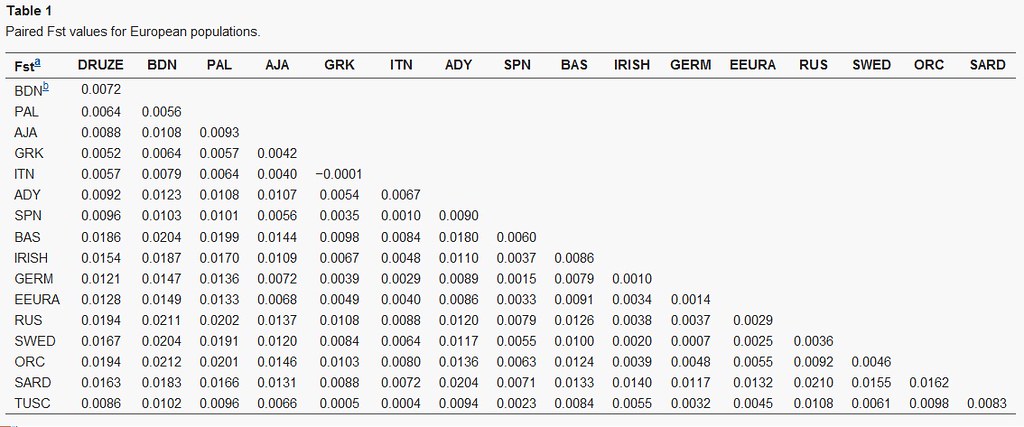
Also, here is an interesting Fst genetic distance table from the study, although it unfortunetely doesn't include Northern Italians it does include Tuscans (ie where the Renaissance first sprung up).


The results as seen in Table 1.


Tuscany to Southern Italy - 0.0004
Tuscany to Greece - 0.0005
Tuscany to Germany - 0.0032
Tuscany to Ireland - 0.0055
Tuscany to Sweden - 0.0061
Tuscany to Russia - 0.0108


SOURCE : Tian et al. (2009). European Population Genetic Substructure: Further Definition of Ancestry Informative Markers for Distinguishing Among Diverse European Ethnic Groups. Mol Med; doi: 10.2119

Link PDF


Genetic Structure of Europeans: A View from the North–East.
Nelis et al. (2009).
"Using principal component (PC) analysis, we studied the genetic constitution of 3,112 individuals from Europe as portrayed by more than 270,000 single nucleotide polymorphisms (SNPs) genotyped with the Illumina Infinium platform. In cohorts where the sample size was >100, one hundred randomly chosen samples were used for analysis to minimize the sample size effect, resulting in a total of 1,564 samples. This analysis revealed that the genetic structure of the European population correlates closely with geography. The first two PCs highlight the genetic diversity corresponding to the northwest to southeast gradient and position the populations according to their approximate geographic origin. The resulting genetic map forms a triangular structure with a) Finland, b) the Baltic region, Poland and Western Russia, and c) Italy as its vertexes, and with d) Central- and Western Europe in its centre. Inter- and intra- population genetic differences were quantified by the inflation factor lambda (λ) (ranging from 1.00 to 4.21), fixation index (Fst) (ranging from 0.000 to 0.023), and by the number of markers exhibiting significant allele frequency differences in pair-wise population comparisons. The estimated lambda was used to assess the real diminishing impact to association statistics when two distinct populations are merged directly in an analysis. When the PC analysis was confined to the 1,019 Estonian individuals (0.1% of the Estonian population), a fine structure emerged that correlated with the geography of individual counties. With at least two cohorts available from several countries, genetic substructures were investigated in Czech, Finnish, German, Estonian and Italian populations. Together with previously published data, our results allow the creation of a comprehensive European genetic map that will greatly facilitate inter-population genetic studies including genome wide association studies (GWAS)."

Yet again, as we can see by PCA analysis, Northern Italians blend perfectly in the Southern European area, and are the second most "southernly" population sampled here after the Southern Italians. Northern Italians pull further south than Spaniards from Madrid, and while they seem to be little closer to the Spanish and some Swiss (who are partly Italian) than to Southern Italians, they are slightly closer to Southern Italians than to the French, and they're much closer to the Southern Italians than to Southern Germans. The Northern Italians also surprisingly pull quite a bit further to the south end of Europe than Bulgarians do, which might mean Bulgarians have substantial medieval Slavic admixture (Bulgarians are southern Slavs after all) which would have brought more "northerly" gene-flow into Bulgaria; there's no telling really regarding them. 

One more thing of note, unlike the other previous two studies, in this study the samples that represented Northern and Southern Italy only came from 2 different locations; here are the sample set locations as representative of "Northern Italy" and "Southern Italy".
Northern Italy:
"The Northern Italian samples have been randomly collected from the Borbera Valley. The Borbera Valley is located in Northern Italy, namely the northern part of the Apennines mountains, between Liguria and Piedmont, about 80 km south of Milan. For the current analysis, 96 individuals were selected from the database where all the samples have complete phenotypic data."

Southern Italy:
"The Italian samples were randomly chosen from those enrolled in a population study named Carlantino Project, which is focused on inhabitants arising from an isolated village at the border between Central and Southern Italy (Province of Foggia, Region of Apulia with 1200 inhabitants)."

Also, it is important to note that while genetic distance is often heavily correlated to geographical distance, genetic barriers can be created by substantial geographical barriers which limit gene flow and cause breeding isolation. In Europe the Alps represent such a genetic barrier and it is not surprising that this study confirms that.
"Barrier analysis revealed genetic barriers between Finland, Italy and other countries, as has been described before [12]. Interestingly, barriers could be demonstrated within Finland (between Helsinki and Kuusamo) and Italy (between northern and southern part). Another barrier emerged between the Eastern Baltic region and Sweden, but not between the Eastern Baltic region and Poland (Figure S4). The barrier between Bulgaria and Western Russia, Poland and Lithuania may have arisen due to the fact that several populations are missing in between those countries"

As stated above there is a noticeable difference between Northern and Southern Italians, according to PC analysis the medians of North and South Germans seem to be roughly 0.009 apart, while those of North and South Italians seem to be 0.010 apart. So no big difference among the ethnic stratification between the two countries. The biological difference between Northern and Southern Italians though rather noticeable, does seem to have been somewhat exaggerated by laymen 'racialists' of past and present.
"Interestingly, PC analysis was also capable of highlighting intra-population differences, such as between the two Finnish and the two Italian samples, respectively. A low level of intra-population differentiation in Germany has been reported previously, and was confirmed here. In addition, we detected intra-population differences within the Czech and Estonian samples."

SOURCE : Nelis M, Esko T, Mägi R, Zimprich F, Zimprich A, et al. (2009) Genetic Structure of Europeans: A View from the North–East. PLoS ONE 4(5): e5472. doi:10.1371/journal.pone.0005472


Also, other than the Greeks in Southern Italy, historical admixture seems to be negligible in Italians.
"An analysis of the genetic makeup of Italy's modern population argues that the various distinctive genetic combinations currently found in different regions within the peninsula by and large track the linguistic distribution that resulted from the migrations of the Iron Age. No data indicate the subsequent large-scale infusion of new genetic material into the populations of these regions except in the case of southern Italy and eastern Sicily, which is explained by the well-documented Greek migrations there."
SOURCE : Rosenstein, Nathan. Rome at War: Farms, Families, and Death in the Middle Republic. Chapel Hill: University of North Carolina Press, 2004.

Link 

 
The genetic article which that book used as a source for that statement is Piazza's "A Genetic History of Italy", and although unfortunately I don't have access to the entire study, the abstract is available online. It's conclusions are clear that the biological stratification seen in today's Italy is reflective of pre Roman times.

"Statistical techniques for displaying the geographical distribution of many genes in few synthetic images have been used to represent the various patterns of gene frequencies in Europe and in the world (Menozzi et al. 1978; Piazza et al. 1981a). It has also been shown that such synthetic displays are particularly useful in detecting clines of genetic differentiation associated with movements of populations like those accompanying the Neolithic expansion of farmers from the Near East or, in more recent times, the putative diffusion of Indo-European-speaking populations (Ammerman & Cavalli-Sforza, 1984; Gimbutas, 1973).

In this paper we use the same combination of statistical and graphical techniques to study the genetic structure of Italy, a European country whose unity of people and cultures was quite a recent event. The possibility of studying genetic differentiation in a small geographical area is tested and trends of genetic differences are tentatively interpreted in terms of historic and linguistic knowledge. The few demographic pieces of information taken from historical sources and compared with linguistic records support the hypothesis that the genetic structure of Italy still reflects the ethnic stratification of pre-Roman times."
SOURCE : Piazza, A., N. Cappello, E. Olivetti, and S. Rendine. 1988. A genetic history of Italy. Ann. Hum. Genet. 52:203-213.

Link


For the most part irrelevant, I found some old hair and eye pigmentation data from Livi on Italian conscripts. Interesting stuff but for the most it's not that important.

SOURCE : Antropometria Militare. Ridolfo Livi. Two volumes, 4°, with atlas. Rome: Preso il Giornale Medico del Regio E Sercito, 1896, 1905..


Summary and conclusions
 
1. Northern and Central Italians are biologically SOUTHERN European.

2. Northern-Central Italians may be a bit closer to North/Central/East Europeans than Southern Italians are (just as Southern Germans are a bit closer to Southern Europeans than Northern Germans are), but Northern-Central Italians still biologically pull to Southern Europe quite strongly as seen that they ALWAYS pull further south than Spaniards, and also one study showed them a bit below Balkan Southern Slavs like Bulgarians. They also always structure with Southern Europeans in European STRUCTURE analysis studies.

3. Slight Germanic admixture is possible for all Italian populations, not just the Northern Italians. Large scale Germanic admixture in any Italian groups is certainly not the case and easily refuted by the data.

4. There is a noticeable difference between the Northern Italians and Southern Italians, and I don't want people to think that Northern Italians cannot be argued to be a genetically distinct (Southern European) ethnos. The Southern Italians are actually closer to the Greeks than they are to actual Northern Italians. However, I want to point out that the differences between Northern Italians and Southern Italians seems to be mostly due to an ethnogenisis prior to Germanic or non European invasions because geneticists agree that no migrations other than the Greek migrations in Southern Italy and Sicily had any substantial biological impact on Italians. Also, the genetic distance between Northern and Southern Italians, although pretty large from a single European 'nationality' point of view, is only roughly equal to that of the genetic distance between Northern Germans and Southern Germans.